 Installation guide
 Owner’s manual


What is the average lifespan of a Kenmore washer?
A Kenmore washer typically lasts 10 to 15 years under normal household use. For the Kenmore 11028522700, lifespan is driven less by the model number and more by load size, installation, and routine care outlined in the 11028522700 washer user manual.
What affects lifespan the most
A washer usually reaches the upper end of its life when wear items are managed and the machine is kept balanced and leak-free.
- Avoid overloading; chronic overload strains the drive system and suspension
- Use the correct water level and temperature settings for the load
- Keep the washer level to reduce vibration and component wear
- Inspect hoses regularly and replace them on schedule
- Address small leaks or unusual noises early
Maintenance that extends life (model-relevant)
The Kenmore 11028522700 documentation calls out a key preventive step: replacing inlet hoses on a time schedule.
- Replace water inlet hoses every 5 years (helps prevent hose failure and leaks)
- Wipe up detergent and bleach spills on the cabinet to prevent corrosion
- Periodically clean the washer interior using a hot cycle and a cleaning mixture as described in the manual
- Keep loads evenly distributed to reduce off-balance spinning
Typical lifespan by usage pattern
| Usage pattern | Typical lifespan | What usually shortens it |
|---|---|---|
| Light (1 to 3 loads/week) | 12 to 15 years | Long idle periods, hose aging |
| Average (4 to 7 loads/week) | 10 to 13 years | Overloading, vibration |
| Heavy (8+ loads/week) | 8 to 11 years | Wear on drive, pump, suspension |
Why it matters
Knowing the expected lifespan helps you decide when preventive maintenance is worth it and when a repair is likely to restore reliable operation. For example, a leak caught early can prevent damage to the drive system and bearings.
Last updated: January 2026
How can I tell what model washer I have?
For Kenmore washer model 11028522700, the model number is printed on the model and serial number label located under the washer lid. Open the lid and look around the rim/underside area for a sticker or metal tag with both the model and serial numbers; our 11028522700 washer user manual also points to this location.
Where to look on this Kenmore washer
On model 11028522700, check these common label spots first:
- Under the lid on the top rim of the cabinet (most common)
- Under the lid near the tub opening (front edge or side edge)
- On the back of the washer cabinet (secondary label on some units)
- Inside the lid itself (less common)
What the label should show
The label typically includes:
- Model number (example format: 11028522700)
- Serial number
- Electrical rating information
- Sometimes a manufacturing date code
Quick ID checklist
| What you see on the label | What it means | What to do next |
|---|---|---|
| “110.28522700” or “11028522700” | This is the model number | Use it to match diagrams and parts |
| A longer mix of letters/numbers | Usually the serial number | Keep it for service records |
| Only “110.” plus more digits | Partial model format | Write down the full string shown |
Why it matters
Using the exact model number ensures you get the right Kenmore washer parts, correct troubleshooting steps, and the right installation details (like hose and drain setup). Even small model-number differences can change compatible components.
Last updated: January 2026
How to unclog drain hose on Kenmore washer?
To unclog the drain hose on your Kenmore washer model 11028522700, unplug the washer, shut off the water, then remove the drain hose from the standpipe or laundry tub and flush it out. If draining is still slow, check the pump inlet hose and drain pump for debris using the 11028522700 installation guide.
Step-by-step: clear the drain hose safely
- Unplug the washer (avoid working around live power).
- Turn off both water faucets.
- Pull the drain hose out of the standpipe or off the laundry tub.
- Place the hose end in a bucket or shallow pan to catch water.
- Straighten any kinks and remove lint or buildup at the hose end.
- Flush the hose with hot water; for stubborn residue, soak the end in hot water and vinegar, then flush again.
- Reinstall the hose with an air gap (do not tape or seal it into the standpipe).
Also check these common clog points (model 11028522700)
A clog is often not only in the drain hose. On this direct-drive style washer, lint, coins, or small socks can lodge at the pump area.
- Inspect the hose routing for pinches behind the cabinet.
- Check the standpipe or laundry tub drain for slow household plumbing.
- If the washer hums but will not drain, inspect the pump and pump hoses.
Parts that commonly relate to “won’t drain”
| Symptom | Most likely area | What to do next |
|---|---|---|
| Water drains slowly | Drain hose or standpipe | Flush hose; clear plumbing; reinstall with air gap |
| Hums but no drain | Pump inlet or pump | Check for debris; replace pump if seized |
| Drains but leaks | Hose connection or clamp | Reseat hose; inspect clamps and hose ends |
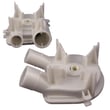
If you find the pump is jammed or leaking, the compatible replacement for this model is the washer drain pump WP3363394.
Why it matters
A restricted drain hose can cause the cycle to stall at drain/spin, leave water in the tub, and strain the drain pump. Clearing the restriction early helps prevent repeat clogs and reduces the chance of pump failure.
Last updated: January 2026





