Owner’s manual
 Error Codes


Why is my Samsung fridge not making ice in the bottom freezer?
If your Samsung RF25HMEDBSR isn’t making ice in the bottom freezer, the most common causes are the ice maker being turned off, the freezer not being cold enough yet, or a water supply issue (shutoff valve closed, kinked line, or a restricted water filter). Use the RF25HMEDBSR user manual to confirm control settings and the ice maker test procedure.
Quick checks we recommend first
- Confirm Ice Maker OFF is not enabled on the control panel.
- Make sure the freezer is set cold enough; the recommended freezer setting is 0°F.
- Verify the household water shutoff valve is fully open.
- Check the water line behind the refrigerator for kinks or crushing.
- If ice production is slow after installation or a long outage, allow 24 hours for full cooling.
Step-by-step troubleshooting for RF25HMEDBSR
1) Confirm the freezer can actually make ice
Ice makers need a properly cold freezer. If the freezer temperature is fluctuating or the drawer is not sealing, ice production can stop.
2) Check the ice bucket and run the built-in test
On this model family, the manual describes pulling out the ice bucket and using the test button on the ice maker. If the test won’t cycle or you don’t hear the normal chime, the ice maker may be jammed or not getting water.
3) Rule out a restricted water filter
A clogged filter can reduce water flow enough that the ice maker won’t fill. If your dispenser water is slow, that’s a strong clue.
| Symptom | Most likely cause | What to do |
|---|---|---|
| No ice, water dispenses slowly | Clogged water filter | Replace filter, then reset filter indicator |
| No ice, no water at dispenser | Water supply/shutoff/line issue | Open valve, straighten line, restore supply |
| Ice maker cycles but no ice forms | Freezer too warm | Set to 0°F and confirm drawer seals |
When a part may be involved
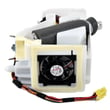
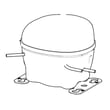
If the refrigerator is cooling normally and water supply is good but ice still won’t produce, a sealed-system cooling problem can sometimes be involved. For this model, the compatible compressor listed is Samsung refrigerator compressor MKV190CL2BASH.
Why it matters
No-ice problems are usually caused by settings, temperature, or water flow, so checking those first can save time and prevent unnecessary part replacement.
Last updated: January 2026
What are the dimensions of the Samsung rf25hmedbsr AA?
For the Samsung RF25HMEDBSR, the overall dimensions are 32 3/4 in. wide x 70 in. high x 36 1/2 in. deep (measured with hinges, handles, and doors). These measurements help confirm fit through doorways and ensure proper clearance for ventilation and door swing.
Dimensions at a glance
Use these common measurement sets when planning delivery, installation, or a cabinet cutout.
- With hinges, handles, and doors: 32 3/4" W x 70" H x 36 1/2" D
- With hinge and door, no handle: 32 3/4" W x 70" H x 34" D
- Without hinges and door: 32 3/4" W x 68 7/8" H x 30" D
- Approximate weight: 339 lb
For additional installation notes (including clearance guidance and door removal steps), see the RF25HMEDBSR manual.
Planning clearances and fit
Even when the refrigerator “fits” by width and height, depth and door swing are usually the deciding factors.
| What you are checking | Measurement to use | Why it matters |
|---|---|---|
| Fits between cabinets | 32 3/4" width | Prevents rubbing and vibration |
| Fits under soffit/upper cabinet | 70" overall height | Avoids top interference |
| Sticks out past counters | 36 1/2" depth (full) | Impacts walkway space |
| Fits through doorway | 32 3/4" width (often) | Confirms delivery path |
Why it matters
Correct dimensions help prevent delivery surprises, protect flooring and cabinetry, and ensure the RF25HMEDBSR has enough airflow around the cabinet for efficient cooling.
Last updated: January 2026
Why is ice forming in the bottom of my Samsung fridge?
Ice forming in the bottom of your Samsung RF25HMEDBSR is usually caused by warm, humid air getting into the freezer and then freezing, or by restricted airflow that keeps moisture from clearing out during normal operation. We recommend checking door sealing and freezer drawer closure first using the RF25HMEDBSR user manual.
Most common causes (and what to check)
- Freezer drawer not fully closed: Even a small gap can pull in humid air and create heavy frost and ice.
- Door gasket not sealing: Look for rips, gaps, or debris on the gasket and cabinet sealing surface.
- Overpacked freezer: Too much food can prevent the drawer from closing completely and can block air circulation.
- Blocked air vents: Items pushed against vents can disrupt airflow and lead to frost buildup.
- Frequent door openings: More openings means more humidity entering and freezing.
Quick troubleshooting steps
- Confirm the freezer drawer closes completely and is not hitting baskets, bags, or bulky packages.
- Inspect and clean the door gaskets with mild detergent and water; dry thoroughly.
- Repack for airflow: leave space around vents and avoid pressing food against the back wall.
- Check for ice clumps in the freezer that could interfere with drawer closure.
- If you recently had a power outage, discard clumped ice and let the unit stabilize for 24 hours.
What “normal” vs “not normal” looks like
| Symptom | More likely cause | First action |
|---|---|---|
| Frost/ice only near the bottom/front of freezer | Drawer not sealing or left ajar | Clear obstructions; re-close drawer |
| Heavy frost on walls and ice buildup over time | Humid air intrusion or blocked vents | Check gasket; improve airflow |
| Condensation on door center/mullion area | High humidity or Energy Saver setting | Wipe dry; adjust settings per manual |
Why it matters
Ice buildup can keep the freezer drawer from sealing, which increases frost, reduces cooling efficiency, and can lead to temperature swings that affect food quality.
Last updated: January 2026