Installation guide
 Owner’s manual


How do I know if my Kenmore dryer thermal fuse is blown?
If your Kenmore electric dryer 11063952101 will not start, or it runs but has no heat, the thermal fuse is a prime suspect. The reliable way to confirm is a continuity test with the dryer unplugged; a blown fuse reads open (no continuity).
Common signs (before you test)
- Dryer will not run even with the door closed and a cycle selected
- Drum tumbles but there is no heat
- The issue started after long dry times or the cabinet felt unusually hot
- Airflow seems weak at the outside vent hood
- Lint screen is clogged or coated with fabric softener residue
For safety steps and troubleshooting checks specific to this model, use the 11063952101 owner's manual.
How to test the thermal fuse with a multimeter
- Unplug the dryer or switch off both breakers.
- Access the fuse (commonly on the blower housing or exhaust duct).
- Remove at least one wire from the fuse terminal.
- Set the meter to continuity or lowest ohms.
- Probe the two fuse terminals.
| Meter result | What it means | Next step |
|---|---|---|
| Beep or near 0 ohms | Fuse is good | Check heating circuit and airflow |
| No beep, OL, high resistance | Fuse is blown | Replace the fuse; do not bypass |
What to check so it does not blow again
A thermal fuse usually opens because the dryer overheated from restricted airflow.
- Clean the lint screen and the lint duct
- Inspect the vent hose for kinks, crushing, or excessive length
- Clear lint buildup at the outside hood so the flap opens fully
- Confirm power supply: electric dryers use two household fuses or breakers; the drum can turn with no heat if one leg is out
Part guidance for this model
If your fuse tests open, replace it with the correct part for this model, such as the dryer thermal fuse WP3390719.
Why it matters
The thermal fuse is a one-time safety device that shuts the dryer down when temperatures get unsafe; restoring airflow prevents repeat failures and improves drying performance.
Last updated: February 2026
How do I know if my dryer heating element is blown?
If your Kenmore electric dryer model 11063952101 runs but produces no heat, the heating element may be blown, but first confirm you have full 240V power (many homes use two fuses or breakers). If power and airflow are good, a continuity test typically confirms a failed element.
Quick checks before testing parts
- Make sure you did not select an air or no-heat cycle; choose a heated cycle.
- Check your home electrical supply; electric dryers often use 2 fuses or 2 breakers, and the drum can still tumble with only one side tripped.
- Clean the lint screen and confirm the exhaust vent is not restricted.
- Run the dryer for about 5 minutes, then open the door and feel for heat (use caution).
- If the dryer will not start at all, confirm the door fully closes and the Start button is pressed firmly.
How we test the heating element (safe, reliable method)
Follow the access and safety steps in the 11063952101 installation guide, then:
- Unplug the dryer (or switch off both breakers).
- Access the heater terminals.
- Use a multimeter on ohms/continuity.
- Good element: you typically read continuity and a resistance commonly in the 10 to 50 ohms range.
- Blown element: you read OL/no continuity (open circuit).
- Short to ground check: test from a heater terminal to the metal heater housing; any continuity indicates a short and the element needs replacement.
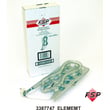
If the element tests bad, replace the dryer heating element WP3387747.
What the symptoms usually look like
| Symptom | Most common cause | What to check next |
|---|---|---|
| Drum turns, no heat | Tripped breaker or blown fuse | Reset both breakers, check both fuses |
| Drum turns, no heat (power OK) | Failed heating element | Ohms/continuity test |
| No heat and long dry times | Restricted venting | Lint screen, vent run, outside hood |
| Heat cuts out | Overheating condition | Vent restriction, thermostats, airflow |
Why it matters
A blown heating element stops drying performance, but restricted venting and partial power are even more common and can also overheat the heater circuit. Verifying power and airflow first prevents repeat failures after installing a new part.
Last updated: February 2026
How do I tell what model my Kenmore dryer is?
Your Kenmore dryer’s model number is printed on the model and serial number label; on model 11063952101, that label is located at the top inside the dryer door well. Write down the full model number and serial number so you can match the correct parts and specifications in the 11063952101 owner’s manual.
Where to look on the dryer
On Kenmore electric dryers like 11063952101, the most reliable spot is:
- Open the dryer door
- Look along the top edge inside the door opening (the door well)
- Find the model and serial number label (sticker or metal plate)
- Record the complete model number and serial number
What the model number tells you (and why it matters)
The model number identifies the exact design version of your dryer. That matters because parts such as the heating system, door switch, and drum support components can vary by model.
- Ensures you order the correct replacement part the first time
- Helps confirm electrical and installation requirements
- Speeds up troubleshooting and service lookups
- Prevents mismatched parts that do not fit or wire correctly
Quick checklist before ordering parts
Use this checklist after you find the label:
- Copy the model number exactly: 11063952101
- Copy the serial number exactly (letters and numbers)
- Confirm you are working on an electric dryer (not gas)
- Use the model number when selecting parts like the dryer heating element WP3387747 or dryer door switch WP3406107
Common label locations (comparison)
| Location | How common on Kenmore dryers | Notes |
|---|---|---|
| Top inside dryer door well | Very common | Primary location for model 110-series dryers |
| Back panel | Sometimes | May be harder to read once installed |
| Near lint screen housing | Sometimes | Depends on design and console style |
Why it matters for installation and setup
Your installation requirements (like having a grounded outlet within about 2 ft of either side of the dryer and keeping the dryer level) are tied to the exact model design. For the correct clearances and requirements, use the 11063952101 installation guide.
Last updated: February 2026