Owner’s manual
 Error Codes


How to raise a refrigerator off the floor?
On the Kenmore Elite 79578753800 bottom-mount refrigerator, the correct way to raise the front of the cabinet is to turn the two front leveling legs; turning the legs clockwise raises the refrigerator and counterclockwise lowers it. We cover the leveling and door-closing tilt in the 79578753800 use & care manual.
- Unplug the refrigerator if you will be working near wiring, the base area, or moving it.
- Open the freezer drawer and remove the base cover screws, then remove the base cover (this gives access to the leveling legs).
- Have a helper push gently backward at the top of the cabinet to take weight off the legs.
- Turn both leveling legs the same amount to keep the cabinet square.
- Recheck door closing; this model is designed to sit slightly higher in front so the doors close more easily.
| Task | Typical tool | Notes |
|---|---|---|
| Turn leveling legs | 11/32-in wrench or flat-blade screwdriver | This model calls out these tools for leveling-leg adjustment. |
| Remove base cover | Screwdriver | Screws are accessible with freezer drawer open. |
| Confirm level | Small level | Check side-to-side; keep a slight rearward tilt. |
Leveling legs are meant for leveling and minor height changes. If you need a larger lift (for example, to clear thick flooring), use a rigid, fully supported platform that can handle the refrigerator’s weight and keeps the cabinet stable.
- Use a solid, flat base (no soft shims that can compress).
- Keep the refrigerator stable; avoid anything that allows rocking.
- Maintain airflow clearances so cooling performance is not restricted.
Proper height and tilt help the doors seal correctly, reduce vibration/noise, and prevent the refrigerator from creeping forward. On the 79578753800, correct leveling is also a key step in door alignment and smooth drawer operation.
Last updated: January 2026
Why is my refrigerator not getting cold at the bottom?
If your Kenmore Elite 79578753800 is warm at the bottom of the fresh-food section, the most common cause is restricted airflow (blocked vents, overpacked shelves, or frost limiting air movement). Start by clearing air paths and confirming the temperature settings, then move to fan and defrost checks.
- Make sure interior air vents are not blocked by food containers.
- Set controls to the recommended starting point: 37°F for the refrigerator and 0°F for the freezer.
- Wait 24 hours after any control change before judging results.
- Confirm both doors close fully and the gaskets seal all the way around.
- Listen for the evaporator fan running when the compressor is on (you may hear airflow from the freezer area).
Your 79578753800 cools the refrigerator section by moving cold air from the freezer into the fresh-food compartment. When that airflow is reduced, the bottom area (near crispers and lower bins) often warms first.
| What you notice | Most likely category | What to do next |
|---|---|---|
| Top shelves cool, bottom warm | Airflow blocked or weak circulation | Clear vents; check for frost; listen for fan |
| Freezer cold, fridge warm | Air not transferring from freezer | Check vents, frost buildup, fan operation |
| Both sections warm | Cooling system or condenser airflow issue | Check condenser area, coils, and fan |
If airflow is clear and settings are correct, a failed fan or a defrost problem can prevent cold air from circulating properly.
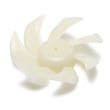
- Lg refrigerator evaporator fan motor 4681JB1027C: Drives airflow across the evaporator and into the refrigerator compartment.
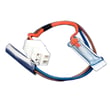
- Refrigerator defrost sensor assembly 6615JB2005H: Helps the control system manage defrost cycles; problems can contribute to frost buildup that blocks airflow.
- Lg refrigerator defrost heater 5300JK1005D: Melts frost off the evaporator; if frost builds up, airflow to the refrigerator section can drop.
When the bottom of the refrigerator runs warm, food in the crisper drawers and lower shelves can spoil sooner, and the compressor may run longer trying to recover. Restoring proper air circulation usually fixes the temperature imbalance without changing how you store food.
For control settings, airflow guidance, and the “Ensuring proper air circulation” section, use the 79578753800 use & care manual.
Last updated: January 2026
Why is there ice on the bottom of my freezer side by side?
On Kenmore Elite model 79578753800 (a bottom-mount freezer design), ice on the freezer floor is most commonly caused by a clogged or frozen defrost drain. During defrost, meltwater can’t flow down the drain, so it refreezes into a sheet of ice; see the defrost and cleaning guidance in the 79578753800 use & care manual.
- A sheet of ice forming from the back toward the front of the freezer drawer
- Water or ice returning a few days after you remove it
- Frost buildup on the rear freezer panel (often goes with a drain freeze-up)
- Door left ajar or frequent openings (adds humidity that increases frost)
- Food packages blocking air vents (can worsen frost and defrost runoff)
- Unplug the refrigerator.
- Remove the freezer drawer/baskets and soak up standing water.
- Melt the floor ice with towels and warm water (not boiling).
- Flush the drain opening with warm water until it runs freely to the drain pan.
- If the drain keeps clogging or won’t clear, inspect and replace the drain tube if needed: refrigerator drain tube 5251JA3003D.
Even though your question says “side by side,” the repair logic is the same for model 79578753800: defrost water must drain to the pan. If it can’t, it freezes on the freezer floor.
A blocked defrost drain can cause recurring ice sheets, water leaks during defrost cycles, harder drawer operation, and temperature swings that can affect frozen food quality.
| What you see | Most likely cause | Best next step |
|---|---|---|
| Ice sheet on freezer floor | Drain clogged or frozen | Flush drain with warm water |
| Water under drawer after defrost | Drain slow/restricted | Clear tube; check for ice |
| Heavy frost plus floor ice | Air leak or frequent openings | Check door closure and vents |
Last updated: January 2026