Owner’s manual
 Error Codes


What is the average lifespan of a Kenmore washer?
A Kenmore washer typically lasts 10 to 15 years with normal household use. For Kenmore model 11028632701, regular care (especially replacing water inlet hoses on schedule) helps you reach the higher end of that range; see the 11028632701 owner's manual for maintenance guidance.
Most Kenmore washers fall into this range when installed correctly and not overloaded:
| Washer type | Typical lifespan | Notes |
|---|---|---|
| Top-load (direct-drive style) | 12 to 15 years | Often longer with simple mechanics and good care |
| Front-load | 10 to 12 years | More components and higher wear on bearings/seals |
These are the most common “life reducers” we see in the field:
- Overloading or consistently unbalanced loads (extra strain on drive and suspension)
- Skipping hose inspections and running old, brittle inlet hoses
- Using too much detergent (can cause residue, odors, and extra wear)
- Ignoring early symptoms (burning smell, grinding, slow drain, no spin)
- Repeatedly running with a failing safety switch or timer
The manual for this washer calls out a key interval: replace inlet hoses after 5 years to reduce the risk of hose failure. Use this checklist as a simple longevity plan:
- Replace inlet hoses every 5 years; write the replacement date on the hose
- Periodically inspect hoses for bulges, kinks, cuts, wear, or leaks
- Keep loads balanced; items should move freely during washing
- Address “won’t spin” or “won’t drain” symptoms quickly (they can cascade into bigger failures)
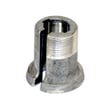
- If agitation becomes weak, inspect common wear items such as the agitator dog 80040
A washer that is maintained on schedule costs less to own: you avoid water damage from hose failures, reduce strain on the drive system, and catch small part wear (like agitator components) before it turns into a major repair.
Last updated: January 2026
How to hard reset Kenmore washer?
To hard reset your Kenmore washer model 11028632701, unplug it (or switch off the breaker) for 1 to 2 minutes, then restore power and start a normal cycle. This clears many temporary control and cycle issues without replacing parts.
- Press the washer control knob to stop the cycle (if it is running).
- Unplug the washer from the grounded outlet (or turn off the circuit breaker).
- Wait 1 to 2 minutes.
- Plug the washer back in (or turn the breaker on).
- Close the lid and pull out the Cycle Control knob to start a cycle.
- If the washer was mid-cycle, select a fresh cycle and restart.
For model-specific operating and stop/restart details, use the 11028632701 owner's manual.
A “reset” will not fix a mechanical failure. On this Kenmore top-load washer, these checks often pinpoint the real issue:
- Confirm the lid closes fully; a failed lid switch can prevent agitation or spin.
- Listen for the drain pump during drain; a jammed pump can stop the cycle.
- If the motor runs but the basket does not move, the motor coupling can be broken.
- If it drains but will not spin, the clutch or drive block can be worn.
- If the timer does not advance, the timer can be failing.
| Symptom after reset | What it often points to | Example part for this model |
|---|---|---|
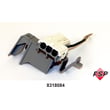
| No spin with lid closed | Lid safety circuit issue | Washer lid switch assembly WP8318084 |
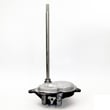
| Motor runs, no agitation/spin | Drive connection failure | Coupling 285753A |
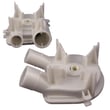
| Drains slowly or not at all | Pump obstruction or failure | Washer drain pump WP3363394 |
| Timer stalls or cycles act erratic | Timer wear | Washer timer WP8577356 |
A hard reset is fast and safe, but repeated “resetting” can hide a failing lid switch, drain pump, coupling, or timer. Identifying the symptom after the reset helps you choose the right repair and avoid unnecessary parts.
Last updated: January 2026
Does a Kenmore Elite washer have a filter?
Yes, Kenmore Elite washers typically have a drain-pump lint trap or a pump inlet screen that acts like a filter; on Kenmore model 11028632701, the “filter” is usually part of the drain system rather than a large, front-access cleanout. For model-specific access and cleaning steps, use the 11028632701 owner's manual.
On many Kenmore top-load designs like 11028632701, filtering happens in the drain path:
- A drain pump inlet screen can catch small debris before it reaches the pump
- Coins, hair pins, and lint often collect in the pump housing or drain hose
- Some models also use a tub-to-pump hose that can trap items
If the washer is not draining well, the drain pump area is the first place we check.
- Washer drains slowly or not at all
- Humming during drain but little water movement
- Water left in the tub at the end of the cycle
- Intermittent draining (works sometimes, fails other times)
- Unplug the washer
- Turn off both water supply valves
- Have towels and a shallow pan ready (water will spill)
- If the tub is full, bail out water first to reduce the mess
If cleaning does not restore draining, the pump or lid safety circuit can be the cause.
| Symptom | Most common area to check | Example part for this model |
|---|---|---|
| Won’t drain, pump noisy or jammed | Drain pump and inlet | Washer drain pump WP3363394 |
| Won’t spin or drain with lid closed | Lid switch circuit | Washer lid switch assembly WP8318084 |
A restricted pump inlet or clogged hose can make the washer stop mid-cycle, leave clothes soaking wet, and strain the drain pump motor over time.
Last updated: January 2026