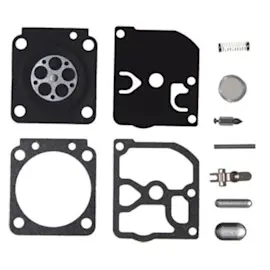
Owner’s manual









What kind of gas goes into a Craftsman chainsaw?
For the Craftsman 358351440 gas chainsaw, we use fresh unleaded gasoline mixed with a good-quality 2-cycle air-cooled engine oil at a 40:1 ratio. Always mix fuel in an approved container, then fill the fuel tank and bar oil tank together as part of normal operation (see the 358351440 operator’s manual).
Fuel type and mix ratio (what to put in the tank)
Use:
- Fresh unleaded gasoline
- 2-cycle air-cooled engine oil (Craftsman oil is recommended)
- A 40:1 gas-to-oil mix
Quick mix chart
| Gasoline amount | 40:1 oil amount | Notes |
|---|---|---|
| 1 gallon | 3.2 fl oz | Common “one can” mix |
| 1/2 gallon | 1.6 fl oz | Good for small batches |
| 1 quart | 0.8 fl oz | Useful for occasional use |
How to fuel safely (best practice)
- Mix and pour fuel outdoors, away from sparks or flames.
- Wipe up spills before starting the saw.
- Move at least 10 feet away from the fueling spot before starting.
- Shut the engine off and let it cool before refueling.
- Store fuel in a cool, dry, well-ventilated area.
Do not forget bar and chain oil
This model uses a separate bar oil tank; fill it whenever you fill the fuel tank. For best bar and chain life, we recommend chainsaw bar oil; SAE 30 oil works as a temporary substitute.
Why it matters
Correct 40:1 mix protects the 2-cycle engine from scoring and seizure, and proper bar oiling reduces chain and guide bar wear. Fueling and storage habits also reduce hard-start and rough-running problems.
Last updated: January 2026
Is 40 1 or 50 1 better for chainsaws?
For the Craftsman chainsaw model 358351440, 40:1 is the correct fuel mix; it is the ratio specified for this engine. Using 50:1 means less oil in the fuel, which reduces lubrication and can shorten engine life.
What 40:1 vs 50:1 really changes
The difference is not fuel “density”; it is how much 2-cycle oil is blended into the gasoline.
- 40:1 = more oil per gallon, more lubrication for an engine designed for it
- 50:1 = less oil per gallon, leaner on lubrication
- Your 358351440 is designed to run on unleaded gas mixed with air-cooled 2-cycle oil at 40:1
- Do not use automotive oil or marine (boat) 2-cycle oil; those can damage an air-cooled 2-cycle engine
Mix amounts (quick reference)
| Ratio | Oil per 1 gallon gas | Oil per 1 quart gas |
|---|---|---|
| 40:1 | 3.2 oz | 0.8 oz |
| 50:1 | 2.6 oz | 0.64 oz |
Best practice for this Craftsman 358351440
We recommend following the fuel instructions in the 358351440 owner's manual.
- Use fresh unleaded gasoline
- Use high-quality air-cooled 2-cycle oil (Craftsman oil is recommended for this model)
- Mix in an approved fuel container, then shake to fully blend
- Make only what you will use soon; old fuel can cause hard starting and rough running
- If the saw will sit 30 days or longer, drain fuel or use stabilizer and run the engine briefly
Why it matters
The correct mix ratio protects the crankshaft bearings, piston, and cylinder from heat and friction. On a 2-cycle chainsaw, the oil in the fuel is the engine’s primary lubrication, so running less oil than specified increases wear.
Last updated: January 2026
What is the L and H on a Craftsman chainsaw?
On the Craftsman 358351440 chainsaw, L and H are the carburetor mixture adjustment screws: L controls the low-speed (idle to acceleration) fuel mixture, and H controls the high-speed (wide-open throttle) fuel mixture. They work with the T (idle speed) screw to tune how the engine runs.
Where to find L and H on this model
On model 358351440, the manual places the H, L, and T screws on the carburetor just above the primer bulb. For screw locations and the adjustment procedure, use the 358351440 owner's manual.
What each screw does (quick reference)
- L (low-speed mixture): Affects starting, idle quality, and how the saw accelerates when you squeeze the throttle.
- H (high-speed mixture): Affects top-end power while cutting and how the engine runs at full throttle.
- T (idle speed): Sets idle RPM; it does not change the fuel mixture.
| Screw | Controls | Most noticeable symptom when off |
|---|---|---|
| L | Low-speed fuel mixture | Hesitation, bogging, stalling on acceleration |
| H | High-speed fuel mixture | Loss of cutting power, poor full-throttle running |
| T | Idle speed (throttle stop) | Chain moves at idle or engine will not stay running |
Safe, practical tuning tips
We recommend making small changes and checking results after each change.
- Warm the engine before fine-tuning.
- Turn screws in small increments (about 1/8 turn at a time).
- If the chain moves at idle, adjust T first.
- If it dies or hesitates when accelerating, adjust L.
- If it has loss of cutting power, adjust H.
- Do not force the limiter caps past their stops.
Why it matters
Correct L and H settings keep the air-fuel mixture right for smooth starting, strong cutting power, and reduced plug fouling. If the saw still runs rough after tuning, fuel delivery issues (like cracked lines) are common; the ayp lawn & garden equipment fuel line, large 530069216 is a frequent fix on older gas chainsaws.
Last updated: January 2026