Owner’s manual


How many cubic feet is my Maytag dryer?
Your Maytag MED5600TQ0 dryer is a full-size dryer; most Maytag dryers in this design class measure about 7.0 to 7.4 cu. ft. of drum capacity. For the exact published capacity for your specific unit, confirm it in the specifications section of the MED5600TQ0 owner's manual.
How to confirm the exact capacity for MED5600TQ0
Use these quick checks so you match the right spec to the right machine:
- Verify the model number on the model and serial tag (usually inside the door opening).
- Open the MED5600TQ0 owner's manual and look for a “Specifications” or “Product dimensions/capacity” section.
- If the manual covers multiple models, match your exact model number (MED5600TQ0) in the model list.
- If you are comparing dryers, use capacity plus venting and cycle type, not capacity alone.
Why drum capacity matters
Capacity affects how well air moves through the load. When the drum is packed too tightly, clothes tumble less, airflow drops, and dry times increase.
Practical load-sizing tips
- Load items loosely; keep at least a hand’s width of open space at the top of the drum.
- Dry bulky items (towels, bedding) in smaller batches for better tumbling.
- Clean the lint screen before every load to maintain airflow.
- If dry times are long, check the entire vent run for kinks, crushed duct, or lint buildup.
Capacity ranges (for comparison)
| Dryer type | Typical drum capacity |
|---|---|
| Compact dryer | 3.4 to 4.0 cu. ft. |
| Full-size dryer (like MED5600TQ0) | 7.0 to 7.4 cu. ft. |
| Extra-large dryer | 7.5 to 9.0+ cu. ft. |
Last updated: January 2026
What is the average lifespan of a Maytag dryer?
Most Maytag dryers, including the Maytag MED5600TQ0, typically last 10 to 15 years with normal household use. Regular lint and vent maintenance, plus addressing wear parts early (belt, rollers, thermostat), helps you stay closer to the high end of that range.
What affects lifespan the most
- Airflow and venting: restricted venting makes the dryer run hotter and longer.
- Lint buildup: lint in the cabinet and blower area increases heat stress.
- Load habits: frequent overloading strains the drive motor, belt, and drum support.
- Heat control health: a failing thermostat or thermal cut-off can cause overheating or no-heat issues.
- Cycle selection: using Auto Dry appropriately reduces over-drying and wear (your dryer senses load temperature and shuts off near the selected dryness).
Maintenance checklist we recommend
- Clean the lint screen every load.
- Inspect and clean the vent duct and outside hood regularly.
- Keep loads balanced; avoid packing the drum tight.
- If drying times increase, check airflow first before replacing parts.
- Use cycle features correctly; for cycle guidance and settings, follow the MED5600TQ0 owner's manual.
Common wear parts that can extend service life
If the dryer tumbles poorly, squeals, or stops turning, these are common fixes:
| Symptom | Common cause | Example part for MED5600TQ0 |
|---|---|---|
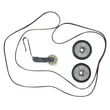
| Drum will not turn | Worn or broken belt | Belt 341241 |
| Runs but no heat | Failed heating element or thermal cut-off | Dryer element 279838 |
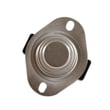
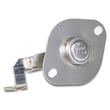
| Overheats or shuts off | Airflow restriction or thermostat issue | Dryer operating thermostat WP3387134 |
Why it matters
A dryer that is overheating or taking too long to dry usually is not “just old”; it is often an airflow or heat-control problem that shortens lifespan and increases energy use. Keeping airflow strong is the simplest way to protect the heating system and drive components.
Last updated: January 2026
What is the most common problem with the Maytag dryer?
On the Maytag MED5600TQ0 dryer, the most common service issue we see is poor airflow from lint buildup or a restricted vent, which leads to overheating symptoms such as no heat, long dry times, or a no-start condition when a safety device opens.
What to check first (fast, high-impact)
- Clean the lint screen before every load and wash it occasionally to remove residue.
- Inspect the vent hose for kinks, crushing, or heavy lint buildup.
- Confirm strong airflow at the outside vent hood while the dryer is running.
- Avoid overloading; heavy loads can trap moisture and extend run time.
- Use an automatic cycle when possible; this model uses Auto Dry to sense load temperature and shut off near the selected dryness.
Common symptoms and the usual causes
| Symptom | Most common cause | Parts often involved |
|---|---|---|
| Takes too long to dry | Restricted venting or lint buildup | Blower wheel, thermostats |
| Runs but no heat | Heating circuit problem or overheating protection | Dryer element 279838, thermal cut-off kit |
| Won’t start | Door not sensed closed or safety device open | Dryer door switch WP3406107, thermal fuse/cut-off |
| Loud squeal or thump | Wear in drum support or belt drive | Belt 341241, idler pulley |
Why airflow problems create “most common” failures
When airflow is restricted, heat stays trapped inside the cabinet. That extra heat can trip high-limit protection, damage heating components, and make cycles run longer. Keeping the vent path clear is the simplest way to prevent repeat heating and shutdown problems.
Model-specific tips for MED5600TQ0
- Use Auto Dry for most loads; it senses temperature and shuts off as the load reaches the selected dryness.
- If items are still damp at the end of Auto Dry, finish with Timed Dry, then correct the airflow issue so it does not keep happening.
- For cycle and feature details (Auto Dry, Timed Dry, Cool Down, Wrinkle Prevent), follow the MED5600TQ0 owner’s manual.
Last updated: January 2026