Owner’s manual


What is the average life of a Kenmore dryer?
A Kenmore electric dryer like model 11067902790 typically lasts 10 to 13 years. With consistent airflow maintenance (lint screen and venting) and prompt repair of wear items, it commonly reaches the upper end of that range.
What affects dryer lifespan the most
- Airflow and venting: restricted exhaust overheats components and shortens life
- Lint screen habits: cleaning every load reduces heat stress and drying time
- Load size: frequent overloading strains the drive system and drum supports
- Heat management: repeated overheating can damage thermostats and fuses
- Noise and vibration: early roller or idler wear can cascade into bigger repairs
Maintenance checklist we recommend
Use the care and troubleshooting sections in the 11067902790 owner's manual as your baseline, then follow these habits:
- Clean the lint screen after every load
- Inspect and clean the vent path at least yearly (more often with long vent runs)
- Keep the dryer level to reduce drum and roller wear
- Stop using the dryer if you smell burning or notice weak airflow
- Address new squealing, thumping, or scraping quickly
Common “life-extending” repairs on this model type
Many Kenmore 110-series dryers are worth maintaining because several wear parts are straightforward to replace.
| Symptom | Likely wear area | Example part you may need |
|---|---|---|
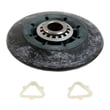
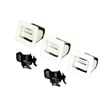
| Thumping or rumbling | Drum support rollers | Support kit WPW10314173 |
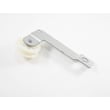
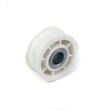
| Squealing | Idler pulley | Dryer idler pulley 279640 |
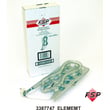
| Runs but no heat | Heating circuit | Dryer heating element WP3387747 |
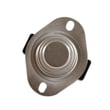
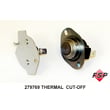
| Stops heating or won’t run after overheating | Safety cutoff | Dryer thermal fuse WP3390719 |
Why it matters
A dryer that is drying slowly or running hot is not just inconvenient; it accelerates wear on the heating element, operating thermostat, and motor. Keeping airflow strong is the simplest way to protect performance and extend service life.
Last updated: January 2026
How do I know if my dryer thermistor is bad?
A bad thermistor in your Kenmore electric dryer model 11067902790 usually shows up as incorrect temperature control: the dryer may not heat, may overheat, may shut off mid-cycle, or may take much longer to dry. We also see heat-related shutdowns when airflow is restricted.
Common signs of a failing thermistor
- No heat on heated cycles, but the drum still tumbles
- Heat that cuts in and out (inconsistent drying results)
- Overheating (clothes feel excessively hot, cycle ends early)
- Dryer stops during the cycle because the control senses unsafe temperature
- Repeated heat-safety issues that look like “no heat” after a shutdown
Quick checks before you replace parts
Before focusing on the thermistor, confirm the basics that affect temperature readings and heat cycling.
- Clean the lint screen before every load and make sure it is seated correctly
- Check that the vent is not crushed, kinked, blocked, or restricted
- Confirm the exhaust hood outside opens freely
- Run a timed heat cycle and check for heat inside the drum after about 5 minutes
- If airflow is poor, correct venting first; poor airflow can cause overheating and heat shutdowns
For model-specific operating and troubleshooting guidance, use the 11067902790 owner’s manual.
What to test (and what it means)
A thermistor is a temperature sensor; when it drifts out of range, the dryer can heat incorrectly. If you are comfortable using a multimeter, you can test the sensor and related heat-safety parts.
| Symptom | Most common causes | Parts to consider |
|---|---|---|
| No heat, tumbles normally | Blown safety device, heater circuit issue | Dryer thermal fuse WP3390719, dryer heating element WP3387747 |
| Overheats or shuts down | Restricted venting, temperature sensing issue | Venting, operating thermostat, thermistor circuit |
| Long dry times | Airflow restriction, lint buildup, weak heat | Venting, lint screen, heater circuit |
Why it matters
When temperature feedback is wrong (or airflow is restricted), the dryer cannot regulate heat correctly. That leads to longer dry times, overheating, and repeated shutdowns that can damage components over time.
Last updated: January 2026
Are thermal fuses for dryers universal?
No. Thermal fuses are not universal on the Kenmore 11067902790 electric dryer; you must match the replacement to the correct temperature rating and the exact fit for your model so the dryer shuts down safely if it overheats. Use the 11067902790 owner's manual to confirm the correct circuit and safety requirements.
What “universal” really means
Some fuses are sold as “universal” because they fit multiple brands, but they still vary by:
- Trip temperature (the most important safety spec)
- Mounting style and terminal type
- Wire connection orientation and harness fit
- Location used in the dryer (heater housing vs blower housing)
How to choose the right thermal fuse for this Kenmore dryer
Use your model number (11067902790) and match the exact part used in the dryer’s wiring and airflow design.
- Confirm the model number from the rating plate before ordering
- Replace the fuse with the correct OEM-style part for the model
- Fix the overheating cause (usually restricted venting) before running the dryer
- If the dryer will not run, also check the home circuit and fusing type
Quick comparison: “universal” vs model-matched
| Option | Fit | Safety rating match | Best use |
|---|---|---|---|
| “Universal” thermal fuse | Sometimes | Not guaranteed | Only when it explicitly lists your model and rating |
| Model-matched thermal fuse | Yes | Yes | Correct repair for 11067902790 |
Why it matters (safety and repeat failures)
A thermal fuse is a one-time safety device. If you install the wrong rating, the dryer can either shut off too soon (nuisance failures) or not shut off soon enough (overheating risk). Overheating is commonly tied to poor airflow, so venting and lint buildup must be addressed.
Related tip for this model
The manual for this dryer calls out using a time-delay fuse or circuit breaker for the dryer’s 30-amp circuit; using a regular fuse can cause operating problems. See the 11067902790 owner's manual for the electrical requirements and troubleshooting guidance.
Last updated: January 2026
How to tell if a dryer start switch is bad?
On Kenmore electric dryer model 11067902790, a bad start switch usually shows up as a dryer that will not start when you press PUSH TO START (with the door closed and the timer set to a cycle). The most reliable check is a continuity test: the switch should read closed only while the button is pressed.
Quick symptoms to look for
- Dryer does nothing when you press PUSH TO START (no motor sound)
- You have power to the dryer (lights or timer movement, if equipped)
- Door is fully closed and the cycle selector (timer) is set to a drying cycle
- Pressing the button feels loose, stuck, or inconsistent
- Dryer starts only if you wiggle or press the button repeatedly
How we test the start switch (safe, basic method)
- Unplug the dryer or switch off the breaker.
- Access the console area where the PUSH TO START switch is mounted (follow the disassembly steps in the 11067902790 owner's manual).
- Pull the wires off the switch terminals (note their positions).
- Set a multimeter to continuity or ohms.
- Test the switch:
- Button not pressed: meter should show open (no continuity).
- Button pressed: meter should show closed (continuity, near 0 ohms).
If it is not the start switch, check these next
The manual troubleshooting for “Dryer will not run” points to several common causes besides the start switch.
| What you see | More likely cause | What to check |
|---|---|---|
| No response at all | Power supply issue | Breaker, outlet voltage, cord connection |
| Stops when door opens | Door switch or latch issue | Door closes firmly, latch engages |
| Hums but will not turn | Motor or drum drive problem | Drum turns by hand, belt/idler condition |
| Starts then quits | Overheat protection opened | Airflow restriction, thermal fuse |
If you suspect an overheat shutdown, a common no-start part to test is the dryer thermal fuse WP3390719.
Why it matters
The start switch is a simple on-demand contact; if it cannot close electrically, the motor circuit never energizes. Testing it first prevents replacing bigger parts like the drive motor or timer unnecessarily.
Last updated: January 2026