Owner’s manual
 Error Codes


What year is my Kenmore dryer model?
For Kenmore dryer model 11087572602, the model number by itself does not identify an exact manufacture year. We date it by using the serial number (from the rating label) and decoding it with the format used for Kenmore 110-series dryers; the 11087572602 owner's manual shows where to find the label.
Check the rating label on the dryer cabinet (commonly inside the door opening). You’ll use:
- The serial number (most important for dating)
- The model number (confirms you’re decoding the right format)
- The type (electric or gas), which can affect parts and wiring
Kenmore 110-prefix dryers are typically built by Whirlpool, and the serial number is what contains the date code. Once you have the serial number, look for a pattern that indicates:
- Manufacturing week (often a 2-digit week)
- Manufacturing year (often a 1- or 2-digit year code)
- Plant code (helps confirm the format)
Use this as a practical way to proceed once you read the label:
| What you have | What it tells you | What to do next |
|---|---|---|
| Model number only (11087572602) | Identifies the model family | Use the serial number to date it |
| Serial number | Contains the date code | Decode year and week from the serial |
| Manual | Shows label location and basic ID info | Confirm label location and safety steps |
Knowing the manufacture year helps us match the correct Kenmore parts and revisions (for example, heating and airflow components) and avoid ordering a look-alike part that doesn’t fit your production run.
Last updated: February 2026
How much does it cost to replace a heating element in a Kenmore dryer?
For Kenmore dryer model 11087572602, replacing the heating element typically costs about $100 to $350 total when you include the part and professional labor. If you do the repair yourself, you’ll usually pay about $80 to $150 for the heating element and any needed wiring.
- DIY part cost: commonly $80 to $150 for a heating element assembly
- Optional related parts: $10 to $50 (terminals, wire kit, thermal fuse kit)
- Professional labor: commonly $100 to $250 depending on service rates and access
- Service call/diagnostic fee: sometimes added if not waived with repair
| Scenario | What you pay for | Typical total |
|---|---|---|
| DIY replacement | Heating element (plus any small parts) | $80 to $200 |
| Pro replacement | Part + labor (and possibly diagnostic) | $100 to $350 |
If the dryer overheated or had a no-heat issue, we often see these replaced at the same time to prevent repeat failures:
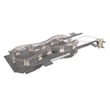
- Dryer heating element WP8544771
- Dryer heating element wire kit 279457
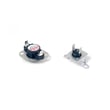
- Dryer thermal cut-off fuse kit 279973
A heating element job can be quick or more involved depending on what failed and how much disassembly is needed.
Common cost drivers:
- Burned or loose wiring at the heater terminals (adds parts and time)
- A blown thermal cut-off from restricted airflow (adds parts and cleanup)
- Heavy lint buildup inside the cabinet (adds labor)
- Access issues (tight laundry closet, long vent run)
Good airflow protects the new element and helps drying performance.
- Confirm the vent is clear and not crushed
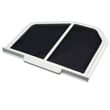
- Clean lint from the lint screen housing and internal ducting
- Follow the cleaning and maintenance steps in the 11087572602 owner's manual
Most repeat heating element failures happen because the dryer overheats from poor venting or lint buildup. Fixing airflow issues first helps the new element last longer and keeps cycle times normal.
Last updated: February 2026
Where is the part number on a Kenmore dryer?
On Kenmore dryer model 11087572602, the model and serial information (often called the ID tag) is typically found on the door opening, usually on the frame just inside the door. That tag is where you’ll find the numbers we use to match the correct replacement parts.
Check these common ID-tag locations on Kenmore dryers:
- On the front frame inside the door opening (most common)
- Along the door opening edge near the lint screen housing
- On the back panel of the dryer cabinet
- Inside the lower front access area (on some designs)
For the exact location and what the label looks like for this dryer, use the 11087572602 owner's manual.
The label can show several different identifiers. Here’s what each one is for.
| What you see on the label | What it’s used for | Example format |
|---|---|---|
| Model number | Identifies the exact dryer design | 11087572602 |
| Serial number | Production code for your specific unit | Letters and numbers |
| Type or code (if present) | Helps narrow variations | Short code |
- Use the model number to look up diagrams and compatible parts.
- Keep the serial number handy when troubleshooting or confirming revisions.
- If the label is worn, take a clear photo and zoom in to read it.
Kenmore dryers can share similar styling across multiple series, but internal parts (like a heating element, thermistor, or drum support components) can differ by model. Using the correct model number helps us match parts like the dryer heating element WP8544771 the first time.
Last updated: February 2026
How do I know if my Kenmore dryer thermal fuse is blown?
A blown thermal fuse in your Kenmore dryer model 11087572602 usually shows up as a dryer that will not run at all, or a dryer that tumbles but has no heat. The sure way to know is a continuity test with a multimeter after disconnecting power (steps and access points are in the 11087572602 owner's manual).
- Dryer will not start even though the door is closed and controls are set
- Drum turns but there is no heat (common when power is partially lost or a safety device opened)
- Cycle starts then stops quickly (intermittent safety opening)
- You recently had restricted airflow (clogged lint screen or crushed vent)
- Unplug the dryer (or switch off the breaker) before opening any panels.
- Access the thermal fuse area (location varies by design; follow the disassembly steps in the 11087572602 owner's manual).
- Pull the wire connectors off the fuse terminals.
- Set the meter to continuity or the lowest ohms scale.
- Touch a probe to each terminal:
- Good fuse: continuity (beep) or near 0 ohms
- Blown fuse: no continuity (no beep) or OL/infinite resistance
Your manual notes that an electric dryer can tumble with no heat if only one side of the 240V supply is present (there are often two household fuses or breakers). Use this quick check before replacing parts.
| What you see | Most likely cause | What to do next |
|---|---|---|
| Dryer will not run | No power, door switch issue, thermal fuse open | Verify power and door closure; then test fuse |
| Drum turns, no heat | One breaker tripped, heating circuit issue, airflow restriction | Check both breakers; then inspect venting and test heat components |
A thermal fuse is a one-time safety device. If it is blown, we treat it as a warning sign that the dryer overheated, most often from poor airflow (lint buildup, kinked vent, blocked exhaust). Fixing the airflow problem helps prevent repeat failures.
Last updated: February 2026