

How do I tell if my dryer heating element is bad?
If your Kenmore 11096585200 electric dryer runs but won’t heat (or takes much longer to dry), the heating element is the first part we test. A bad element typically shows no continuity (open circuit) or it can be shorted to the metal housing, which often trips heat-related safety cutoffs.
Quick symptoms checklist
- Dryer tumbles normally but there’s no heat
- Clothes stay damp and cycles take too long
- Burning smell or visible scorching near the heater area
- Dryer heats briefly, then stops heating (often after a safety cutoff opens)
- Breaker trips when heat should turn on (possible short)
Definitive test (multimeter)
- Unplug the dryer (or switch off the breaker).
- Access the heater terminals and remove at least one wire from the element.
- Test element continuity: most electric dryer elements read roughly 10 to 50 ohms.
- Test for a short to ground: place one probe on an element terminal and the other on the metal heater housing; the meter should show no continuity.
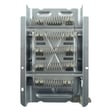
If the element fails either test, replace the heater assembly for this model: element 279838.
Visual inspection (helpful, not final)
Look for these common signs:
- Broken coil
- Coil touching the metal housing
- Burnt terminals or melted wire insulation
Related parts to check if heat is still missing
A failed element is common, but these parts can also stop heat:
| What you find | Most likely part to check next | Why it matters |
|---|---|---|
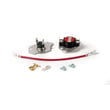
| No heat and safety opened | Cut-off kit 279816 | A blown thermal cutoff kills heat to prevent overheating |
| Weak airflow, overheating | Dryer blower wheel WP694089 | Poor airflow overheats the heater and opens safety devices |
| Heat cycles oddly | Dryer operating thermostat WP3387134 | Thermostat regulates heater cycling and temperature |
Why it matters
Running with a grounded or failing heating element can overheat wiring and repeatedly blow thermal safety parts. Fixing airflow issues (lint screen, venting, blower wheel) helps the new heater last.
Last updated: February 2026
How much does it cost to replace a heating element in a Kenmore dryer?
For Kenmore electric dryer model 11096585200, replacing the heating element typically costs $50 to $350 total. The part itself is commonly $20 to $100+, and professional labor (if you hire it) often adds $100 to $250 depending on service rates and access.
Typical cost breakdown
- Heating element part: $20 to $100+ (assembly style and supplier affect price)
- Service call and labor: $100 to $250
- Optional related parts (sometimes needed): thermal cut-off, wiring repair kit, thermostat
- DIY tools/supplies: $0 to $30 (nut driver, vacuum, vent brush)
| Scenario | What you pay for | Typical total |
|---|---|---|
| DIY element replacement | Part only | $20 to $100+ |
| DIY plus safety parts | Element + cut-off kit | $75 to $175 |
| Pro repair | Part + labor | $150 to $350 |
Parts that commonly get replaced with the element
If the element failed because of overheating or restricted airflow, we often replace these at the same time to prevent repeat failures:
- Element 279838 (heater that produces heat)
- Cut-off kit 279816 (thermal safety devices that open if temperatures get too high)
- Dryer operating thermostat WP3387134 (regulates heater cycling)
- Dryer heating element wire kit 279457 (repairs heat-damaged terminals and wiring)
Why it matters (and what drives the price)
A heating element usually fails faster when airflow is restricted. Cleaning lint buildup and confirming strong vent airflow can reduce overheating, shorten dry times, and help the new element last.
Before you buy parts: quick checks that save money
- Clean the lint screen and housing thoroughly.
- Inspect and clear the vent duct to the outside.
- Confirm the dryer has proper power (electric dryers need full 240V supply to heat).
- If the dryer tumbles but won’t heat, test the element and thermal cut-off for continuity.
For general component locations and what each part does, use what are the main parts of a clothes dryer.
Last updated: February 2026
Is it worth replacing the heating element in a dryer?
Yes, for a Kenmore electric dryer model 11096585200, replacing the heating element is usually worth it when the dryer still tumbles normally and the cabinet, drum, and controls are in good shape. A failed heater is a common, repairable issue, and the fix typically costs far less than replacing the dryer.
When replacing the heating element makes sense
- The drum turns and airflow feels strong, but clothes stay cold or take too long to dry.
- The dryer heats briefly, then stops heating (often a heat safety device issue).
- The dryer is otherwise reliable (no loud squealing, burning smell, or repeated shutdowns).
- You can safely access the heater housing and wiring connections.
- You plan to keep the dryer for a few more years.
A common replacement for this model is the element 279838.
Check these items first (they can mimic a bad heater)
Before ordering parts, we recommend ruling out the most common causes of “no heat” or “low heat”:
- Clogged venting or crushed exhaust duct (overheats the heater area and trips safeties)
- Blown thermal cut-off or thermal fuse (often caused by restricted airflow)
- Failed operating thermostat
- Loose or burned wire terminals at the heater
- Power supply issue (electric dryers need the correct voltage; a partial power loss can cause “runs but no heat”)
If an overheat event occurred, replacing the heater alone can lead to a repeat failure; the cut-off kit 279816 is often used to restore safe heating.
Quick cost and outcome comparison
| Situation | Typical best move | Why |
|---|---|---|
| Dryer tumbles, no heat, vent is clear | Replace heater or heat safety parts | Most cost-effective repair |
| No heat plus weak airflow | Fix venting first, then test heat parts | Prevents repeat overheating |
| Multiple major issues (motor noise, belt slip, heat problems) | Compare repair total vs replacement | Costs can add up quickly |
Why it matters
A heating element failure is straightforward, but airflow problems are the number one reason new heat parts fail early. Fixing venting and any blown safety devices protects the new heater and improves drying time.
Last updated: February 2026
What is a F01 code on a Kenmore dryer?
On the Kenmore 11096585200 electric dryer, an F01 error code points to a main electronic control problem (the control board is not processing inputs correctly). The most common fix is restoring power to clear a glitch; if the code returns, the control typically needs repair or replacement.
What to do first (quick checks)
- Unplug the dryer (or switch the breaker off) for 5 minutes, then restore power and try a cycle.
- Make sure the dryer is on a dedicated 240V circuit and both breakers are fully on.
- Confirm the door closes firmly; a weak door switch can cause confusing symptoms.
- If the dryer starts and stops randomly, check for a sticking start switch.
- If the code appears after a surge or outage, power-cycling often resolves it.
Parts that commonly relate to “won’t start” symptoms
If F01 returns after a power reset, the control is still the prime suspect, but these parts can be involved in no-start complaints:
Symptom-to-likely-cause guide
| What you notice | Most likely cause | What we recommend |
|---|---|---|
| F01 shows immediately when powered | Control board fault | Reset power; if it returns, plan for control service/replacement |
| Dryer won’t start, no error sometimes | Door switch or start switch | Test/replace switch if intermittent |
| Timer advances oddly or won’t advance | Timer issue | Inspect/replace timer |
Why it matters
The control manages motor operation, heat, and cycle timing. When it fails, the dryer can stop mid-cycle, refuse to start, or display F01 repeatedly, so addressing it prevents repeated shutdowns and inconsistent drying.
Related help
For Kenmore electronic-control dryers, our Kenmore 110 series electronic control model dryer error codes guide helps you compare F01 with other codes that can look similar.
Last updated: February 2026
Where can I find my Kenmore dryer model number?
Your Kenmore dryer model number is on the appliance ID label; on model 11096585200 it’s typically inside the dryer door opening on the cabinet frame, or on the back of the dryer near the top. Use that full model number to match the correct parts and diagrams.
Common places to check
- Open the dryer door and look around the door opening on the cabinet frame
- Check the back panel near the top edge
- Look along the side of the door opening (left or right cabinet flange)
- If the label is worn, use a flashlight and read it at an angle
What the label looks like (and what to write down)
The label usually includes a MODEL number and a SERIAL number.
| What to capture | Example | Why we need it |
|---|---|---|
| Model number | 11096585200 | Ensures parts fit your exact Kenmore electric dryer |
| Serial number | (varies) | Helps identify production changes when applicable |
Why it matters
Kenmore dryers often share similar cabinets, but internal components can differ by model. Using the exact model number helps us point you to the right replacement part the first time, such as a drum belt 341241 if the drum won’t tumble or a door switch W10820036 if the dryer won’t start with the door closed.
Quick tips if you can’t read the label
- Take a close-up photo and zoom in
- Wipe dust off gently; avoid solvents that can erase printing
- If the label is missing, check any purchase paperwork for the full model number
Last updated: February 2026