Installation guide
 Owner’s manual


What size is a Kenmore Model 11076132410 dryer?
The Kenmore dryer model 11076132410 is 29 inches wide, 28 1/4 inches deep, and 40 7/8 inches high (overall cabinet dimensions). For installation, plan extra room for venting, door swing, and service access; the installation guide shows the minimum clearances.
Dimensions and what they mean
These are the typical measurements you need for a laundry room fit check:
- Width: 29 in (737 mm)
- Depth: 28 1/4 in (717 mm)
- Height: 40 7/8 in (1038 mm)
- Leveling legs: set to about 1/2 in (13 mm) as shown in the guide
Space planning tips (so it actually fits)
Even when the cabinet fits, installation often needs more space than the raw dimensions.
- Leave extra space behind the dryer for the exhaust duct and connections.
- Make sure the door can fully open; the guide notes space must be large enough for full door swing.
- Add side clearance to reduce noise transfer and make servicing easier.
- If installing in a closet, louvered or closet doors typically need top and bottom air openings.
- For garage installs, place the dryer at least 18 in above the floor (per the guide).
Quick reference table
| Measurement | Size |
|---|---|
| Width | 29 in |
| Depth | 28 1/4 in |
| Height | 40 7/8 in |
Why it matters
Correct sizing prevents crushed venting, restricted airflow, and installation headaches. Good airflow also helps drying performance and can reduce overheating issues over time.
Last updated: February 2026
What is the most expensive part to replace on a dryer?
On a Kenmore dryer like model 11076132410, the most expensive repairs are usually the drive motor or the electronic control (control panel or main control). These parts cost more because they are complex and take longer to diagnose and install.
Most expensive dryer parts (typical)
These are the repairs that most often land at the top of the price range:
- Drive motor (drum turns, blower moves air)
- Electronic control or control panel assembly (runs cycles, reads sensors)
- Gas burner assembly parts on gas models (burner, valve, coils)
- Drum assembly (less common, but expensive when needed)
- Wiring harness (when damaged or overheated)
For this model, examples of higher-cost parts we commonly see include the drive motor 279827 and the dryer control panel assembly W10658496.
Quick cost comparison (part-only)
Actual totals vary by labor and diagnosis time, but this is a practical way to compare what tends to be “most expensive.”
| Repair type | Why it costs more | Typical part cost range |
|---|---|---|
| Drive motor | Major disassembly; critical moving part | $90 to $250+ |
| Electronic control/control panel | Electronics; model-specific | $150 to $400+ |
| Gas burner components | Multiple parts; heat-related wear | $70 to $300+ |
| Drum assembly | Large component; labor intensive | $150 to $300+ |
How to decide if it is worth replacing
We use these checkpoints when helping customers choose parts for a Kenmore dryer repair:
- If the dryer will not run, confirm basics first (door fully closed, correct power supply, breakers/fuses). See the 11076132410 owner's manual.
- If the dryer runs but has unusual noise, a roller/belt service kit is often more cost-effective than a motor. (A common option is the dryer repair kit 4392065.)
- If the dryer will not heat on a gas model, burner-related parts like the dryer gas valve coil kit WPW10328463 or igniter 279311 are common suspects.
- If multiple major parts are failing, compare total repair cost to the value of the dryer.
Why it matters
The “most expensive part” is usually expensive because it is either the brain (controls) or the muscle (motor). Identifying the correct failure first helps you avoid replacing a high-dollar part that is not actually causing the symptom.
Last updated: February 2026
What are common problems with Kenmore dryers?
Common problems on Kenmore dryer model 11076132410 include not starting, running but not heating, long dry times from restricted airflow, and unusual noises or vibration. Most issues trace back to power supply, door/Start operation, venting and lint buildup, or worn moving parts.
Most common symptoms and what usually causes them
- Dryer will not run: door not fully closed, START/PAUSE not held long enough, tripped breaker or blown fuse
- Drum turns but no heat: one side of the 240V supply is out (electric), or gas supply valve is closed (gas)
- Dry times too long: lint screen or lint screen housing clogged; exhaust vent or outside hood blocked
- Rattling/vibration: small item caught at drum edge, dryer not level, load is balled up
- Humming/whining (Steam cycle): water inlet valve or pump running during Steam function (normal)
Quick checks we recommend first (fast, no parts)
- Close the door firmly and press and hold START/PAUSE up to 3 seconds.
- Check power: many dryers use 2 fuses or 2 breakers; make sure both are on.
- Clean lint system: clean the lint screen every load and vacuum the lint screen housing.
- Check vent airflow: run 5 to 10 minutes and feel for strong airflow at the outside hood.
- Level the dryer: all four feet should contact the floor to reduce vibration.
Common fixes and related parts (when checks point to a failure)
| Symptom | Likely area | Example part on this model page |
|---|---|---|
| Won’t start when door closes | Door switch/catch | Dryer door switch WP3406107, dryer door catch W11429587 |
| Loud thumping/squeal, drum support wear | Rollers, shafts, bearing surfaces | Dryer repair kit 4392065 |
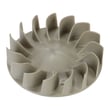
| Poor airflow noise, weak drying | Blower wheel | Dryer blower wheel WP694089 |
| No heat on gas models (ignition system) | Igniter, radiant sensor, coils | Igniter 279311, dryer radiant sensor WP338906, dryer gas valve coil kit WPW10328463 |
Why it matters
Airflow restrictions and overheating conditions can cause long dry times, poor performance, and nuisance shutdowns. Catching venting and lint issues early also helps protect key components like the drive motor and temperature sensors.
For model-specific operating steps and troubleshooting tables, use the owner's manual.
Last updated: February 2026