Installation guide
 Owner’s manual


How many cubic feet is a Kenmore series 500 dryer?
Kenmore “500 Series” dryers come in multiple sizes, so cubic feet depends on the exact model number. For Kenmore gas dryer model 11077132412, the capacity is typically in the 6.5 to 7.0 cu. ft. range for this style of full-size dryer; confirm the exact figure in the 11077132412 use and care guide.
How to find the exact capacity for your dryer
We recommend using the model-specific documentation because “Series 500” is a marketing family, not a single capacity.
- Check the specifications section in the 11077132412 use and care guide
- Look for the model/serial label on the dryer (often inside the door opening)
- If your guide lists multiple models, match the exact model number: 11077132412
- If you are comparing dryers, use capacity plus venting and cycle type (sensor vs timed)
Typical capacity ranges (quick reference)
| Dryer type | Typical capacity range | What it’s best for |
|---|---|---|
| Compact dryer | 3.4 to 4.4 cu. ft. | Small loads, tight spaces |
| Full-size dryer (common) | 6.5 to 7.4 cu. ft. | Everyday family laundry |
| Extra-large dryer | 7.5+ cu. ft. | Bulky items, large households |
Why it matters
Capacity affects how well clothes tumble and dry. Overloading a drum can increase dry time and reduce performance, even when the dryer is heating correctly. The manual also ties good results to proper installation and airflow; we cover those clearances and venting basics in the 11077132412 installation instructions.
Last updated: February 2026
How do I know if my Kenmore dryer thermal fuse is blown?
On a Kenmore gas dryer model 11077132412, a blown thermal fuse commonly shows up as a dryer that will not start, or a dryer that runs but has heat problems after an overheating event. The sure way to confirm is a continuity test with a multimeter after disconnecting power (and gas).
Quick symptoms to look for
- Dryer will not run even though the door is closed and you press Start
- Dryer runs but shuts off unexpectedly during a cycle
- Burning smell or very hot cabinet before the failure (overheating history)
- Repeated long dry times leading up to the problem (restricted venting)
- No obvious error code, but the dryer acts “dead”
How we confirm it (safe, reliable test)
- Unplug the dryer (or disconnect power at the breaker) as shown in the 11077132412 owner’s manual.
- Shut off the gas supply valve.
- Access the thermal fuse location (typically on the blower housing or exhaust duct area).
- Pull the wires off the fuse terminals.
- Check continuity across the fuse with a multimeter.
Result guide:
| Meter result | What it means | What to do next |
|---|---|---|
| Beep or near 0 ohms | Fuse is good | Keep troubleshooting airflow, door switch, motor circuit |
| No beep or OL/infinite | Fuse is blown | Replace the fuse and correct the overheating cause |
Parts that are often involved
On this model, overheating and no-run complaints often trace back to airflow restrictions or safety devices. If you’re replacing a safety device, we also correct the root cause.
- Dryer thermal cut-off fuse kit W11050897 (commonly replaced when overheating occurs)
- Clean lint screen housing and internal lint buildup
- Inspect vent duct for kinks, crushed sections, or heavy lint
- Confirm the outside vent hood opens fully
Why it matters
A thermal fuse is a one-time safety device; it opens to stop operation when temperatures get unsafe. Replacing the fuse without fixing poor airflow (lint blockage, long vent run, crushed duct) often leads to another failure.
Last updated: February 2026
What is the code F01 on a Kenmore dryer?
On Kenmore gas dryer model 11077132412, an F01 (F1)-type code is a control-detected fault that points to a problem the dryer needs serviced for; it commonly relates to temperature sensing or control input issues. We start by checking airflow, wiring connections, and the temperature sensor circuit.
What the display code means on this model
In the 110.77132*410 series Use & Care Guide, codes shown as “F# E#” indicate the control detected a problem that requires service. Use the troubleshooting steps in the 11077132412 owner's manual to rule out simple causes before replacing parts.
Quick checks we recommend first
- Unplug the dryer (or switch off the breaker) for 1 minute, then restore power and retry a heated cycle.
- Confirm the cycle knob is set to an actual cycle (not between selections).
- Clean the lint screen and make sure the exhaust vent is not crushed, kinked, or blocked.
- Verify the dryer is getting proper power and the cord is installed correctly.
- If the code returns quickly, inspect wiring connectors at the sensor and control for looseness or corrosion.
Parts that commonly relate to F01/F1 symptoms
If the dryer runs poorly, overheats, or shuts down with an F01/F1-type code, these model-compatible parts are common suspects:
| Symptom you notice | Likely area | Example part for this model |
|---|---|---|
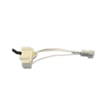
| Heat is erratic, cycle ends early, or temps seem “off” | Temperature sensing | Dryer thermistor WP8577274 |
| Dryer overheats or stops heating after a while | Safety temperature limit | Dryer thermal cut-off fuse kit W11050897 |
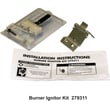
| No heat and igniter never glows (gas model) | Burner ignition | Igniter 279311 |
Why it matters
When the control detects a fault, the dryer can stop mid-cycle, over-dry, or fail to heat. On a gas dryer, airflow problems can also trigger overheating and safety shutdowns, so venting checks are just as important as testing parts.
When to move from DIY to service
If the code persists after airflow and power checks, the issue is typically in the sensor circuit, wiring harness, or electronic control. Use the diagnostic guidance in the 11077132412 installation guide for safe access and setup, and have a technician test live-voltage and control signals if needed.
Last updated: February 2026
How much does it cost to replace a heating element in a Kenmore dryer?
For a Kenmore dryer like model 11077132412, heating-element replacement typically runs $100 to $350 total when you include labor; the part alone is usually $20 to $100+ depending on whether it’s a bare element or an assembly. Confirm the exact part style and access steps in the 11077132412 owner’s manual.
Typical cost breakdown
- Heating element part: $20 to $100+ (assembly-style parts cost more)
- Service call and labor: commonly $80 to $250
- Optional add-ons: vent cleaning, worn drum support parts, or electrical/gas checks
| Scenario | What you pay for | Typical total |
|---|---|---|
| DIY replacement | Part only (plus basic tools) | $20 to $100+ |
| Pro repair | Part + labor + service call | $100 to $350 |
| “While you’re in there” refresh | Part + wear items | $130 to $450 |
What changes the price most
- Dryer type: Electric dryers use a heating element; gas dryers heat with a burner system. Model 11077132412 is a gas dryer, so “no heat” repairs often involve ignition or flame-sensing parts instead of an element.
- Access time: Some designs require more disassembly to reach the heater/burner area.
- Root cause: A failed heater is sometimes a symptom of restricted airflow or a control/temperature-sensing issue.
If your 11077132412 is not heating (common gas-dryer parts)
- Check for ignition problems; a weak igniter is common: igniter 279311
- Verify temperature sensing and cycling; a bad sensor can stop heat: dryer thermistor WP8577274
- Address overheating shutdowns; safety devices can open if airflow is poor: dryer thermal cut-off fuse kit W11050897
Why it matters
Pricing is driven by diagnosing the correct heat source. On gas Kenmore dryers, replacing “a heating element” is often the wrong repair; targeting the burner ignition and safety circuit usually restores heat faster and avoids repeat failures.
Last updated: February 2026