Owner’s manual
 Error Codes



How to tell what model Kenmore refrigerator?
To identify your Kenmore refrigerator model, look for the model and serial number on the identification label inside the fresh food section; on Kenmore model 79576203900, the label is located on the right-hand side of the refrigerator compartment. Use that exact model number when ordering parts and checking specifications in the owner's manual.
Check these common locations first (in order):
- Right-hand side wall inside the refrigerator compartment (most common for 795-series bottom-mount units)
- Upper side wall or ceiling area inside the fresh food section
- Behind or beside the crisper drawers (you may need to slide a drawer out)
- Behind the lower kick plate or toe grille (less common, but worth checking)
Record both numbers exactly as shown; they are used for parts compatibility and service information.
| Item | What it tells us | Example format |
|---|---|---|
| Model number | The exact design and parts list | 795.76203900 (may appear with or without a dot) |
| Serial number | Production sequence and build details | Mix of letters and numbers |
- Copy every digit; one wrong number can pull the wrong door gasket, sensor, or ice maker.
- If the model shows a dot (for example, 795.76203900), also try it without the dot when searching.
- Take a clear photo of the label before it fades or gets damaged.
Kenmore model numbers identify the correct parts and documentation for your exact refrigerator configuration (shelves, icemaker setup, door style, and control features). That prevents ordering mismatched items like a door switch or gasket.
Last updated: February 2026
Can I adjust the height of my refrigerator?
Yes. On Kenmore refrigerator model 79576203900, you adjust the height by turning the two front leveling screws (leveling legs) behind the base grille; turning clockwise raises that side and counterclockwise lowers it. The front should sit slightly higher than the rear to help doors close.
Follow these steps from the owner's manual:
- Plug the refrigerator into a grounded outlet and slide it into its final position.
- Remove the base grille (kick plate) to access the leveling screws.
- Use a flat-blade screwdriver in the leveling screw slots.
- Turn clockwise to raise that side; turn counterclockwise to lower it.
- Turn both sides the same amount to keep the cabinet square.
- Reinstall the base grille when finished.
Use these checks to confirm the height and tilt are correct:
- Place a level on an interior shelf to verify the cabinet is level side-to-side.
- Confirm the refrigerator is slightly higher in front than in back.
- Open and release each door; it should close smoothly without slamming.
- Check for rocking; if it rocks, re-adjust the leveling screws.
| Symptom | What it usually means | What to do |
|---|---|---|
| Doors do not close easily | Front is too low (not enough rearward tilt) | Raise the front slightly by turning both leveling screws clockwise equally |
| Refrigerator rocks | One front corner is low | Raise the low side until stable |
| Uneven gap between doors | Door alignment issue (not leveling) | Use the door alignment steps in the manual (top hinge adjustment) |
Proper leveling reduces vibration and noise, helps the doors seal, and improves temperature stability in both the refrigerator and freezer compartments.
Last updated: February 2026
What size is Kenmore refrigerator model 79576203900?
Kenmore refrigerator model 79576203900 is a bottom-freezer design; the exact exterior dimensions (width, depth, height) vary by the specific 795.7620 color suffix and configuration. For the precise cabinet size and clearance requirements for your unit, use the specifications and installation section in the 79576203900 owner's manual.
- Check the model label inside the fresh food compartment and confirm it reads 795.76203900 (including any color suffix shown on the tag).
- In the 79576203900 owner's manual, look in the Refrigerator Installation section for:
- Overall width, depth, and height
- Door swing and handle clearance
- Required air space around the cabinet
- Measure your refrigerator to match the manual:
- Width: cabinet edge to cabinet edge (not the doors)
- Depth: include handles if you need “overall depth” for a tight space
- Height: floor to top of hinge cover
- If your doorway is tight, plan for door and drawer removal; the manual notes that if the entrance is less than 35 inches wide, doors and the freezer drawer may need to be removed.
Most Kenmore 795 bottom-freezer refrigerators are built around a 33-inch class cabinet and stand roughly 66 to 70 inches tall, with depth commonly in the 30 to 34 inch range depending on handles and door style.
| Measurement | What to measure | Typical range |
|---|---|---|
| Width | Cabinet only | ~32 to 34 in. |
| Depth | With handles | ~30 to 34 in. |
| Height | Floor to top | ~66 to 70 in. |
Correct dimensions prevent delivery surprises and help avoid cooling issues caused by poor airflow. Proper clearance also reduces door alignment problems and helps the door gasket seal consistently.
Last updated: February 2026
What are the common problems with Kenmore Elite refrigerators?
Common problems we see on Kenmore Elite refrigerators like model 79576203900 include warm temperatures from airflow or defrost issues, frost buildup from door sealing problems, unusual fan or compressor noise, and water leaks from a clogged defrost drain. Many of these symptoms trace back to basic maintenance and a few high-wear parts.
- Not cooling or weak cooling: dirty condenser coils, blocked vents, evaporator fan issues, or temperature control/sensor problems
- Frost or ice buildup: door not sealing, frequent door openings, or a defrost system problem
- Water leaking or puddles: clogged/iced defrost drain or drain tube
- Loud buzzing, rattling, or grinding: condenser fan, evaporator fan, or compressor start components
- Doors not closing well: unit not level, bins/shelves out of position, or gasket sticking/worn
- Confirm door closure: push doors firmly shut; make sure shelves, bins, and food packages are not blocking the door.
- Clean the condenser coils: dirty coils reduce heat transfer and make the compressor work harder.
- Check airflow: keep items from blocking interior air vents.
- Adjust temperatures correctly: adjust the refrigerator control first, then wait 24 hours before judging results (then adjust the freezer if needed).
- Inspect for drain issues: if you see water under crispers or near the freezer, suspect a defrost drain restriction.
For model-specific care, cleaning, temperature adjustment guidance, and troubleshooting charts, use the 79576203900 owner's manual.
| Symptom | Common suspect part | Example part on this page |
|---|---|---|
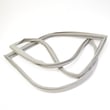
| Door pops open, warm temps, frost | Door gasket not sealing | Refrigerator door gasket ADX73350927 |
| Interior light issues, door alarm behavior | Door switch not sensing closure | Lg refrigerator door switch 6600JB1010A |
| Water pooling, ice buildup near drain | Drain tube restricted or damaged | Refrigerator drain tube 5251JA3003D |
| No ice or poor ice production | Ice maker issue or water supply problem | Ice maker kit AEQ72909603 |
Cooling, frost, and leak complaints often start small (dirty coils, a door not sealing, or a slow drain). Fixing those early prevents temperature swings that can spoil food and reduces strain on major components like the compressor and evaporator fan.
Last updated: February 2026
How to tell if a Kenmore refrigerator compressor is bad?
On your Kenmore 79576203900 bottom-mount refrigerator, a bad compressor typically shows up as both sections warming while the unit runs a lot, or repeated start attempts (clicking) with little or no cooling. Confirm basic causes first; they often mimic compressor failure. Use the 79576203900 owner's manual for normal sound descriptions and troubleshooting.
These issues commonly cause long run times or warm temps even when the compressor is OK:
- Make sure the refrigerator is not in Demonstration Mode (cooling disabled).
- Verify temperature controls are set correctly; allow up to 24 hours after plugging in or changing settings.
- Confirm doors close fully and the gasket seals all the way around.
- Clean the condenser coils; dirty coils make the compressor work harder.
- Listen for normal sounds (fan airflow, gurgling refrigerant, occasional clicks) versus repeated rapid clicking.
Look for a pattern of multiple symptoms, not just one:
- Refrigerator and freezer both warm even though it “runs” most of the time
- Repeated clicking from the compressor area (start attempt that fails)
- No steady compressor hum, but interior lights and display work
- Compressor housing gets very hot after repeated start attempts (avoid touching tubing)
| Sound/behavior | Often normal | More concerning |
|---|---|---|
| Occasional click as it cycles | Yes | No |
| Gurgling/pulsating refrigerant sound | Yes | No |
| Fan blowing over condenser | Yes | No |
| Repeated clicking with little/no cooling | No | Yes |
If the compressor is trying to start but cannot, these parts are often checked during diagnosis:
- Refrigerator compressor TCA35931726 (sealed-system repair)
- Compressor start relay (commonly tied to clicking and no-start symptoms)
Compressor and sealed-system repairs are among the most expensive refrigerator fixes. Ruling out settings, door sealing, and dirty condenser coils first prevents unnecessary parts replacement.
Last updated: February 2026