Owner’s manual
 Error Codes


What is the average lifespan of a Kenmore Elite refrigerator?
Most Kenmore Elite refrigerators, including model 10650599003, typically last 10 to 15 years with normal household use. Regular care (cleaning, good door sealing, and stable temperatures) helps you reach the high end of that range and avoid early sealed-system or cooling problems.
A refrigerator’s life is mostly driven by how hard the cooling system has to work and how well airflow and door sealing are maintained.
- 10 to 15 years is the typical average for a modern refrigerator
- 15+ years is common when coils are kept clean and doors seal tightly
- Heavy use, hot garages, and clogged condenser coils can shorten life
- Power interruptions and frequent door openings increase compressor run time
- Water and ice features add components that may need service over time
Use the care and cleaning guidance in the 10650599003 owner's manual and focus on the items below.
- Clean dust from the condenser area on a routine schedule
- Keep door gaskets clean so they seal without gaps
- Set temperatures correctly (fresh food around 37°F, freezer around 0°F)
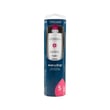
- Replace water filters on schedule to protect water flow and taste
- Keep vents inside the compartments unblocked for proper airflow
| Symptom | Often indicates | Usually worth checking first |
|---|---|---|
| Warm fridge and freezer, compressor running a lot | Sealed-system or airflow issue | Condenser cleaning, evaporator fan airflow, door sealing |
| Frost buildup on freezer back wall | Defrost system problem | Defrost heater, defrost bi-metal, defrost control |
| No ice or slow water dispensing | Water supply issue | Water filter, inlet valve, frozen water line |
| Doors not closing smoothly | Hinge/cam wear | Door cam and hinge alignment |
Knowing the typical lifespan helps you decide whether to repair or replace. If your 10650599003 is already in the 10 to 15 year window, investing in basic maintenance and addressing small issues early can prevent expensive cooling-system strain later.
Last updated: January 2026
How to tell cubic feet of Kenmore refrigerator by model number?
You typically can’t calculate cubic feet from the Kenmore model number alone. For Kenmore Elite model 10650599003, the most reliable way is to look up the capacity in the 10650599003 owner's manual or estimate it by measuring the usable interior space and converting cubic inches to cubic feet.
- Check the manual/specs: Capacity is often listed with other specifications in the 10650599003 owner's manual.
- Look for the rating label: Many refrigerators list capacity on the model/serial label or nearby product data label.
- Measure and calculate (good estimate): Measure the main food-storage areas and convert.
- Compare to typical sizes: Most side-by-side refrigerators are commonly in the 20 to 26 cu. ft. range.
- Empty enough space to measure accurately.
- Measure width x depth x height (in inches) of the refrigerator compartment usable box.
- Do the same for the freezer compartment.
- Convert each to cubic feet:
- cubic feet = (W x D x H) / 1728
- Add the two results for an estimated total.
| What you have | What to do | Result |
|---|---|---|
| Inches (W x D x H) | Multiply to get cubic inches | cu. in. |
| Cubic inches | Divide by 1728 | cu. ft. |
Cubic feet helps you buy the right replacement parts and accessories (like shelves, bins, and water filter components) and set realistic expectations for food storage. It also helps when comparing side-by-side refrigerator sizes across brands like Kenmore and Whirlpool.
Last updated: January 2026
When was Kenmore Elite made?
Kenmore Elite is a premium Kenmore product line that began in 1999, and your Kenmore Elite side-by-side refrigerator model 10650599003 comes from that broader Kenmore Elite era. For model-specific details like the exact production date range, we use the model’s identification information shown in the 10650599003 owner's manual.
Kenmore Elite is a line name, not a single appliance model. That means:
- The line started in 1999, but individual Elite models were produced across many years.
- Your exact build date is tied to the refrigerator’s serial number, not the “Elite” label.
- The same model number can have multiple production runs.
- Parts like the water system and defrost system can vary by revision.
Use the refrigerator’s model and serial tag (commonly inside the fresh food compartment on a side wall or ceiling area).
- Locate the model/serial label.
- Write down the serial number exactly.
- Check the date-code section in the 10650599003 owner's manual.
- If you are ordering parts, match by model number + serial for best accuracy.
| Item | What it tells you | Where to find it |
|---|---|---|
| Kenmore Elite launch | When the Elite line began (1999) | Brand history context |
| Model number (10650599003) | Which design family you have | Model/serial label |
| Serial number | Approximate build date and revision | Model/serial label + manual |
The build date helps us match the correct refrigerator parts (for example, water and ice components like the refrigerator inlet valve W10408179) and avoid ordering a part that fits a different production revision.
Last updated: January 2026
What are the common problems with Kenmore Elite refrigerators?
Common problems we see on the Kenmore Elite 10650599003 side-by-side refrigerator include warm temperatures from airflow issues, frost buildup from defrost or door-seal problems, dispenser water flow dropping due to a clogged filter, and normal-to-loud operating noises from fans, valves, or the defrost cycle. Use the 10650599003 owner’s manual troubleshooting section to match symptoms to the right checks.
- Not cooling or weak cooling: dirty condenser area, blocked vents, failing fan motor, or a sealed-system issue
- Excessive frost/ice buildup: defrost system failure (heater, bi-metal, control) or a door not sealing
- Water dispenser flow slows down: filter clogged or installed incorrectly; flow often improves with the filter removed for a quick test
- Buzzing, clicking, sizzling, popping, or gurgling sounds: often normal; can also point to a fan, valve, or compressor/start issue
- Doors hard to open or not closing well: dirty or sticky gaskets, bins/pans out of position, or the cabinet not level
- Confirm the temperature controls are set correctly and vents are not blocked by food packages.
- Clean the door gaskets and make sure shelves, bins, and pans are seated correctly.
- If water flow is weak, remove the filter cartridge briefly and test dispenser flow (reinstall or replace the filter afterward).
- Listen for where the noise is coming from (freezer rear panel, machine compartment, dispenser area).
- Level the refrigerator if it wobbles or doors swing open.
| Symptom | Common suspect | Example part for 10650599003 |
|---|---|---|
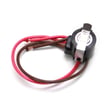
| Frost/ice buildup | Defrost safety thermostat (bi-metal) | Refrigerator defrost bi-metal WPW10225581 |
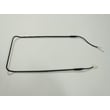
| Frost/ice buildup | Defrost heater | Refrigerator heater WP2323198 |
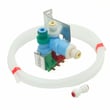
| Ice maker not filling, buzzing at fill | Water inlet valve | Refrigerator inlet valve W10408179 |
Catching airflow, defrost, and gasket issues early helps prevent food spoilage, reduces compressor run time, and avoids ice buildup that can block the evaporator fan and restrict cooling.
Last updated: January 2026