Owner’s manual



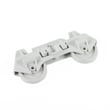

Does my Whirlpool dishwasher have a filter to clean?
Yes. Whirlpool dishwasher model DU945PWSQ0 uses a filter module in the bottom of the tub to help trap food soil so it does not recirculate. Keeping that filter and the sump area clean helps prevent gritty dishes, odors, and wash or drain problems; see the DU945PWSQ0 owner’s manual for the exact diagram and access steps.
Where the filter is on DU945PWSQ0
The manual lists a POWER CLEAN filter module as a parts-and-features item. It sits in the tub bottom area near the lower spray arm.
You will typically see these nearby items:
- Lower spray arm and its mounting hardware
- Sump area (tub floor opening where water circulates)
- Heating element
- Overfill protection float (front right corner)
- Filter module area at the tub bottom
How we recommend cleaning it
Use this routine for regular maintenance.
- Turn off power at the breaker before reaching into the tub bottom
- Pull out the lower rack
- Remove any visible debris from the sump area (wear gloves for glass)
- Rinse any screens or covers you can remove with warm water
- Use a soft brush to loosen stuck-on soil
- Make sure the overfill protection float moves freely up and down
Cleaning frequency guide
| Dishwasher use | Check and clean the filter area |
|---|---|
| Daily loads | Every 2 to 4 weeks |
| Typical use | Monthly |
| Light use | Every 2 to 3 months |
If cleaning does not fix poor washing or draining
These parts commonly affect performance on dishwashers like DU945PWSQ0:
- Dishwasher spray arm WP8268874 (clogged spray holes reduce wash pressure)
- Dishwasher drain hose WP3374077 (kinks or restrictions can leave standing water)
- Dishwasher float assembly WP3376397 (a stuck float can limit filling)
Why it matters
A dirty filter and sump area restrict water flow to the pump and can redeposit food particles on dishes. Regular cleaning keeps wash pressure consistent and helps the dishwasher drain normally.
Last updated: February 2026
What does E9 mean on a Whirlpool dishwasher?
On a Whirlpool dishwasher, an E9 code commonly points to a stuck or continuously pressed key on the control panel (a button being held too long or moisture causing the keypad to read as pressed). For model DU945PWSQ0, start by clearing the keypad condition, then reset the control.
How to clear E9 on DU945PWSQ0
- Press Cancel/Drain (or the model’s cancel function) once to stop the cycle.
- Wipe the control area dry; remove any damp cloths or steam buildup near the console.
- Press each key one at a time to make sure none feel stuck.
- If the dishwasher is unresponsive, turn power off at the breaker for 1 minute, then restore power.
- Run a short cycle to confirm the code stays cleared.
For the exact button sequence and control panel layout used on this series, follow the steps in the DU945PWSQ0 owner’s manual.
What usually causes E9
| Cause | What you’ll notice | What to do |
|---|---|---|
| Button held down (accidental press) | Code appears while loading/unloading | Release button; reset power if needed |
| Moisture on keypad/console | Code after heavy steam or wiping controls | Dry console; avoid spraying cleaner directly |
| Keypad or control issue | E9 returns quickly after reset | Inspect console; consider control panel replacement |
Why it matters
A stuck-key condition can prevent cycle selection, stop a wash mid-cycle, or keep the dishwasher from starting. Clearing the keypad issue quickly helps protect normal operation and avoids repeated interruptions.
Parts that may be involved if E9 keeps returning
If E9 comes back after drying the console and resetting power, the issue is often in the user interface area.
- Dishwasher control panel WPW10101960 (user interface/control panel assembly)
- Check for signs of moisture intrusion around the console and door top edge
- Confirm the door closes and latches consistently (a loose close can increase steam leakage)
For additional Whirlpool code help and what to check next, use our Whirlpool dishwasher error codes reference.
Last updated: February 2026
Why is my Whirlpool dishwasher leaking at the bottom of the door?
A Whirlpool DU945PWSQ0 dishwasher typically leaks at the bottom of the door when the door seal is worn, the door is not latching tightly, or wash water is being deflected toward the door by loading issues or excess suds. Fixing the seal and ensuring proper spray-arm clearance usually stops the leak.
Quick checks that solve most door-bottom leaks
- Inspect the door gasket for tears, flattening, or hardened sections; replace if damaged.
- Confirm the door closes evenly and latches firmly; a weak latch can let water escape.
- Make sure nothing blocks spray arm rotation; items that stop the arm can redirect water at the door.
- Avoid soap or laundry detergent; high suds can push water past the seal.
- Verify the bottom rack is installed correctly; an incorrectly positioned rack can interfere with proper door closure.
Parts that commonly fix this problem on DU945PWSQ0
If you see water tracking from the lower corners or along the bottom edge, these model-matched parts are the first place we look:
| Symptom you see | Most likely part | What it does |
|---|---|---|
| Drips along bottom of door | Dishwasher door seal WPW10509257 | Seals the tub-to-door opening to keep wash water inside |
| Door feels loose or pops open | Dishwasher door latch WP3380854 | Pulls the door tight against the seal |
Loading and spray issues that mimic a bad seal
Your manual notes that items can block spray patterns and that the spray arm(s) must move freely. When a pan, handle, or tall item stops the arm, the spray can “shoot” toward the door and overwhelm the gasket.
Use these loading rules:
- Keep large sheets and pans to the sides and back.
- Do not place items between the bottom rack and the tub wall.
- Reposition tall utensils or pot handles that could hit the spray arm.
- Keep the detergent dispenser area clear so the cycle runs normally.
For model-specific loading guidance, follow the DU945PWSQ0 owner’s manual.
Why it matters
A door-area leak can quickly cause cabinet swelling, floor damage, and repeated cycle interruptions. Correcting the seal, latch tension, and spray direction restores normal wash pressure and keeps water where it belongs.
Last updated: February 2026