Owner’s manual
 Error Codes


How do I tell what model Kenmore fridge I have?
To tell what model Kenmore fridge you have, find the model/serial tag on the refrigerator and match the full model number to your appliance. For Kenmore model 79576209901, the tag is typically inside the fresh food compartment or freezer, or near the lower front kickplate; see the 79576209901 manual for label-location guidance.
Where to look for the model number tag
On Kenmore bottom-mount refrigerators like 79576209901, we most often see the model/serial label in one of these spots:
- Inside the refrigerator compartment on a side wall (often near the crisper area)
- On the inside wall behind or beside the lower crisper drawers
- Inside the freezer compartment on a side wall
- Along the door frame when the door is open
- Behind the lower front toe grille or kickplate
What to write down (so you get the right parts)
When you find the tag, record these details exactly as shown:
- Model number (example format: 795.7620xxxx)
- Serial number (helps with production variations)
- Any revision or suffix characters
- The brand (Kenmore) and product type (bottom-mount refrigerator)
Quick check: model number vs. serial number
| Item on the tag | What it’s used for | Why it matters |
|---|---|---|
| Model number | Identifies the exact refrigerator design | Ensures parts diagrams match your unit |
| Serial number | Identifies production run/date | Helps confirm compatible replacement parts |
Why it matters
Kenmore model numbers can look very similar, but small differences can change which parts fit (door hardware, ice maker components, sensors, and control boards). Using the exact model number helps us match the correct diagrams and compatible replacement parts the first time.
Last updated: January 2026
How to tell if a Kenmore refrigerator compressor is bad?
On Kenmore refrigerator model 79576209901, a “bad compressor” usually shows up as poor cooling with the unit running often, unusual buzzing or clicking at the compressor area, or the compressor overheating and shutting down. Before condemning the compressor, we verify the start components and airflow first (see the 79576209901 manual).
Quick signs the compressor (or its start circuit) is failing
- Refrigerator and freezer are warm even though the unit runs for long periods
- Repeated clicking every few minutes (start attempt, then stop)
- Loud humming, buzzing, or rattling from the lower rear area
- Compressor shell is very hot to the touch and cooling is still weak
- Breaker trips or the unit shuts off shortly after trying to start
What to check first (common look-alikes)
Many “compressor” symptoms on 79576209901 are actually caused by a start device, fan, or defrost issue.
- Power reset: unplug for 5 minutes, then restart
- Condenser airflow: confirm the condenser fan runs and the rear/bottom area is not packed with dust
- Evaporator airflow: if the freezer fan is not moving air, the refrigerator section can warm up
- Frost pattern: heavy frost on the evaporator cover points to a defrost problem, not a compressor
- Start components: a weak capacitor can prevent the compressor from starting
Parts that are commonly involved
| Symptom | More likely cause | Example compatible part for this model |
|---|---|---|
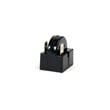
| Clicks, won’t start | Start circuit issue | Refrigerator run capacitor 0CZZJB2014L |
| Runs but won’t cool | Sealed system or compressor | Refrigerator compressor TCA35931726 |
Why it matters
A compressor replacement is a major repair; confirming the start circuit and airflow first can prevent replacing an expensive part when the real issue is a simpler component.
Last updated: January 2026
Why does ice form on the bottom of my Kenmore freezer?
Ice on the freezer bottom in your Kenmore 79576209901 is almost always caused by defrost water not draining correctly; the water pools under the evaporator area, runs to the lowest point, then freezes into a sheet. A clogged drain path or a drain component issue is the most common reason.
What to check first (quick, safe checks)
- Make sure the freezer drawer closes fully and the door gasket seals all the way around.
- Look for a layer of frost on the back freezer panel; heavy frost can point to a defrost or airflow issue.
- Check for a frozen puddle directly under the rear panel; that often indicates a blocked defrost drain.
- Confirm food packages are not blocking vents, which can increase frost and meltwater.
- If you recently had a power outage or door left open, expect temporary excess meltwater that can refreeze.
For model-specific access steps and panel removal guidance, follow the 79576209901 user manual.
Likely causes and the parts involved
When the defrost drain is restricted, meltwater cannot reach the drain pan and instead freezes on the freezer floor.
- Blocked or iced-over drain tube: Clear the drain opening and flush with hot water.
- Drain tube not routing water correctly: Inspect for kinks, splits, or a loose connection.
- Drain pan issue: If the pan is cracked or out of position, water may not evaporate normally.
If you find damage, these model-compatible parts are commonly involved:
- Refrigerator drain tube 5251JA3003D
- Refrigerator drain tube cap 5006JA3049A
- Refrigerator drain pan 3390JJ0004A
Symptom-to-cause guide
| What you see | Most likely cause | What we recommend |
|---|---|---|
| Solid ice sheet on freezer floor | Drain iced/blocked | Defrost and flush drain path |
| Water dripping then freezing near rear | Drain tube/cap not sealing or routing | Inspect tube and cap fit |
| Repeating ice buildup every 1 to 2 weeks | Drain restriction returning | Clean drain thoroughly; check for debris |
Why it matters
Ice buildup on the freezer bottom can block the drawer from sliding smoothly, restrict airflow, and lead to warmer freezer temperatures or recurring frost. Fixing the drain path stops the water source so the ice does not come back.
Last updated: January 2026
Why is there water leaking from the bottom in my Kenmore refrigerator?
Water leaking from the bottom of your Kenmore 79576209901 bottom-mount refrigerator is most often caused by a clogged or frozen defrost drain that overflows into the drain pan, or by a drain pan that’s cracked or out of position. We recommend clearing the drain path and inspecting the pan.
Quick checks we recommend first
- Unplug the refrigerator before removing panels or working near wiring.
- Look for a sheet of ice on the freezer floor; that commonly points to a blocked defrost drain.
- Check for water trails from the freezer area down to the front or center of the cabinet.
- Pull the toe grille or lower rear access cover (if equipped) and inspect the drain pan.
- If the unit has an ice maker or water dispenser, check the supply line and valve area for drips.
How to clear a clogged or frozen defrost drain
- Remove food and the freezer drawer/bins as needed.
- Locate the drain opening at the bottom of the evaporator cover area (exact access varies by configuration).
- Melt ice with warm water (a turkey baster works well) and clear debris with a flexible pipe cleaner.
- Flush until water flows freely down to the drain pan.
For panel removal guidance and compartment layout, use the 79576209901 manual.
Parts that commonly relate to “water on the floor” symptoms
If you find damage or a loose connection, these model-compatible parts are common leak culprits:
| What you find | Likely area | Model-compatible part to inspect |
|---|---|---|
| Water collecting under the cabinet | Drain/evaporation system | Refrigerator drain pan 3390JJ0004A |
| Water dripping from a tube at the back | Drain outlet/tube | Refrigerator drain tube 5251JA3003D |
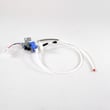
| Water leaking only when ice maker fills | Water supply/valve | Refrigerator water inlet valve assembly AJU55759303 |
Why it matters
A defrost drain overflow can keep returning and can lead to recurring ice buildup in the freezer, wet flooring, and odors. Fixing the drain path and confirming the drain pan and tubing are intact prevents repeat leaks.
Last updated: January 2026