Owner’s manual
 Error Codes



Why is my refrigerator not getting cold at the bottom?
If your Kenmore Elite 79571056012 is warm at the bottom, the most common causes are restricted airflow (blocked vents or overpacked shelves), incorrect temperature settings, or poor heat removal from dirty condenser coils. Start with control settings and airflow checks, then clean the condenser area.
Quick checks we recommend first
- Confirm the refrigerator is set near 37°F and the freezer near 0°F; then wait 24 hours after any change for temperatures to stabilize (per the 79571056012 owner's manual).
- Make sure food packages are not blocking air vents; blocked vents can keep cold air from reaching the lower section.
- Avoid overloading the refrigerator; tight packing prevents air circulation.
- Verify doors close fully and seals are making contact all the way around.
- Check room temperature; operation is intended for spaces roughly 55°F to 110°F.
Clean the condenser coils (a top cause of warm temperatures)
Dust and pet hair on the condenser coils reduce cooling performance and can make the refrigerator section (often the lower area) run warm.
Basic steps:
- Unplug the refrigerator.
- Pull the unit out enough to access the lower rear or bottom area.
- Vacuum coils and surrounding vents with a brush attachment.
- Restore power and allow several hours to recover.
| What you notice | Likely issue | What to do |
|---|---|---|
| Bottom shelves warm, top seems closer to normal | Airflow blocked | Clear vents, reduce packing |
| Whole fresh-food section warm | Controls set too warm or doors not sealing | Adjust 1 step, check gaskets |
| Cooling weak and unit runs a lot | Dirty condenser coils | Clean coils and airflow path |
Parts that commonly relate to cooling and airflow
If cleaning and airflow do not help, these parts are often involved in cooling complaints:
- Refrigerator condenser coil ACG73784701 (heat rejection)
- Refrigerator condenser fan motor assembly EAU61723501 (moves air across condenser)
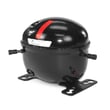
- Refrigerator compressor TCA38091801 (drives the sealed system)
Why it matters
Bottom-warm symptoms usually point to airflow or heat-removal problems. Fixing those first protects food safety, reduces run time, and helps the refrigerator reach and hold the recommended temperatures.
Last updated: January 2026
What does DH mean on Kenmore Elite refrigerator?
On Kenmore Elite refrigerator model 79571056012, DH commonly points to a defrost heating problem (the unit is not warming the evaporator enough during defrost), which can lead to frost buildup and poor cooling. Use the troubleshooting steps in the 79571056012 owner's manual to confirm the exact display meaning and checks.
What you’ll usually notice when DH shows up
- Refrigerator or freezer temperature starts rising
- Frost or ice buildup on the rear freezer panel
- Fan noise changes, or airflow feels weak at vents
- Water dripping or puddling after a defrost attempt
- Ice maker output drops because airflow is restricted
Quick checks we recommend first (safe, no tools)
- Power reset: Unplug the refrigerator for 5 minutes, then restore power.
- Door seal check: Make sure doors close fully and gaskets are sealing (warm air intrusion increases frost).
- Airflow check: Do not block vents with food packages.
- Condenser coil cleaning: Dust buildup can worsen cooling performance and make symptoms look like a defrost issue.
Parts that commonly cause a DH or defrost-heat related issue
A DH-style defrost heat problem is typically tied to the defrost circuit (heater, thermostat/sensor, wiring, or control). If you’re also seeing dispenser or ice issues, inspect water system parts separately.
| Symptom | Most likely system | Example part for this model |
|---|---|---|
| Heavy frost on freezer back wall | Defrost system | (Heater/sensor/control, model-specific) |
| No ice, but freezer temp is OK | Ice maker or fill system | Refrigerator ice maker assembly AEQ73110205 |
| Water dispenser weak or no water | Water supply/valve/filter | Lg refrigerator water inlet valve AJU72992601 or genuine Kenmore refrigerator water filter 9690 AGF80300801 |
Why it matters
When defrost heat is not working correctly, frost can blanket the evaporator coil and block airflow. That forces longer run times, warmer temperatures, and can eventually stop cooling even though the compressor is running.
Last updated: January 2026
What size is Kenmore refrigerator model 79571056012?
Kenmore Elite refrigerator model 79571056012 is a bottom-freezer style unit in the 795.7105* series; its total capacity is typically about 22 to 23 cu. ft. For the exact exterior height, width, and depth for your specific configuration, use the dimensions section in the 79571056012 owner's manual.
What “size” usually means (and what to check)
When customers ask about refrigerator size, we usually confirm these specs:
- Overall capacity (cu. ft.): how much the refrigerator holds
- Exterior width: important for cabinet openings and door swing
- Exterior height: important for overhead cabinets
- Exterior depth: important for counter depth and clearance behind the unit
- Clearances: space needed for airflow and water line routing
Typical capacity and what affects it
This model family is commonly listed around 22.7 cu. ft., but usable space can vary based on:
- Ice room and in-door ice bin configuration
- Shelf and bin layout
- Crisper and pantry drawer arrangement
- Whether the water filter and housing reduce interior volume slightly
| Spec type | What it tells you | Best place to confirm |
|---|---|---|
| Capacity (cu. ft.) | Storage volume | Product specs section in the manual |
| Exterior dimensions | Fit in your kitchen | Dimensions/installation section |
| Required clearances | Airflow and service space | Installation guidance |
Why it matters
Getting the right size prevents installation problems like doors hitting cabinets, poor airflow that can cause warm temperatures, and difficulty connecting the water supply line for the ice maker and dispenser.
Related help for this model
If you are also planning filter replacement while measuring and setting up the refrigerator, use how to replace the water filter in a Kenmore refrigerator for the correct steps and reset guidance.
Last updated: January 2026
What are the common problems with Kenmore Elite refrigerators?
On the Kenmore Elite 79571056012 bottom-mount refrigerator, the most common issues we see are poor cooling, frost buildup, water leaks, and dispenser or ice maker problems. Many are caused by airflow restrictions, dirty coils, door sealing issues, or water-supply faults; start with the basics in the 79571056012 owner's manual.
Most common symptoms and what they usually mean
- Not cooling or warm temperatures: restricted airflow, dirty condenser coils, evaporator fan issues, or sealed-system/compressor problems
- Runs a lot: frequent door openings, warm room temperature, or heavy food load (the manual notes modern units can run about 40% to 80% of the time at normal room temps)
- Frost or ice buildup: door left ajar, torn/warped gasket, or defrost system trouble
- Water under the refrigerator: clogged/iced drain path or drain tube issue
- No ice or slow ice production: water filter restriction, inlet valve problem, or ice maker fault
- Buzzing/clicking: fan blade hitting ice, failing fan motor, or compressor/start components
Quick checks we recommend first (safe DIY)
- Confirm doors close fully and nothing blocks the door bins or drawers.
- Clean condenser coils and make sure the grille area has airflow.
- Verify control settings and allow 24 hours after major adjustments or loading groceries.
- If the unit vibrates or rattles, level it; the manual ties rattling to uneven floors or leveling legs.
- For ice/water issues, replace the filter on schedule and flush the line after replacement.
Parts that commonly solve these problems
| Problem area | Common fix | Example model-matched part |
|---|---|---|
| Bad taste/slow water flow | Replace clogged filter | Genuine Kenmore refrigerator water filter 9690 AGF80300801 |
| No ice or no water fill | Test/replace inlet valve | Lg refrigerator water inlet valve AJU72992601 |
| Door not sealing, frost | Replace damaged gasket | Refrigerator door gasket, right ADX73550624 |
| Ice maker not cycling | Replace ice maker assembly | Refrigerator ice maker assembly AEQ73110205 |
Why it matters
Cooling, frost, and water issues often get worse quickly: warm temps can spoil food, frost blocks airflow, and leaks can damage flooring. Catching the cause early also helps avoid unnecessary compressor run time.
Last updated: January 2026