Owner’s manual
 Error Codes



How wide is a 26 cubic foot fridge?
A “26 cubic foot” refrigerator size describes interior capacity, not exterior width. For the Whirlpool GSF26C4EXW02 side-by-side refrigerator, the exact cabinet width isn’t identified by capacity alone; we recommend confirming the published dimensions in the GSF26C4EXW02 user manual.
Most 26 cu. ft. refrigerators fall into a few common width classes, depending on door style and insulation:
- Side-by-side: often around 33 inches to 36 inches wide
- French door: often around 35 inches to 36 inches wide
- Counter-depth versions: can be similar width, but reduced depth
Because door thickness, hinges, and handles vary, two “26 cu. ft.” models can differ by more than an inch in real-world fit.
When you’re planning a replacement or checking clearance for your Whirlpool GSF26C4EXW02, we recommend measuring these points:
- Cabinet opening width (wall to wall)
- Refrigerator cabinet width (box only)
- Overall width with doors and hinges
- Overall width with handles (often the widest point)
- Door swing clearance (space needed to fully open doors)
| Spec type | What it tells you | What it does not tell you |
|---|---|---|
| Cubic feet (26 cu. ft.) | Storage volume inside | Exact width, depth, or height |
| Published dimensions | How it fits your space | How much usable space you get |
| Measured opening | Whether it will physically install | Whether doors will clear nearby walls |
Width is one of the most common “it won’t fit” issues. Confirming the Whirlpool GSF26C4EXW02 dimensions helps avoid problems with installation clearance, door swing, and airflow space around the cabinet.
Last updated: January 2026
What is the most common problem with a Whirlpool refrigerator?
For Whirlpool refrigerators like model GSF26C4EXW02, the most common issues we see are cooling problems (warm fridge or freezer), followed by ice maker and dispenser troubles and unusual noises. Many of these start with airflow restrictions, frost buildup, or a failing fan or control component; see the GSF26C4EXW02 user manual for model-specific operating and care guidance.
- Refrigerator not cold enough: dirty condenser coils, blocked vents, or evaporator fan issues
- Freezer cold but fridge warm: airflow/duct problem or evaporator fan not moving air
- Ice maker not making ice: water supply issue, inlet valve problem, or ice maker assembly fault
- Water dispenser slow/no water: filter housing restriction, air in the line, or inlet valve issue
- Buzzing, clicking, or rattling: fan blade interference, failing fan motor, or compressor start components
If troubleshooting points to a specific component, these are common “usual suspects” for GSF26C4EXW02:
| Symptom | Part to inspect first | Example compatible part for this model |
|---|---|---|
| Warm temps, poor airflow | Evaporator fan area | Evaporator motor 4389144 |
| Frost buildup, not defrosting | Defrost system | Refrigerator defrost bi-metal WPW10225581 |
| No ice or weak water flow | Water supply control | Refrigerator water inlet valve WPW10238100 |
| Dead display or erratic cooling | Main control | Refrigerator electronic control board W11088499 |
- Confirm temperature settings and allow time for changes to stabilize
- Make sure vents inside the refrigerator and freezer are not blocked by food packages
- Clean condenser coils and verify the condenser fan area is clear (if equipped)
- Check door seals for gaps and make sure doors close fully
- If you have a dispenser, verify household water supply is on and the line is not kinked
Cooling and ice maker complaints often share the same root causes: restricted airflow, frost buildup, or inconsistent water supply. Catching those early helps prevent food spoilage, reduces compressor run time, and avoids repeat failures.
Last updated: January 2026
What are the disadvantages of Whirlpool refrigerators?
Whirlpool refrigerators (including model GSF26C4EXW02) are generally known for solid reliability, but common disadvantages can include fewer premium “smart” features on some trims, more noticeable operating noise in certain kitchens, and higher repair cost when electronic or ice-and-water components fail. For model-specific use and care details, use the GSF26C4EXW02 user manual.
These vary by model and installation, but we most often see concerns in these areas:
- Feature set: some Whirlpool models prioritize core cooling performance over advanced connectivity or specialty zones.
- Noise sensitivity: evaporator fan and airflow noise can be more noticeable in open floor plans.
- Ice and water complexity: dispensers and icemakers add parts that can clog, leak, or wear.
- Electronic control repairs: control boards can be expensive compared to mechanical components.
- Filter upkeep: air and water filtration requires periodic replacement to maintain performance.
Because GSF26C4EXW02 is a side-by-side with common dispenser and airflow systems, the “downsides” most likely to matter are maintenance and part wear in the cooling-airflow and ice-and-water areas.
If you are troubleshooting symptoms (warm temps, odd noises, dispenser issues), these model-compatible parts are often involved:
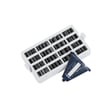
- Refrigerator air filter W10311524 (odor control and airflow freshness)
- Refrigerator water inlet valve WPW10238100 (water supply to icemaker and dispenser)
- Refrigerator ice maker assembly WPW10251076 (ice production)
- Evaporator motor 4389144 (circulates cold air through compartments)
| Concern | What you may notice | First check |
|---|---|---|
| Noise | humming, whirring, fan sound | door seals closed, airflow not blocked, fan area for ice buildup |
| Weak ice/water | slow fill, small cubes, no dispense | household water pressure, filter condition, inlet valve |
| Temperature swings | warm spots, freezer OK but fridge warm | vents blocked, evaporator fan operation, defrost issues |
Knowing the typical disadvantages helps you decide whether you are dealing with normal tradeoffs (like airflow noise) or a fixable problem (like a failing inlet valve or evaporator fan). That can prevent food spoilage and reduce repeat service calls.
Last updated: January 2026