Owner’s manual
 Error Codes


How many cubic feet is a LFX31945ST 00?
The LG LFX31945ST refrigerator is typically a 30.5 cubic foot unit. The “00” suffix is usually a revision/production code and does not normally change the cabinet’s overall capacity for this model family; confirm details in the LFX31945ST manual.
What to know about the “00” after the model number
On LG refrigerators, extra digits after the base model (such as “00”, “01”, “02”) often indicate a version, factory run, or minor design update.
Common differences can include:
- Handle style or trim pieces
- Control panel or user interface revisions
- Ice maker or dispenser component updates
- Internal bin/shelf configuration changes
- Part substitutions for service
Where capacity is defined (and why it matters)
Capacity is the total interior volume (fresh food plus freezer). It matters because it affects:
- How much food you can store
- How quickly the refrigerator recovers temperature after door openings
- Whether replacement shelves, bins, and drawers fit correctly
For model-specific labeling and features, we recommend checking the rating label and the specifications section in the LFX31945ST manual.
Quick reference: capacity vs. what it describes
| Spec | What it means | What it does not guarantee |
|---|---|---|
| Total cubic feet | Combined fresh food + freezer volume | Exact shelf/bin layout |
| Usable space | Practical storage room with shelves installed | Total advertised cubic feet |
| Model suffix (00/02) | Version identifier | Different cabinet size |
Related parts that do not affect cubic feet
If you are comparing versions because you are shopping parts, these common replacements will not change capacity:
- LG kenmore refrigerator water filter ADQ36006101
- LG refrigerator air filter ADQ73214408
- Door bins, gaskets, and drawer rails
Why it matters
Knowing the correct capacity helps you compare like-for-like models and avoid ordering storage parts that do not match your exact configuration.
Last updated: January 2026
Why is my LG refrigerator leaking from the bottom?
On LG model LFX31945ST, a leak from the bottom is most often caused by defrost water not draining correctly (water backs up and spills), or by a water-supply leak related to the ice maker or dispenser lines. We recommend checking the defrost drain path and the water inlet and tubing first; see the LFX31945ST manual for access and safety guidance.
Quick checks we recommend (start here)
- Look for ice or water under the crisper drawers; this often points to a defrost drain backup.
- Check the freezer floor for a sheet of ice; meltwater can overflow and run out the front.
- Inspect the water filter area for drips after dispensing.
- Pull the unit forward and look underneath for a wet drain pan or water trails.
- Check the ice maker fill area for splashing or a slow drip.
Most common causes and what to do
| What you see | Most likely cause | What we do next |
|---|---|---|
| Water inside fresh food section, then puddle at front | Defrost drain restricted or frozen | Thaw the drain area; flush with warm water; clear debris |
| Puddle near left/right front corner, worse after using dispenser | Water line or fitting leak | Inspect tubing connections; replace damaged tubing |
| Water appears near back/bottom, intermittent | Water inlet valve seeping | Check valve body and outlet ports for mineral tracks |
| Water only when ice maker is on | Ice maker fill leak or overfill | Inspect fill tube area and ice maker for cracks |
Parts that commonly relate to bottom leaks on this model
If you confirm the leak is from the water supply system, these model-compatible parts are common suspects:
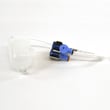
- Refrigerator water inlet valve AJU74532703 (controls water flow to ice maker/dispenser)
- Refrigerator water tubing MJU62070602 (carries water; can crack or leak at ends)
- Ice maker assembly AEQ73110205 (can leak at the mold or fill area)
Why it matters
A bottom leak can damage flooring and can also lead to ice buildup that blocks airflow, causing warm temperatures in the refrigerator or freezer. Fixing the source early helps prevent repeat leaks and cooling problems.
Safety notes before you troubleshoot
- Unplug the refrigerator before removing panels or working near wiring.
- Turn off the household water supply if you are inspecting valves, tubing, or the ice maker.
- Dry any standing water to prevent slipping.
Last updated: January 2026
What's the most common problem with LG refrigerators?
Cooling problems are the most common issue we see across LG refrigerators, including the LG LFX31945ST; symptoms include warm fresh-food and freezer temperatures, longer run times, and sometimes unusual fan or compressor noise. Many “not cooling” complaints trace back to airflow restrictions, dirty condenser areas, or a failing cooling-system component.
What to check first on LG LFX31945ST
Start with the basics before assuming a major sealed-system failure:
- Verify temperature settings; allow 24 hours after any change
- Make sure interior air vents are not blocked by food packages
- Clean dust from the condenser area; confirm the condenser fan runs when the compressor runs
- Check door gaskets for gaps, rips, or areas that do not seal
- Listen for the evaporator fan; weak or no airflow can cause uneven or warm temps
For model-specific access points, control locations, and operating checks, use the LFX31945ST manual.
Common causes (and model-matched parts to consider)
If basic checks do not restore cooling, these parts are commonly involved on bottom-mount designs like the LFX31945ST:
- Compressor not pumping or not starting reliably: refrigerator compressor TCA38091801
- Restricted heat rejection from a dirty or damaged condenser: refrigerator condenser coil ACG73645004
- Poor airflow from a fan issue (fresh-food cooling problems, noise, or warm temps): refrigerator damper motor EAU61524007
Quick symptom-to-likely-area guide
| What you notice | Most likely area to inspect | Why it matters |
|---|---|---|
| Fridge and freezer both warm | Compressor, condenser coil, condenser fan | System cannot remove heat effectively |
| Freezer cold, fridge warm | Damper/airflow path, evaporator fan | Cold air is not reaching fresh-food section |
| Clicking or repeated start attempts | Start components or compressor | Compressor may not be starting consistently |
| Temps fluctuate a lot | Airflow restrictions, sensor/control issues | Cooling cycles become unstable |
Why it matters
Cooling issues can lead to food spoilage quickly and can make the refrigerator run longer than normal, increasing energy use. Catching airflow and maintenance problems early often prevents more expensive repairs.
Last updated: January 2026