Owner’s manual
 Error Codes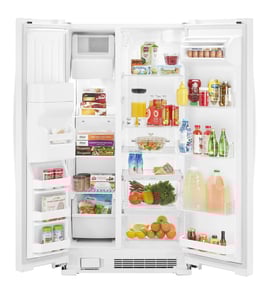



Are GE side by side refrigerators good?
GE side-by-side refrigerators like model GSE25HEMKHDS are a solid choice for everyday use because they typically deliver consistent cooling, easy access to both fresh and frozen foods, and convenient dispenser features. For the exact features and care guidance for your unit, use the GSE25HEMKHDS owner's manual.
What “good” usually means for a side-by-side
A good side-by-side refrigerator balances temperature stability, usable storage, and low-maintenance operation.
- Keeps freezer and fresh food temperatures steady with proper airflow
- Offers adjustable shelves and door bins for flexible storage
- Provides ice and water dispensing convenience (on equipped models)
- Uses LED lighting on many models for better visibility
- Runs efficiently when condenser area and door seals are kept clean
Common pros and tradeoffs
Side-by-side designs have predictable strengths and a few compromises.
| Category | Typical strength | Typical tradeoff |
|---|---|---|
| Organization | Easy access to freezer items at eye level | Narrower shelf width for large platters |
| Convenience | In-door ice and water on many models | Dispenser area can need periodic cleaning |
| Cooling | Good airflow when vents are clear | Performance drops if vents are blocked |
Quick checks that keep performance “good”
These steps prevent many cooling and dispenser complaints.
- Set temperatures to recommended settings in the GSE25HEMKHDS owner's manual
- Keep air vents inside both compartments unblocked
- Replace the water filter on schedule; a restricted filter can reduce water flow and ice production (use GE refrigerator water filter XWFE)
- If ice production is slow, confirm the icemaker is on and the supply line is fully open
- Clean spills and crumbs around the dispenser area to prevent sticking and odors
Why it matters
A side-by-side can seem “bad” when the real issue is maintenance: a clogged water filter, blocked vents, or dirty condenser area can cause warm temps, slow ice, and extra noise.
Last updated: January 2026
How wide is a 25.6 cubic foot refrigerator?
Most 25.6 cubic foot side-by-side refrigerators are about 36 inches wide. For the GE GSE25HEMKHDS, the installation dimensions shown in our documentation use a 36-inch cabinet width, and you should also plan for small side clearances for airflow and door swing; see the GSE25HEMKHDS owner’s manual.
Typical width you should plan for
Even when the cabinet is 36 inches wide, the space you need is usually a bit more than the cabinet width once you include clearances.
- Typical cabinet width: 36 inches
- Typical overall “space needed” width: about 36 1/4 inches (to allow side clearances)
- Door removal note: if an entrance is less than 38 inches wide, the doors typically need to be removed to move the refrigerator through
- Don’t forget door swing: handles and door swing can require extra room beyond the cabinet
Clearance quick guide (common for this GE platform)
The manual’s clearance guidance is a good planning baseline for this model family.
| Location | Typical clearance to allow | Why it matters |
|---|---|---|
| Sides | 1/8 inch each side | Air circulation, easier install |
| Top | 1 inch | Venting and fit under cabinets |
| Back | 1/2 inch to 1 inch | Plumbing and electrical space |
Why it matters
If the opening is too tight, the refrigerator can run warmer, doors may not open fully, and water line or power cord routing can get pinched. Planning for the cabinet width plus clearances helps prevent cooling and installation problems.
Related install tip for water and ice
If your GSE25HEMKHDS has a dispenser or ice maker, leave enough slack in the water line so you can pull the refrigerator out for cleaning and service. If you’re troubleshooting low water flow later, a restricted filter can also be a cause; the correct filter for this model is the GE refrigerator water filter XWFE.
Last updated: January 2026
Where is the thermostat on a GE side by side refrigerator?
On the GE GSE25HEMKHDS side-by-side refrigerator, the temperature control (often called the thermostat) is typically located in the fresh food compartment control area, commonly at the top of the refrigerator section or on the dispenser control panel, depending on the exact control style.
Where to look first on model GSE25HEMKHDS
Check these common locations in order:
- Inside the refrigerator (fresh food) compartment at the top, near the temperature control display/knobs
- On the dispenser control panel (if your model uses dispenser-based temperature controls)
- Behind the control housing cover in the fresh food section (the control board and sensor wiring are often routed here)
- Along the back wall air tower area (airflow components are there, but controls are usually not)
For the exact control layout and access steps for your configuration, use the GSE25HEMKHDS owner's manual.
Thermostat vs. sensor (what you are actually looking for)
Many GE side-by-side models regulate temperature using electronic controls and thermistors (temperature sensors) rather than a single mechanical thermostat.
| What it is | What it does | Where it’s usually found |
|---|---|---|
| Temperature control setting | Tells the refrigerator what temp to maintain | Top of fresh food section or dispenser panel |
| Temperature sensor (thermistor) | Reports actual temperature to the control board | Mounted to a liner wall, air duct, or clipped near airflow |
If you are troubleshooting temperature swings, a failed sensor is a common cause; the model-compatible option is the GE profile refrigerator temperature sensor WR55X10025.
Quick checks before replacing parts
- Make sure the control settings were not accidentally changed
- Confirm doors are closing fully and seals are making contact
- Avoid blocking air louvers in the air tower or air tunnel with food packages
- Give the unit 24 hours after any setting change to stabilize
- If you see an error code, use the GE refrigerator error codes reference to narrow the failure
Why it matters
Finding the correct control location helps you avoid removing the wrong panels and speeds up diagnosis. On electronic-control GE refrigerators, the “thermostat” function is shared between the control setting and one or more temperature sensors.
Last updated: January 2026
What is the most common problem with a GE refrigerator?
Cooling problems are the most common issue we see on GE refrigerators like model GSE25HEMKHDS. The root cause is often restricted airflow (dirty condenser coils, blocked vents), a defrost system problem that lets frost build up, or a failing fan that cannot move cold air.
Quick checks we recommend first
- Confirm the temperature controls are not set to OFF and are set to normal cooling ranges.
- Listen for normal operating sounds during defrost (sizzling, dripping, gurgling can be normal).
- Make sure the refrigerator is fully plugged into a properly grounded 3-prong outlet.
- Check that doors close and seal fully so warm air is not leaking in.
- Look for heavy frost on the freezer back wall (a strong clue of a defrost issue).
Common causes and what they usually look like
| Symptom | Most likely area | What you typically notice |
|---|---|---|
| Fresh food warm, freezer cold | Airflow/evaporator fan | Weak or no air from vents |
| Both sections warm | Condenser airflow or sealed system | Compressor runs a lot, poor cooling |
| Frost-packed freezer panel | Defrost system | Ice buildup, reduced airflow |
| Water dispenser slow | Water filter or inlet valve | Low flow, hollow ice cubes |
Parts that commonly relate to cooling complaints
If troubleshooting points to a specific failure, these model-compatible parts are often involved:
- Refrigerator evaporator fan motor WR60X10307 (moves cold air through the compartments)
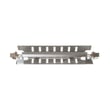
- Refrigerator defrost heater WR51X10055 (melts frost off the evaporator during defrost)
- GE profile refrigerator temperature sensor WR55X10025 (helps regulate temperatures)
Why it matters
A refrigerator that cannot maintain temperature can spoil food quickly and can also overwork the compressor. Catching airflow and defrost problems early often prevents bigger, more expensive failures.
Helpful GE troubleshooting resources
- GSE25HEMKHDS manual for model-specific troubleshooting steps and control settings
- GE refrigerator error codes if your display is showing a fault code
Last updated: January 2026