Owner’s manual

What's the average lifespan of a Genie garage door opener?
A Genie garage door opener like model ISD990 typically lasts 10 to 15 years. Lifespan depends most on daily cycles, door balance, and basic maintenance (tight hardware, correct force settings, and clear safety sensors). Use the ISD990 owner's manual for model-specific maintenance and adjustment guidance.
Typical lifespan by use and conditions
Most openers wear out from repeated load and vibration. These ranges are practical expectations for a residential opener:
| Use pattern | Typical lifespan | What shortens it fastest |
|---|---|---|
| Light use (1 to 4 cycles/day) | 12 to 15 years | Poor lubrication, loose fasteners |
| Average use (5 to 10 cycles/day) | 10 to 12 years | Door out of balance, binding travel |
| Heavy use (10+ cycles/day) | 7 to 10 years | Misadjusted force/limits, worn door hardware |
Signs your ISD990 is nearing end of life
Watch for these common symptoms before a complete failure:
- Door starts up but stops before fully open (often tied to force/limit settings or door balance)
- Motor runs but the door does not move (drive engagement issues)
- Noisy operation that persists after tightening fasteners and lubricating door hardware
- Lights or wall control behavior becomes inconsistent
- Safety sensor (Safe-T-Beam®) issues that prevent closing
For diagnostic direction, use Genie screw-drive error codes or Genie chain and belt-drive error codes (choose the one that matches your drive type).
Maintenance that extends opener life
These steps reduce strain on the motor and drive system:
- Confirm the door moves smoothly by hand and stays near-stationary when released halfway open
- Tighten mounting fasteners and hardware to reduce vibration noise
- Keep rollers, hinges, and springs properly lubricated (door hardware, not the safety sensors)
- Verify Safe-T-Beam® lenses are aligned and unobstructed
- Recheck open/close limits and force controls if the door reverses, stops, or struggles
Why it matters
A garage door that sticks, binds, or is out of balance forces the opener to work harder, which shortens motor and control board life. Keeping the door balanced and the safety sensors aligned improves reliability and helps the opener reach its full service life.
Last updated: February 2026
How do I sync my remote to my garage door opener?
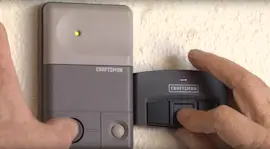
To sync a remote to your Genie ISD990 garage door opener, you program the remote into the opener’s receiver memory using the Learn button on the power head. Program each remote separately, then test operation from a safe distance with the door area clear.
Program a remote to the Genie ISD990
- Close the garage door and keep people clear of the opening.
- Locate the Learn Code button and Learn indicator light on the opener power head.
- Press the Learn button to enter programming mode (the indicator light turns on).
- With the remote at least 24 inches from the antenna wire, press the button you want to use for this opener.
- Watch for the indicator light behavior that confirms the code was stored.
- Repeat the same steps for each additional remote.
For the exact button locations and indicator-light behavior for your unit, follow the steps in the ISD990 owner's manual.
If it will not program or stops mid-program
- Keep the remote at least 24 inches from the opener antenna wire during programming.
- If the red Learn indicator light blinks rapidly (about 4 times per second), restart the programming steps.
- Program each remote separately (one at a time).
- On 2-button or 3-button remotes, use one button per opener (each button is intended for a different opener).
- Replace the remote battery if range is short or programming is inconsistent (this model uses an A23 12-volt battery).
Erase all remotes (receiver memory) and start over
If you want to clear everything and re-sync from scratch:
- Press and hold the Learn button on the power head for 10 seconds, or until the Learn indicator light goes out.
- Reprogram your remotes again, one at a time.
| Task | What you do | What to expect |
|---|---|---|
| Add a remote | Learn button, then press remote button | Indicator light confirms code stored |
| Add more remotes | Repeat the same steps | Each remote must be programmed separately |
| Clear all remotes | Hold Learn button 10 seconds | Memory erased; reprogram needed |
Why it matters
Correct programming ensures your remote talks to the opener reliably and helps prevent “no response” issues that are often caused by erased receiver memory, weak batteries, or programming too close to the antenna wire.
Last updated: February 2026
Why is my Genie garage door opener not working?
If your Genie ISD990 garage door opener is not working, start with power and the wall console lock switch, then check the Safe-T-Beam® safety sensors, remote battery, and door balance. The ISD990 status light blink pattern also points to the failed system.
Quick checks (most common fixes)
- Confirm the opener has power (outlet, plug, breaker).
- Check the wall console Vacation Lock switch; it must be UNLOCKED for normal operation.
- Replace the remote battery (A23 type is commonly used on Genie remotes).
- Inspect the Safe-T-Beam® lenses for dirt, sun glare, or misalignment; clear any obstruction.
- If the motor runs but the door does not move, make sure the magnetic carriage is engaged to the rail drive screw.
- If the door starts moving then stops, check that the door moves freely and is properly balanced.
Use the status light blink code to narrow it down
The ISD990 uses a status light blink pattern to indicate what is wrong. Use this as a fast “where to look first” guide (then follow the detailed steps in the owner's manual).
| Status light pattern | What it usually points to | What we do next |
|---|---|---|
| 1 blink (repeats) | Door condition or balance issue | Check for binding, worn rollers, or an out-of-balance door |
| 5 blinks (repeats) | Safe-T-Beam® malfunction | Clean/align sensors; check for sensor diagnostic codes |
| 6 blinks (repeats) | Wall console issue | Inspect wall console wiring; temporarily disconnect wall console to test |
| 7 blinks (repeats) | Limit switches not working | Inspect limit switch wiring; reset and recheck travel setup |
Reset the opener (recommended first step)
A reset is specifically called out for several fault conditions.
- Disconnect power to the opener.
- Wait 5 seconds.
- Restore power.
- Run one cycle from the wall console (the first cycle may run at slow speed).
Why it matters
When the door is out of balance or the safety sensors are blocked, the opener can stop, reverse, or refuse to close to prevent damage and reduce the risk of injury. Fixing the root cause also prevents repeated “false” faults and premature wear on the drive system.
Last updated: February 2026
How to do a hard reset on a garage door opener?
For the Genie ISD990 garage door opener, a hard reset is done by disconnecting power briefly, then restoring power and testing from the wall console. This clears a temporary control fault and the first run cycle may operate at a slower speed.
Hard reset steps (Genie ISD990)
- Disconnect power to the opener (unplug it or switch off the circuit).
- Wait 5 seconds.
- Restore power.
- Activate the opener from the wall console and observe operation.
For model-specific reset and troubleshooting details, follow the steps in the owner's manual.
If the wall console still does not respond
These checks address the most common causes after a reset (power, safety inputs, and door travel setup):
- Wait 10 minutes before doing anything else if the opener stopped responding after many cycles; the built-in timer/cycle counter needs time to reset (do not unplug during this wait).
- Confirm the opener has power (outlet, breaker, and any ceiling plug connection).
- Check the safety sensor alignment and wiring; a sensor issue can prevent closing.
- Verify the emergency release is re-engaged to the carriage so the opener can move the door.
- Recheck travel limits and force settings; incorrect limit switch or force adjustment can trigger faults.
What “hard reset” means on this model
On the ISD990, “reset” in the troubleshooting guidance refers to a power reset that restores normal controller operation.
| Reset type | What it does | When to use it |
|---|---|---|
| Power reset (hard reset) | Reboots the control system; first cycle may run slow | Opener is unresponsive or shows a fault condition |
| Timer/cycle counter reset | Automatically restores response after a cooldown | Opener stops responding after repeated cycles |
Why it matters
Resetting correctly helps you avoid chasing the wrong problem. If the ISD990 is overheated, has incorrect force settings, or detects a travel/limit issue, a proper reset plus limit/force verification can restore safe, consistent door operation.
For blink-code diagnostics that point you to the exact fault area, use Genie chain and belt-drive error codes.
Last updated: February 2026