Installation guide
 Owner’s manual
 Error Codes


How to identify a Kenmore washer model?
Your Kenmore washer model number is printed on the model and serial number label; on Kenmore model 11015962400, that label is located under the washer lid. Once you have the full model number, we can match the correct Kenmore parts and diagrams for your exact washer.
Check these common label locations in this order:
- Under the lid (lift the lid and look around the rim or underside area)
- Around the lid opening (top edge of the cabinet opening)
- Back panel (near the power cord entry or console area)
- Inside the cabinet (visible when the lid is open on some builds)
For the exact label location and how the model and serial are recorded, use the 11015962400 owner's manual.
For Kenmore washers in the 110 series, the model number typically starts with 110 and continues with additional digits.
| Item to record | Example format | Why it matters |
|---|---|---|
| Model number | 110XXXXXXXX | Ensures parts fit your washer |
| Serial number | Letters and numbers | Helps confirm production details |
| Purchase date | Month/day/year | Useful for service history |
- Copy the model number exactly as printed, including all digits.
- Take a clear photo of the label before ordering.
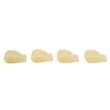
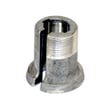
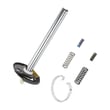
- Match parts by model number first, then confirm by part name (for example, agitator dog 80040 if you are fixing an agitator that will not move properly).
- If the label is worn, look for faint stamped characters and compare multiple locations.
Kenmore washers can look similar across many 110-series models, but internal components like the drive system, drain pump, and lid switch can vary. Using the exact model number helps us narrow to the correct diagrams and compatible replacement parts.
Last updated: February 2026
What is the average lifespan of a Kenmore washer?
A Kenmore washer typically lasts 10 to 15 years with normal household use. For Kenmore model 11015962400, correct installation (level floor, proper water pressure, and avoiding freezing conditions) and routine care help you reach the longer end of that range; see the 11015962400 owner's manual.
- Overloading or consistently washing heavy items can strain the drive system and suspension.
- Poor installation (unlevel floor, weak flooring) increases vibration and wear.
- Water quality and temperature; very hot water and harsh chemicals can accelerate hose and seal aging.
- Freezing exposure; water left inside can damage internal components.
- Skipped maintenance; residue buildup and small leaks shorten component life.
- Keep loads balanced so items move freely during washing.
- Use the right amount of detergent; too much can cause buildup.
- Wipe up bleach spills and never pour undiluted bleach directly on fabrics.
- If the washer will be in a cold area, winterize it per the 11015962400 installation guide.
- Address early symptoms (slow drain, burning smell, loud spin) before they become major failures.
| What you notice | Common cause | Typical fix type |
|---|---|---|
| Agitator moves poorly | Worn agitator dogs | Small part replacement |
| Won’t spin or agitates weakly | Drive coupling wear | Small to mid repair |
| Won’t drain | Drain pump issue or blockage | Mid repair |
| Loud grinding or oil leak | Gearcase wear | Major repair |
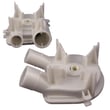
If your washer stops draining, a frequent replacement part is the washer drain pump WP3363394.
Knowing the typical 10 to 15 year lifespan helps you decide whether to repair or replace. On an older washer, replacing a high-wear part (like a coupling or drain pump) often restores performance, while major drive or gearcase issues can shift the value toward replacement.
Last updated: February 2026
How do I troubleshoot my 11015962400?
For Kenmore washer model 11015962400, we troubleshoot fastest by checking power, water supply, lid position, load balance, and drain hose setup first; these cause most “won’t start,” “won’t fill,” “won’t agitate/spin,” noise, and leak complaints. Use the owner's manual troubleshooting section for symptom-by-symptom checks.
- Confirm the power cord is plugged into a grounded 3-prong outlet; do not use an extension cord.
- Make sure the Cycle Control knob is aligned with a cycle; turn it slightly to the right and pull to start.
- Verify both hot and cold faucets are fully on; check inlet hoses for kinks.
- Close the lid fully; this washer will not agitate or spin with the lid open.
- Balance the load and level the washer; tighten front feet nuts and reset rear leveling legs.
- Check the drain hose: it must not be clogged, and the end must be 96 in. (244 cm) or less above the floor.
| Symptom | What to check first | What it usually means |
|---|---|---|
| Won’t fill/rinse/agitate | Water faucets on, inlet screens, hose kinks | Water supply restriction or control not started correctly |
| Won’t drain/spin | Lid closed, drain hose height/clog | Drain restriction or lid safety issue |
| Noisy | Load balance, washer level | Normal gear engagement noises or out-of-level cabinet |
| Leaking | Fill hoses tight, hose washers seated, drain hose clamp | Loose connection or drain setup issue |
| Cycle seems stuck | Normal pause (about 2 minutes on some cycles) | Built-in pause/soak period |
If the basic checks pass and the symptom repeats, these model-matched parts are common suspects:
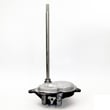
- No spin or no agitation with lid closed: washer lid switch WP8054980
- Won’t drain or drains poorly: washer drain pump WP3363394
- Agitates weakly or “clicks” and clothes do not move: agitator dog 80040
Correct leveling, proper drain hose height, and a closed lid prevent out-of-balance spinning, long drain times, and nuisance stops; that protects the drive system, reduces leaks, and improves wash performance.
Last updated: March 2026