Owner’s manual
 Error Codes


Are bottom mount fridges better?
Yes for most households, a bottom-mount design is better because it puts the fresh-food section at eye and waist level, so you reach less for everyday items. On the GE PFE28KSKGSS bottom-mount refrigerator, that layout typically improves convenience without changing basic cooling performance.
What “better” usually means in day-to-day use
- More ergonomic access to produce, milk, and leftovers in the refrigerator compartment
- Less bending compared with top-freezer models
- Better organization for frozen foods using pull-out baskets and drawers
- More door openings focused on fresh food, which many households use most
- Good fit for meal prep and cooking because fresh ingredients are easiest to reach
Tradeoffs to consider before you choose
Bottom-mount refrigerators are a strong all-around choice, but they are not automatically best for everyone.
- Freezer access: you bend more to reach the freezer drawers
- Freezer capacity feel: drawers can make bulky items harder to stack
- Cleaning and moving: you may need to pull the unit out for deep cleaning; raise and lower the leveling legs as described in the owner's manual
- Sound differences: modern compressors and airflow can sound different than older fridges (hums, whooshes)
Quick comparison
| Layout | Best for | Main downside |
|---|---|---|
| Bottom-mount (bottom freezer) | Everyday fresh-food use, ergonomic access | Bending for freezer items |
| Top-freezer | Budget-friendly, simple storage | Bending for fresh-food items |
| Side-by-side | Narrow door swing, easy freezer access | Narrow shelves for wide items |
Why it matters
Most people open the refrigerator section far more than the freezer. A bottom-mount refrigerator keeps the most-used shelves at a comfortable height, which reduces strain and makes it easier to see and rotate food.
Parts and help for this model
For GE PFE28KSKGSS parts and diagrams, start with the model parts list; for broader model searches and ordering, use Sears PartsDirect.
Last updated: February 2026
What are the disadvantages of a bottom freezer refrigerator?
Bottom-freezer refrigerators like the GE PFE28KSKGSS keep fresh food at eye level, but the tradeoffs are mostly about freezer access and service complexity: you bend more to reach frozen items, heavy drawers can be awkward, and drain or defrost-related issues can be more involved than on simpler layouts. For model-specific use and care details, use the owner's manual.
Common disadvantages you may notice day to day
- More bending for freezer use: the freezer is low, so frequent access means more crouching.
- Heavier lifting: large baskets and bins can get heavy when fully loaded.
- Deep-drawer organization: items can stack and get buried, especially in lower baskets.
- Higher purchase price (typical): many bottom-freezer designs cost more than basic top-freezer models.
- More parts in the freezer door system: slides, rails, and door hardware add wear points over time.
Service and maintenance downsides (what we see most)
Bottom-freezer designs often route airflow and drainage through the lower section, so when something goes wrong it can show up as water, frost, or door-closing issues.
- Water or ice buildup from a restricted drain path
- Frost patterns that affect drawer movement or sealing
- Door alignment or closing effort issues due to heavy door and slide mechanisms
Quick comparison: bottom freezer vs top freezer
| Feature | Bottom freezer | Top freezer |
|---|---|---|
| Fresh food access | Easier (eye level) | More bending |
| Freezer access | More bending | Easier |
| Organization | Deep drawers, can bury items | Shelves, easier visibility |
| Hardware complexity | More slides and door mechanisms | Typically simpler |
Why it matters
If your household uses the freezer many times per day, the bending and drawer-lifting can be the biggest “real world” downside. If you use fresh food more often, the eye-level refrigerator section can outweigh those drawbacks.
Tips to reduce the downsides
- Put everyday frozen items in the upper basket for easier reach.
- Use bins to group foods (breakfast, snacks, meats) to prevent “buried” items.
- Avoid overloading drawers; it reduces glide life and makes access harder.
- Keep doors sealing and aligned to prevent frost and moisture problems.
- If the door alarm becomes a frequent annoyance, follow how to reset the door alarm on a GE refrigerator.
If you need diagrams or want to look up replacement components by model number, we list parts for GE PFE28KSKGSS, and you can also search by model on Sears PartsDirect.
Last updated: February 2026
Is GE Cafe considered high end?
Yes. GE Café is considered a high-end, “attainable luxury” line within the GE family, positioned above standard GE and GE Profile in styling and premium features, but typically below GE Monogram’s true luxury tier. For warranty and feature details that apply to Café models, use the PFE28KSKGSS owner's manual.
Where GE Café fits in the GE lineup
GE’s refrigerator families generally stack up like this:
| GE line | Typical positioning | What you usually get |
|---|---|---|
| GE (standard) | Mainstream | Core features, value-focused |
| GE Profile | Premium | More features, upgraded design |
| GE Café | High-end (attainable luxury) | Pro-style look, design customization, premium features |
| GE Monogram | Luxury | Built-in style options, top-tier fit and finish |
What “high end” means in real-world terms
When customers call Café “high end,” they usually mean:
- Premium exterior styling and a designer look
- Pro-style handles and coordinated hardware options
- Feature-rich controls (depending on model and configuration)
- Higher price point compared to standard GE and many Profile models
- Aimed at kitchens where appearance and features matter as much as basic cooling
Model-specific note for GE Café refrigerators
Some GE Café models include enhanced warranty coverage compared with non-Café models. For example, the documentation for this refrigerator platform references “GE PROFILE and GE CAFÉ models only” coverage for certain sealed system components. Check the warranty section in the PFE28KSKGSS owner's manual for the exact terms that apply to your unit.
Why it matters
Knowing the product tier helps set expectations for features, finish, and long-term ownership costs. It also helps when comparing replacement parts, filters, and accessories by model number.
If you are shopping parts by model, start with the parts list for GE PFE28KSKGSS, or search by model number on Sears PartsDirect.
Last updated: February 2026
What is the most common problem with GE profile refrigerators?
On GE Profile refrigerators like model PFE28KSKGSS, the most common customer complaints involve the ice maker and water dispenser (no ice, slow water, leaks) and cooling or temperature problems (warm fresh food section, frost, or uneven temps). Our PFE28KSKGSS owner's manual helps you match symptoms to the right checks.
Most common symptoms we see
- Ice maker not making ice or making small/hollow cubes
- Water dispenser flow is slow or stops
- Water leaking in the fresh food section or under the refrigerator
- Refrigerator section too warm while freezer seems OK
- Door alarm beeping because a door is not closing or sealing fully
Quick checks that solve many calls
- Confirm doors are sealing and closing: A slightly open door can trigger alarms and cause temperature swings.
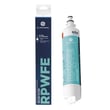
- Check the water filter: A restricted filter reduces dispenser flow and can affect ice production; this model uses the RPWFE water filter cartridge.
- Verify airflow is not blocked: Keep packages away from air vents in the refrigerator and freezer.
- Clean condenser coils (if accessible): Dust buildup reduces cooling performance.
- Listen for fan clues: Unusual fan noise or warming often points to an evaporator fan or airflow issue.
Symptom-to-cause guide (fast triage)
| Symptom | Most likely area | What to do first |
|---|---|---|
| Slow water at dispenser | RPWFE water filter, supply valve | Replace RPWFE; confirm household shutoff valve is fully open |
| No ice | Filter, fill system, ice maker | Replace RPWFE; confirm freezer temp setting; check for a frozen fill tube |
| Warm refrigerator | Airflow, coils, fans | Check vents, clean coils, listen for evaporator fan |
| Door alarm keeps sounding | Door alignment, gasket, bin interference | Inspect gasket and door closure; use the alarm reset steps |
Why it matters
Ice and water issues often start with restricted water flow (commonly the RPWFE filter) or a door that is not sealing. Cooling complaints frequently trace back to airflow and heat removal (coils and fans), which are maintenance-sensitive on bottom-mount designs.
Helpful DIY resources
- How to reset the door alarm on a GE refrigerator
- GE refrigerator error codes
- How to replace the water filter in a GE refrigerator
For model-based diagrams and replacement items, use the parts list for PFE28KSKGSS or search by model on Sears PartsDirect.
Last updated: February 2026