Owner’s manual


Where is the model number on the Kenmore Elite dryer?
On the Kenmore Elite dryer model 79681029900, the model and serial number are printed on an identification plate inside the dryer door opening. Open the door and look along the inner door frame area for the label; it is meant to be easy to find when you need service or parts.
Where to look first
- Open the dryer door fully and use a flashlight
- Check the cabinet frame just inside the door opening
- Look along the upper portion of the opening, then the side areas
- Wipe dust off the label gently so the numbers are readable
- Record both the model and serial number for future reference
What the label typically includes
| Item on the label | What it’s used for |
|---|---|
| Model number (79681029900) | Matching the correct Kenmore Elite dryer parts and diagrams |
| Serial number | Identifying the production run for service and support |
| Rating information | Electrical or gas requirements reference |
Why it matters
We use the model number to match the exact configuration of your Elite dryer so you get the right parts the first time (for example, a belt, thermostat, or control board that fits your specific build).
Helpful next step
If you are ordering parts or checking specs, keep the label info with your paperwork and use the 79681029900 owner’s manual for model-specific details.
Last updated: February 2026
How do I know if my Kenmore dryer thermal fuse is blown?
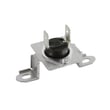
If your Kenmore Elite dryer model 79681029900 won’t start at all or runs but won’t heat, a blown thermal fuse is a top suspect. The sure way to know is a continuity test with a multimeter after unplugging the dryer; a good fuse shows continuity, a blown fuse does not.
Quick symptoms checklist
- Dryer will not turn on (no motor run)
- Dryer tumbles but there is no heat
- Cycle seems normal but clothes stay damp
- Vent indicator may blink if airflow is restricted (airflow problems often lead to overheating)
- Drying times get longer before the failure happens
How we test a dryer thermal fuse (safe, accurate method)
- Unplug the dryer (or switch off the breaker).
- Access the thermal fuse location shown in the 79681029900 owner’s manual.
- Remove at least one wire from the fuse terminal.
- Set a multimeter to continuity or lowest ohms.
- Test across the fuse terminals.
What the meter reading means
| Meter result | What it means | What to do next |
|---|---|---|
| Continuity (near 0 ohms or beep) | Fuse is good | Keep troubleshooting heat/airflow/controls |
| No continuity (open circuit) | Fuse is blown | Replace the fuse and correct the overheating cause |
Fix the root cause: airflow restriction
A thermal fuse usually blows because the dryer overheated, and restricted venting is the most common reason. Your manual calls out that vent ductwork should be checked for lint buildup and cleaned at least once per year, and to check ductwork for obstructions when drying performance drops.
- Clean the lint screen before every load
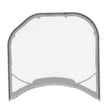
- Inspect and clean the lint screen housing and chute
- Check the entire vent run for lint buildup, crushed flex duct, or too many turns
- Confirm the outside damper opens freely
- Re-test drying performance after cleaning (exhaust should feel strongly warm on heat cycles)
Related parts that often get involved
If you’re also seeing long dry times or weak airflow, these model-matched parts are commonly inspected during service:
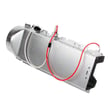
- Dryer heating element 5301EL1001J (electric heat issues)
- Dryer thermistor AGM30045804 (temperature sensing)
- Dryer high-limit thermostat 6931EL3003D (overheat protection)
Why it matters
The thermal fuse is a one-time safety device; replacing it without fixing venting or overheating can lead to repeat failures, longer dry times, and higher energy use.
Last updated: February 2026
How do I reset my Kenmore Elite dryer?
To reset your Kenmore Elite 79681029900 dryer, we recommend a hard reset first: unplug the dryer (or switch off the breaker) for 5 minutes, then restore power and try a cycle. If you see “CL”, turn off Control Lock by pressing and holding Control Lock for 5 seconds.
Quick reset options (what to try first)
- Hard reset: unplug for 5 minutes, then plug back in.
- Control Lock reset (CL on display): press and hold Control Lock for 5 seconds.
- Cycle restart: press START/PAUSE to begin; open the door or press START/PAUSE to pause.
- Avoid losing settings: if the dryer is paused/stopped for more than 4 minutes, it shuts off and cycle settings are lost.
- If it still acts up: check airflow and lint buildup; restricted venting can trigger performance issues.
What “reset” fixes (and what it does not)
A reset clears temporary control glitches and restores normal operation after a pause, lockout, or power interruption. It does not fix a failed heating circuit, motor problem, or airflow restriction.
| Symptom | Best “reset” step | Next check if it returns |
|---|---|---|
| Display shows CL | Hold Control Lock 5 seconds | Confirm buttons respond normally |
| Dryer won’t start after a pause | Press START/PAUSE | Door fully closed, power supply OK |
| Dryer shuts off and settings disappear | Restart cycle | Avoid stopping longer than 4 minutes |
When to check parts instead of resetting
If the dryer tumbles but has heat or drying problems after a reset, we move to common wear items and temperature sensing.
- For no heat or overheating symptoms, inspect heating and safety controls such as the dryer heating element 5301EL1001J and thermostats.
- For long dry times, confirm strong airflow and a clean lint path (lint screen, housing, and vent duct).
- For unusual noises or poor tumbling, check drum drive components.
Why it matters
Resetting the control and unlocking Control Lock gets you back to drying quickly, and it helps you separate a simple control issue from problems like restricted venting, failed thermostats, or a heating element fault.
For control and display behavior details specific to this model, follow the steps in the 79681029900 owner’s manual.
Last updated: February 2026
How much does it cost to replace a heating element in a Kenmore dryer?
For the Kenmore Elite dryer model 79681029900, replacing the heating element typically costs about $250 to $600 total: roughly $150 to $350 for the part plus $100 to $250 for labor, depending on service rates and whether additional thermostats or wiring repairs are needed. Use the 79681029900 owner's manual to confirm your dryer is an electric model and to follow the correct safety steps.
Typical cost breakdown (parts vs. labor)
Most of the total cost comes down to whether you DIY or hire a technician, and whether you replace only the element or a larger heater assembly.
- Heating element part: commonly $150 to $350 for this model class
- Service call and labor: commonly $100 to $250
- Extra parts sometimes replaced together: high-limit thermostat, blower thermostat, wiring terminals
- Vent cleaning (if needed): may be added to the visit
| Replacement approach | What you pay for | Typical total cost |
|---|---|---|
| DIY element replacement | Part only | $150 to $350 |
| Pro replacement | Part + labor | $250 to $600 |
| Pro repair with airflow fixes | Part + labor + vent service | $300 to $700 |
What to check before buying a heating element
A dryer that will not heat is not always a failed element. We recommend these quick checks first:
- Confirm the dryer is on a 240 VAC supply (electric dryers can run but not heat on a partial power loss)
- Check for restricted venting (lint buildup can cause overheating and repeated thermostat failures)
- Look for a burning smell or visible damage at wire terminals near the heater
- If the drum turns but heat is weak, consider temperature-sensing parts like the thermistor
If you already know the heater is open or damaged, the correct replacement for this model is the dryer heating element 5301EL1001J.
Why it matters
A weak or failed heating system increases dry times and can overheat the dryer when airflow is restricted. The manual also notes the dryer must be on a dedicated 240 VAC, 60 Hz circuit and warns against connecting to 110/115/120 volts, which helps prevent repeat failures after a repair.
Last updated: February 2026
Why is my Kenmore dryer drum not spinning?
If the drum in your Kenmore Elite dryer model 79681029900 isn’t spinning, the most common causes are a broken or slipped drum belt, a seized idler pulley or support roller, or a failed drive motor. Start with a quick safety check and then inspect the belt-drive parts.
Quick checks first (safe and fast)
- Unplug the dryer before opening any panels; do not reach into the drum if anything is moving.
- Confirm the door fully closes; a failed door switch can prevent operation.
- Try turning the drum by hand (with power off):
- Turns very freely: belt may be broken or off the pulley.
- Hard to turn or scraping: roller, drum seal, or a foreign object may be binding.
- If the dryer runs but the drum does not, stop using it until the belt-drive parts are inspected.
Parts that most often stop the drum from turning
For model 79681029900, these are the highest-likelihood mechanical causes:
| Symptom | Most likely part | What you typically notice |
|---|---|---|
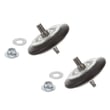
| Motor runs, drum doesn’t move | Dryer drum belt 4400EL2001F | Drum stays still; belt may be snapped or off-track |
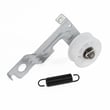
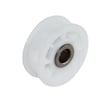
| Squealing, thumping, or drum binds | Dryer idler pulley 4560EL3001A or drum rollers | Noise, intermittent stopping, heavy drag when turning by hand |
| Hums, trips, or won’t start under load | Drive motor or blower bind | Humming, breaker trip, or stops shortly after start |
What to do next (recommended order)
- Follow the access and disassembly steps in the 79681029900 owner’s manual.
- Inspect the belt for cracks, glazing, stretching, or a clean break.
- Spin the idler pulley and support rollers by hand; replace any that feel rough, wobbly, or seized.
- Check for lint buildup or an object rubbing the drum; also inspect the rear drum seal if you hear scraping.
- If the belt system is good, move to electrical checks (door switch, motor, and safety devices) using the manual’s guidance.
Why it matters
A slipping belt or seized pulley/roller can overwork the motor and create excessive heat and wear. Fixing the belt-drive issue early helps prevent bigger repairs and keeps drying performance consistent.
Last updated: February 2026
What are the codes for Kenmore Elite dryer?
Kenmore Elite dryer error codes are the display messages your Kenmore Elite model 79681029900 uses to point to a specific problem area, such as a power interruption (PF), a control issue (F:01, F:02), a heater relay problem (F:20), or temperature-sensing faults (TE1, TE2). For model-specific operating details, use the 79681029900 owner's manual.
Common Kenmore Elite dryer codes and what they mean
Here are the most common codes customers see on Kenmore Elite dryers, including this 796-series platform:
- PF: Power failure or power interruption during a cycle
- F:01: Main electronic control board problem
- F:02: Keypad or user interface problem
- F:20: Heater relay problem (heating circuit control)
- F:22 / F:23: Outlet thermistor (temperature sensor) fault
- F:24 / F:25: Inlet thermistor (temperature sensor) fault
- TE1 / TE2: Temperature sensing failure (the manual directs turning the dryer off and calling for service)
What to do first when an error code appears
We recommend these quick checks before replacing parts:
- Reset power: Unplug the dryer (or switch the breaker off) for 1 minute, then restore power.
- Confirm correct power supply: A dryer can sometimes run but not heat if a breaker is tripped on one leg.
- Check airflow: Clean the lint filter and make sure the vent duct is not crushed or clogged.
- Run a timed cycle: Try a short Timed Dry cycle to see if the code returns consistently.
- Document the code: Write down the exact code and when it appears (start of cycle, during heat, end of cycle).
Parts that commonly relate to heating and sensor codes
If troubleshooting points to heat or temperature sensing, these model-matched parts are often involved:
| Symptom or code family | Commonly related part | Example for this model |
|---|---|---|
| No heat, heat shuts off, overheating | High-limit thermostat | Dryer high-limit thermostat 6931EL3003D |
| Thermistor-related codes (F:22-F:25) | Thermistor | Dryer thermistor AGM30045804 |
| Heater relay or heating performance issues | Heating element (electric models) | Dryer heating element 5301EL1001J |
Why it matters
Using the code narrows the problem to a system (power, controls, heating, or temperature sensing). That saves time and helps you avoid replacing good parts, especially on higher-cost items like a control board or heater assembly.
Last updated: February 2026