Owner’s manual
 Error Codes


How to move a Jenn-Air refrigerator?
To move a Jenn-Air JFD2589KEP bottom-mount refrigerator safely, we unplug it, secure shelves and drawers, tape the doors shut, and use an appliance dolly while keeping the unit upright. For stability and easier rolling, adjust the front screws and stabilizing legs as described in the JFD2589KEP owner's manual.
- Unplug the power cord.
- If the refrigerator has a water supply line, shut off the water and confirm the connection is dry and secure.
- Tape shelves and drawers in place so they cannot slide and crack.
- Tape the doors shut to prevent hinge damage.
- Protect vinyl or other flooring with cardboard, rugs, or another protective layer.
- Use an appliance dolly; keep the refrigerator upright during the move.
Many bottom-mount refrigerators use front adjustment screws and stabilizing legs to level the cabinet and reduce rocking. When you are ready to move it, you typically back off the stabilizing legs so the unit can roll, then re-level it after placement.
| Adjustment | What it does | When to use it |
|---|---|---|
| Front adjustment screws | Raises or lowers the front of the cabinet | Before moving (to help it roll) and after moving (to level) |
| Rear adjustment screws (if equipped) | Raises or lowers the rear of the cabinet | After moving, to level front-to-back |
| Stabilizing legs | Locks the refrigerator firmly to the floor | After moving, to prevent rocking |
- Truck the refrigerator from its side or back, never from its front.
- Move slowly over thresholds; keep the dolly straps tight.
- After placement, re-level the cabinet so the front is slightly higher than the back (this helps doors close properly).
Moving a refrigerator without securing internal parts or supporting it correctly can crack shelves, damage door alignment, and cause leaks at the water connection. Keeping the unit upright and re-leveling it protects cooling performance and door sealing.
Last updated: January 2026
How tall is a Jenn-Air fridge?
Jenn-Air refrigerator height depends on the exact model and door style. For the Jenn-Air JFD2589KEP bottom-mount (French door) refrigerator, the exact cabinet height is listed in the installation and dimensions section of the JFD2589KEP owner's manual. Most 36-inch French door refrigerators are roughly 68 to 71 inches tall without hinges and handles.
Refrigerator height varies most by hinge design, leveling legs, and whether you measure to the top of the hinge.
- Cabinet only (no hinge): commonly 68 to 71 inches
- To top of hinge: often 69 to 72 inches
- With leveling legs adjusted: can change about 1/2 to 1 inch
- With door handles: usually affects depth more than height
Use a tape measure and decide which “height” you need for your opening.
- Measure from the floor to the top of the cabinet.
- Measure from the floor to the top of the hinge (often the limiting point).
- Confirm the refrigerator is properly leveled; the manual notes the front is set slightly higher than the back during leveling.
- Compare your measurement to the cabinet opening, leaving clearance for airflow.
| Measurement you need | What it includes | Best for |
|---|---|---|
| Cabinet height | Box only | Tight overhead cabinets |
| Height to hinge | Hinge cover and hinge | Most accurate “will it fit” check |
| Installed height | Leveling legs adjustment | Final in-place clearance |
If you size only to cabinet height, the hinge area can still hit an overhead cabinet or trim. Measuring both cabinet and hinge height helps prevent fit issues and avoids door alignment problems after leveling.
Last updated: January 2026
What are common problems with Jenn-Air refrigerators?
Common problems we see on the Jenn-Air JFD2589KEP bottom-mount refrigerator include warm temperatures (freezer cold but fresh food warm), water leaks or droplets, odors, and ice maker issues. Most causes trace back to airflow restrictions, dirty condenser coils, door sealing problems, or a failed cooling or ice-making component; the owner's manual troubleshooting chart helps narrow it down fast.
- Fridge warm, freezer OK: blocked rear air grille, damper issue, or evaporator fan problem
- Both sections warm: dirty condenser coils, control settings off, or a start/compressor problem
- Water droplets on the outside: high humidity or door gasket not sealing
- Bad odors: spills, spoiled food, or a dirty compartment
- Ice maker not working: ice maker assembly issue, water supply restriction, or temperature too warm
- Confirm the unit is powered and controls are turned on (the manual notes power, control, and breaker checks).
- Check for blocked vents and overcrowding; the manual notes overcrowding reduces air circulation and makes the refrigerator run longer.
- Clean condenser coils; the manual lists dirty coils as a cause of food temperatures being too warm or too cold.
- Inspect door closing and gasket seal; the manual calls out poor door closing and gasket sealing as common contributors.
- If the compressor is not running but lights are on, allow for defrost mode; the manual notes waiting about 40 minutes to see if it restarts.
| Symptom | Common part area | Example part for this model |
|---|---|---|
| Fridge warm, airflow weak | Damper or evaporator fan | Refrigerator electronic damper WPW10196393 |
| Noisy or poor airflow | Evaporator fan motor/blade | Evaporator motor WPW10128551 |
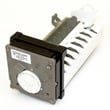
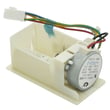
| Ice maker not producing ice | Ice maker assembly | Refrigerator ice maker D7824706Q |
| Sweating, warm spots, poor seal | Door gasket | Refrigerator door gasket W11368721 |
Catching airflow and coil issues early helps the JFD2589KEP hold safe food temperatures, reduces run time, and prevents secondary problems like frost buildup, leaks, and premature compressor wear.
Last updated: January 2026
Why is the internal water dispenser not working on my Jenn-Air refrigerator?
If the internal water dispenser in your Jenn-Air JFD2589KEP is not working, the most common causes are air trapped after a filter change, a clogged or frozen filter system, or a closed or kinked household water supply line. Start by flushing the dispenser for 2 minutes.
- Hold a container under the spout and press the dispenser pad firmly.
- If you recently changed the filter, run water continuously for 2 minutes until flow is steady.
- Make sure the shutoff valve is fully open and the supply line behind the refrigerator is not kinked.
- If the refrigerator sat unused for months, dispense 2 to 3 glasses to flush the system.
- If the filtration system froze, replace the filter cartridge.
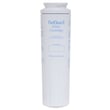
On the JFD2589KEP, the water filter is in the upper right-hand corner of the fresh food compartment. If it is not fully seated, it can block water flow.
- Reinstall the filter: insert into the filter head and rotate gently clockwise until it stops, then close the cover.
- After installing a new filter, allow a 1 to 2 minute delay while the internal tank fills.
- If you are troubleshooting without a filter installed, use the correct bypass.
Helpful parts:
| What you see | Most likely cause | What we do next |
|---|---|---|
| No water right after filter change | Air trapped | Flush 2 minutes |
| Slow flow | Clogged filter or low supply | Replace filter, verify valve |
| No water and ice maker also dry | Supply restriction | Check kinks, shutoff valve |
A restricted water path can also reduce ice production and cause sputtering. Correct filter installation and flushing helps protect the dispenser system and restores steady flow.
For model-specific dispenser steps and filter handling cautions, use the JFD2589KEP owner's manual.
Last updated: January 2026