Installation guide
 Owner’s manual
 Error Codes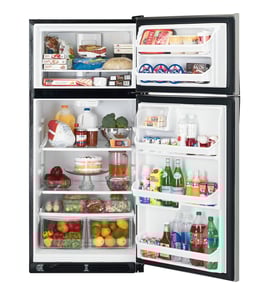




What are the disadvantages of a top mount fridge?
Top-mount refrigerators like the Frigidaire FFHT1817LSB are usually affordable and reliable, but the main disadvantages are convenience and organization: fresh-food items sit lower (more bending), freezer access is higher, and many top-mount designs offer fewer premium features than bottom-freezer models.
Common drawbacks you may notice
- More bending for daily items: the refrigerator compartment is below the freezer, so produce, drinks, and leftovers often sit lower.
- Less flexible organization: many top-mount layouts have fewer adjustable storage options than higher-end styles.
- Fewer built-in features: water and ice dispensers are less common on basic top-mount models.
- Door-seal sensitivity: if doors are not level or seals do not close evenly, you can get temperature swings, moisture, or frost.
- Tighter installation requirements: top-mount units still need proper clearances and leveling for good airflow and door closing.
What to check on your FFHT1817LSB to reduce the downsides
We recommend using the setup and leveling steps in the FFHT1817LSB installation guide to make the refrigerator easier to live with day to day.
- Level the cabinet side-to-side and keep a slight tilt back so doors close on their own.
- Confirm the door seals contact the cabinet on all sides.
- Keep the toe grille unblocked for airflow.
- Allow typical clearances (sides/top and back) so the compressor can cool properly.
- After changing temperature controls, wait about 24 hours before adjusting again.
Quick comparison: top-mount vs bottom-freezer
| Feature | Top-mount (like FFHT1817LSB) | Bottom-freezer |
|---|---|---|
| Fresh-food access | Lower, more bending | Higher, easier access |
| Freezer access | Higher, easier reach | Lower, often drawers |
| Organization | Often simpler | Often more flexible |
| Premium features | Less common | More common |
Why it matters
Most “top-mount complaints” come down to ergonomics and setup. When the refrigerator is properly leveled and the door seals close tightly, you get steadier temperatures, less frost risk, and better efficiency.
Last updated: January 2026
Which is better, top mount or bottom mount refrigerator?
A top-mount refrigerator like the Frigidaire FFHT1817LSB is usually the better pick if you want lower upfront cost, strong reliability, and efficient everyday cooling. A bottom-mount is usually better if you want fresh-food items at eye level and easier access to the refrigerator section.
Quick comparison (what most homeowners notice)
| Feature | Top-mount (freezer on top) | Bottom-mount (freezer on bottom) |
|---|---|---|
| Fresh-food access | Requires more bending | More eye-level access |
| Freezer access | Easier to reach | Often pull-out drawer |
| Cost | Typically lower | Typically higher |
| Repairs | Often simpler layouts | More complex drawer/rail systems |
| Energy use | Often very efficient | Varies by design |
When a top-mount is the better choice
- You want a straightforward, proven layout with fewer complex moving parts.
- You use the freezer often and want it at a comfortable height.
- You want a refrigerator that is easier to place and level in tight kitchens.
- You prefer simpler door swing options (some models allow reversal by moving hinges).
- You want strong value for the price.
For model-specific setup details like clearances, leveling, and door swing guidance, follow the FFHT1817LSB owner's manual.
When a bottom-mount is the better choice
- You use the refrigerator section more than the freezer.
- You want less bending for produce, drinks, and leftovers.
- You like wide refrigerator shelves and more “grab-and-go” organization.
- You prefer a pull-out freezer drawer for frozen foods.
Installation and kitchen-fit considerations
Even if you choose based on layout, fit and airflow matter just as much for performance. For the FFHT1817LSB installation basics, we recommend:
- Leave proper air space around the cabinet (sides/top and back clearances).
- Level the refrigerator so doors close smoothly.
- Keep the toe grille unblocked for airflow.
- If you are not connecting water right away, keep the ice maker turned OFF.
Use the FFHT1817LSB installation guide for the exact clearance and leveling steps for this model.
Why it matters
Choosing the “better” style is really about matching the layout to how you cook and shop. The right configuration reduces door-open time, improves temperature stability, and helps prevent issues like warm spots, excess frost, and food spoilage.
Last updated: January 2026
Why is my Frigidaire top mount freezer not freezing?
If your Frigidaire FFHT1817LSB top-mount freezer is not freezing, the most common causes are incorrect temperature control settings, blocked air vents, dirty condenser coils, or an evaporator fan problem that stops cold air from circulating. Use the FFHT1817LSB owner's manual to confirm control locations and the correct adjustment method.
Quick checks we recommend first
- Make sure the refrigerator/freezer control is not set to “0” (that stops the compressor and cooling).
- Adjust temperatures gradually; move the knob in small increments and allow 24 hours to stabilize.
- Confirm food packages are not blocking cold air vents in the freezer or fresh-food section.
- Check door closure and gasket contact; warm air leaks quickly reduce freezing performance.
- Listen for the evaporator fan; it should run to circulate air between compartments.
Temperature settings and airflow basics (how this model behaves)
On FFHT1817LSB, the refrigerator/freezer control affects both compartments. Many units also have an auxiliary freezer control; it helps fine-tune freezer temperature but does not shut power off.
| What you change | What it affects | What to expect |
|---|---|---|
| Refrigerator/freezer control | Freezer and refrigerator temps | Biggest impact on freezing |
| Auxiliary freezer control (if equipped) | Freezer temp balance | Smaller adjustments |
| Air vent blockage | Air circulation | Can cause warm freezer even if compressor runs |
When to suspect a fan or defrost problem
If the freezer is warm and you also notice poor airflow or unusual frost patterns, focus on the evaporator area.
- If the fan is noisy, broken, or not moving air, inspect the refrigerator evaporator fan blade 5308000010.
- If the freezer back wall is heavily frosted and airflow is weak, a defrost system issue is likely; the refrigerator defrost heater 242044008 is one common component involved.
Why it matters
A top-mount refrigerator cools the fresh-food section by moving freezer air through vents. When controls are off, vents are blocked, coils are dirty, or the evaporator fan cannot circulate air, the freezer temperature rises first and food safety is affected.
Last updated: January 2026
What is the most common problem with a Frigidaire refrigerator?
Cooling complaints are the most common issue we see on Frigidaire refrigerators, including model FFHT1817LSB. Most “not cooling” calls come down to restricted airflow, a defrost-related ice buildup, or doors that are not sealing tightly, all of which prevent cold air from circulating correctly.
Quick checks that fix many “not cooling” calls
- Make sure the temperature controls are not set to “0” (that stops cooling but still leaves power to the light and other components).
- Confirm the power cord plug is fully seated in the outlet.
- Check the house breaker or fuse (a 15-amp time-delay fuse is commonly specified).
- If you suspect a defrost cycle, wait about 20 minutes and recheck temperatures.
- Verify interior vents are not blocked by food packages.
Common symptoms and what they usually mean
| Symptom | Most likely cause | What to do first |
|---|---|---|
| Fridge warm, freezer cold | Airflow problem at evaporator area | Listen for fan; clear obstructions |
| Both sections warm | Control setting, power issue, dirty coils | Check settings and power; clean coils |
| Heavy frost, weak airflow | Defrost system problem | Look for ice blanket on rear freezer panel |
| Moisture or warm edge at door | Door not sealing | Clean gasket and cabinet mating surface |
Parts often involved in cooling and airflow issues
If troubleshooting points to a failed component, these parts are commonly involved on this model:
- Evaporator fan motor: refrigerator evaporator motor 242077705
- Evaporator fan blade (noise, wobble, poor airflow): refrigerator evaporator fan blade 5308000010
- Defrost heater (ice buildup blocking airflow): refrigerator defrost heater 242044008
Why it matters
When cold air cannot move properly, the refrigerator runs longer, wastes energy, and food temperatures rise. Fixing airflow, defrost, and door-seal problems early also reduces strain on the compressor.
Helpful references
- Use the troubleshooting and “common occurrences” section in the FFHT1817LSB owner’s manual to match symptoms like “refrigerator does not run” or temperature complaints.
- If you see a code or suspect an electronic issue, use Frigidaire refrigerator error codes.
Last updated: January 2026