Owner’s manual
 Error Codes



What is the advantage of a bottom mount fridge?
A bottom-mount refrigerator like the KitchenAid KRFC300EBS00 puts the fresh-food compartment at eye level, so we reach everyday items with less bending. The freezer stays in the lower drawer, which keeps frequently used foods easier to see and grab in the main refrigerator section.
Key advantages you will notice day to day
- Less bending for milk, produce, and leftovers (fresh-food section is higher)
- Better visibility for commonly used items at eye level
- Freezer drawer can hold bulky frozen items and stacks well
- Doors typically open wide for easier loading of shelves and bins
- Often easier to keep fresh foods organized because they are front-and-center
What to plan for with a bottom-mount design
Bottom-mount models trade convenience up top for a freezer drawer down low. That is great for most households, but it helps to know what changes.
| Feature | Bottom-mount benefit | Possible tradeoff |
|---|---|---|
| Fresh-food access | Most-used items are higher | None for most users |
| Freezer storage | Deep drawer fits large items | You still bend to reach freezer |
| Organization | Easy to sort fresh foods | Drawer can hide small frozen items |
Why it matters
Ergonomics and airflow both affect how a refrigerator feels to use. With a bottom-mount layout, we naturally access the refrigerator section more often, so putting it at eye level reduces strain and makes it easier to keep temperatures stable by minimizing door-open time.
Helpful setup tip for best performance
For proper ventilation and efficient cooling, we follow the spacing guidance in the owner's manual; most installations need clearance on the sides and top, plus space behind the refrigerator (and extra room if an ice maker water line is connected).
Last updated: February 2026
How to remove bottom grill from KitchenAid refrigerator?
On the KitchenAid KRFC300EBS00, the bottom grill (base grille or toe grille) is held by two screws. Remove those two screws, then grasp the grille and pull it straight toward you to release it from the cabinet. See the owner's manual for the exact grille location and alignment points.
Steps to remove the base grille
- Unplug the refrigerator (recommended anytime you are working near wiring or moving the unit).
- Locate the two screws securing the base grille at the bottom front of the cabinet.
- Remove both screws and set them aside.
- Grasp the grille with both hands and pull it straight toward you.
- If you need more room, raise the leveling legs slightly so the refrigerator rolls easier.
Reinstalling the bottom grill
Align the grille holes with the cabinet holes, then reinstall the same two screws.
| Task | What you do | Tool |
|---|---|---|
| Remove grille | Remove 2 screws; pull grille toward you | Screwdriver |
| Adjust leveling (optional) | Turn leveling screws to raise or lower front | 1/4-in hex driver |
| Reinstall grille | Align holes; reinstall 2 screws | Screwdriver |
Why it matters
We remove the base grille to access the leveling screws and front roller area for door closing and door alignment, and to clean behind the grille (especially in dusty homes or with pets). A properly installed grille also helps airflow and keeps debris out of the condenser area.
Last updated: February 2026
What is the most common problem with KitchenAid refrigerators?
The most common KitchenAid refrigerator problems are cooling and ice maker or water system issues. On the KitchenAid KRFC300EBS00, the most frequent root causes we see are restricted airflow (dirty condenser area, failed evaporator fan), temperature sensing problems, and water flow restrictions from a clogged filter.
Most common symptoms customers notice
- Refrigerator section too warm or freezing food
- Freezer temperature swings or soft ice cream
- Ice maker slow, small cubes, or no ice
- Water dispenser slow, sputtering, or tastes off
- Unusual fan noise (rattling, buzzing, or no fan sound)
What usually causes those problems (and what to check first)
Start with the simplest checks; they solve a large share of “not cooling” and “no ice” complaints.
- Airflow and heat removal: Clean dust from the condenser area and confirm the condenser fan runs.
- Evaporator airflow: If the freezer is cold but the fresh food section is warm, the evaporator fan or air damper is often involved.
- Temperature sensing: A drifting sensor can cause erratic temperatures and cycling.
- Water flow: Replace the water filter on schedule and confirm household water pressure is adequate.
Quick part-to-symptom map (KRFC300EBS00)
| Symptom | Common suspect | Example part for this model |
|---|---|---|
| Fresh food warm, freezer OK | Air not moving to refrigerator section | Refrigerator electronic damper WPW10594329 |
| Warm temps, fan noise, poor airflow | Evaporator fan issue | Refrigerator evaporator motor W11024089 |
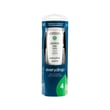
| Slow water, poor ice production | Restricted filtration or supply | Refrigerator water filter EDR4RXD1 |
| Temps swing, runs too long/short | Sensor feedback problem | Refrigerator thermistor W10316760 |
Why it matters
Cooling, ice, and water problems often share the same few systems: airflow, sensing, and water supply. Fixing the underlying cause protects food temperatures, reduces compressor run time, and prevents repeat failures.
Helpful model-specific references
- Use the owner's manual for the recommended temperature settings, troubleshooting steps, and water system specifications.
- For step-by-step filter help, follow how to replace the water filter in a KitchenAid refrigerator.
Last updated: February 2026
Why is my KitchenAid refrigerator leaking at the bottom?
A bottom leak on your KitchenAid KRFC300EBS00 refrigerator is usually caused by a water supply connection seep, a cracked or loose water tube, or a defrost drain problem that lets meltwater overflow and run down to the floor. Use the owner's manual to locate access panels and shutoff points safely.
Quick checks (most common causes)
- Look behind the refrigerator for a slow drip from the household water line connection.
- Check the tubing at the inlet valve for a loose quick-connect fitting or a nicked tube.
- Inspect the water filter area for moisture after a recent filter change.
- Look for water under the crisper drawers (often points to a clogged defrost drain).
- Check the freezer floor for a thin sheet of ice (drain backed up, then melts and leaks).
- Confirm the refrigerator is level; a tilt can redirect water toward the front.
Water system leak points to inspect
If the leak appears only when the ice maker fills or the dispenser runs, focus on the water circuit.
| Symptom | Most likely area | What to do next |
|---|---|---|
| Puddle behind unit | Supply line or fitting | Tighten connection; replace damaged tubing |
| Drip at back lower area | Inlet valve/tube connection | Inspect fittings; replace valve if seeping |
| Moisture near filter housing | Filter not fully seated or O-ring issue | Reinstall filter; check for cracks |
| Intermittent leak during fills | Valve not closing fully | Test and replace valve if it weeps |
Helpful model-matched parts to consider:
- Refrigerator water inlet valve assembly WPW10420083
- Refrigerator water supply tube union, 5/16 x 5/16-in WP2300868
- Refrigerator water filter EDR4RXD1
Defrost drain overflow (common “leak at the bottom” cause)
When the defrost drain clogs, water can back up, freeze, then spill forward as it melts.
- Unplug the refrigerator.
- Remove items from the freezer bottom and look for ice buildup.
- Clear the drain opening with hot water (a turkey baster works well).
- Make sure the drain tube at the rear is not blocked by debris.
Why it matters
Leaks can damage flooring and also lead to ice buildup, poor cooling, and longer compressor run times. Fixing the source early helps protect the sealed system components (compressor, evaporator, condenser, and connecting tubing).
Last updated: February 2026