Owner’s manual
 Error Codes




How to remove bottom grill from KitchenAid refrigerator?
On the KitchenAid KFCO22EVBL1 bottom-mount refrigerator, we remove the bottom grill (base grille) by gripping it firmly and pulling it straight toward us to release the clips. Once it pops free, we lift it away and set it aside.
Steps to remove the base grille
- Unplug the refrigerator if you will be working near wiring or cleaning components behind the grille.
- Stand in front of the refrigerator and locate the base grille at the very bottom.
- Grasp the grille firmly with both hands (near the ends works best).
- Pull the grille straight toward you to disengage the retaining clips.
- If it resists, pull evenly from both sides rather than twisting.
- Set the grille aside where it will not get stepped on or cracked.
Reinstalling the bottom grill
To reinstall, we align the grille with the lower frame and press it back into place until it snaps in securely.
What you can do while the grille is off
Removing the base grille is also the first step for a couple of common maintenance tasks:
| Task | Why you would do it | Typical frequency |
|---|---|---|
| Clean condenser area behind grille | Helps cooling efficiency and reduces run time | Every 2 to 3 months in dusty, greasy, or pet-heavy homes |
| Adjust front leveling screws | Helps doors close properly and reduces rocking | As needed after moving or door alignment issues |
Why it matters
A properly seated base grille helps protect the condenser area from debris and makes routine cleaning and leveling adjustments easier, which can improve temperature stability and energy efficiency.
For the exact illustrations and leveling screw locations, follow the KFCO22EVBL1 owner’s manual.
Last updated: January 2026
Why is my KitchenAid refrigerator leaking from the bottom?
On KitchenAid model KFCO22EVBL1, a leak from the bottom is most often caused by defrost water that cannot drain properly (a clogged or frozen defrost drain), so it overflows into the fresh food section or down to the floor. Use the steps in the KFCO22EVBL1 owner's manual to safely access and clear the drain path.
Quick checks we recommend first
- Confirm where the water is: under the front of the cabinet, inside under crisper drawers, or in the freezer drawer.
- Check the drain pan (rear, near the compressor area): if it is cracked or out of place, water can miss the pan.
- Look for ice buildup on the freezer floor or around the evaporator cover; this points to a frozen drain.
- Inspect the door gaskets for gaps that can cause excess frost (which later melts and overwhelms the drain).
- Verify the water supply line and fittings if the unit has an ice maker or dispenser.
Most common causes and what to do
| Symptom | Most likely cause | What usually fixes it |
|---|---|---|
| Water under crisper drawers | Clogged defrost drain or drain tube | Flush drain with hot water; clear debris from drain tube |
| Ice sheet on freezer floor | Frozen defrost drain | Thaw ice; clear drain; confirm drain stays open |
| Water only when ice maker runs | Loose/leaking water line connection | Tighten fittings; replace damaged tubing/union |
| Water in back near compressor | Drain pan issue | Re-seat pan; check for cracks |
How to clear a clogged or frozen defrost drain (safe DIY)
- Unplug the refrigerator (or switch off the breaker).
- Remove the freezer drawer/baskets as needed to access the rear interior panel.
- If you see ice, thaw it with a hair dryer on low (keep heat moving) or use warm towels.
- Locate the drain opening and flush with hot water using a turkey baster.
- If the drain tube is restricted, clean it from the bottom end if accessible; replacing a damaged tube is often the permanent fix (see refrigerator drain tube W10619951).
Why it matters
A restricted defrost drain can keep returning, leading to recurring puddles, ice buildup, and temperature swings that stress the evaporator fan and sealed system.
Last updated: January 2026
What is the most common problem with a KitchenAid refrigerator?
For KitchenAid model KFCO22EVBL1, the most common issues we see are ice maker problems (slow or no ice) and cooling complaints (warm fridge or freezer). These are often tied to airflow restrictions, dirty condenser coils, or a failing evaporator fan motor; the troubleshooting steps in the KFCO22EVBL1 owner's manual help narrow it down fast.
Most common symptoms and what they usually point to
- No ice or slow ice production: water supply restriction, air in the water line, or an ice maker fault
- Fridge warm but freezer cold: weak airflow from the evaporator area (fan, frost buildup, blocked vents)
- Both sections warm: condenser airflow problem, sealed system issue, or control problem
- Noisy operation: fan blade rubbing ice, worn fan motor, or normal longer run times on high-efficiency designs
- Water under the refrigerator: defrost drain issue or water line connection leak
Quick checks we recommend first (before replacing parts)
- Confirm the refrigerator is plugged into a grounded outlet and has power.
- Set temperatures to typical targets: 37°F fresh food and 0°F freezer.
- Clean condenser coils and make sure the grille area has good airflow.
- Check for frost buildup on the freezer back wall (a clue to defrost or airflow trouble).
- For ice maker issues, verify the shutoff arm is down (or ice maker is turned on) and the water supply valve is fully open.
Common parts involved (when symptoms match)
| Symptom | Likely area | Example part for KFCO22EVBL1 |
|---|---|---|
| Warm temps, poor airflow, unusual fan noise | Evaporator fan system | Refrigerator evaporator fan motor WPW10128551 |
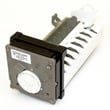
| Ice maker not producing | Ice maker assembly | Refrigerator ice maker D7824706Q |
| Sealed system cooling loss (advanced diagnosis) | Compressor start/cooling system | Refrigerator compressor start device WPW10194431 |
Why it matters
Ice maker and cooling problems can look similar, but the fix is very different. A simple airflow issue (like a fan problem or blocked vents) can cause warm temperatures and poor ice production at the same time, so diagnosing the cooling side first prevents unnecessary part replacement.
Last updated: January 2026
What is a bottom mount refrigerator?
A bottom-mount refrigerator (like the KitchenAid KFCO22EVBL1) keeps the fresh-food compartment on top and the freezer drawer on the bottom, so the items you use most are at eye level and easier to reach. For model-specific features and setup details, use the KFCO22EVBL1 owner's manual.
How a bottom-mount design works
In a bottom-mount layout, the refrigerator section is the primary upper compartment, and frozen food is stored in a lower pull-out drawer. This design typically improves everyday access to refrigerated groceries and reduces bending for frequently used items.
Common characteristics include:
- Fresh foods stored higher for easier visibility and access
- Freezer stored in a lower drawer (often full-extension)
- Two refrigerator doors on many models (French door style)
- Door alignment and leveling are important for smooth closing and sealing
What you will notice on the KFCO22EVBL1
Our KitchenAid KFCO22EVBL1 manual describes features that are typical of bottom-mount units, including dual refrigerator doors and a freezer drawer front that may require two people to remove and reinstall.
Practical points to expect:
- Two refrigerator compartment doors with a hinged seal between them
- Adjustable front leveling screws to help doors close properly
- Clearance needs for ventilation and door swing (especially near walls)
Quick comparison: bottom-mount vs. top-mount
| Feature | Bottom-mount refrigerator | Top-mount refrigerator |
|---|---|---|
| Fresh-food access | Higher, easier reach | Lower, more bending |
| Freezer access | Lower drawer | Upper door |
| Best for | Frequent fresh-food use | Frequent freezer use |
| Door/leveling sensitivity | Often higher | Often lower |
Why it matters
Bottom-mount refrigerators are designed around daily convenience. When the cabinet is level and the doors seal correctly, temperatures stay more stable, food stays fresher longer, and the unit runs more efficiently.
Last updated: January 2026