Installation guide
 Owner’s manual
 Error Codes



What is the most common problem with a KitchenAid dishwasher?
For the KitchenAid KUDS30IXWH1 dishwasher, the most common problems we see are poor cleaning (often tied to restricted water flow or filtration) and drain issues (water left in the tub). Leaks and “won’t start” symptoms are also common and usually trace back to latching, water supply, or a worn seal.
- Confirm the door closes tightly and latches fully.
- Verify the water supply is turned on.
- Run the shortest cycle and check for water in the bottom of the tub after about 2 minutes.
- Check for kinks or clogs in the drain hose routing.
- Listen for the drain pump running at the end of a cycle.
For model-specific operating checks and installation-related causes (water supply, drain connection, leveling), follow the steps in the KUDS30IXWH1 installation guide.
| Symptom | Most likely area | Common next step |
|---|---|---|
| Dishes still dirty | Filtration, spray coverage, water temperature | Clean filters, load correctly, use hot water |
| Water won’t drain | Drain path or drain pump | Check hose/air gap, test pump |
| Dishwasher won’t start | Door latch, power, cycle selection | Confirm latch, breaker/fuse, restart cycle |
| Leaking at the bottom/front | Door seal or hose connections | Inspect seal and clamps, check for drips |
If you have standing water or slow draining, the drain system is the first place to focus. These parts are commonly involved on this model:
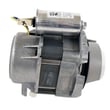
- Dishwasher drain pump WPW10348269 (won’t drain, humming, intermittent draining)
- Dishwasher drain hose 8269144A (leaks, kinks, clogs)
- Seal WPW10497235 (leaks at the bottom of the door)
Dishwashers like the KUDS30IXWH1 are designed to wash longer for better efficiency, so small restrictions (a partially blocked drain hose, a weak drain pump, or a leaking seal) can quickly show up as dirty dishes, water left in the tub, or leaks.
Last updated: January 2026
What is the average lifespan of a KitchenAid dishwasher?
A KitchenAid dishwasher typically lasts 10 to 14 years. For your KitchenAid KUDS30IXWH1 undercounter dishwasher, lifespan depends most on installation quality, water conditions (hard water), and routine care like using rinse aid and keeping the wash system clean; see the KUDS30IXWH1 installation guide for setup details that help prevent early wear.
- Water quality: hard water speeds up mineral buildup on the heater and internal parts.
- Detergent and rinse aid use: rinse aid improves drying and helps control deposits.
- Loading habits: overloading can strain racks, spray arms, and the pump.
- Drain performance: slow draining can leave dirty water in the sump and increase odors and residue.
- Cycle selection: frequent heavy cycles add heat and run-time stress compared to normal cycles.
- Use rinse aid consistently to improve drying and reduce hard-water deposits.
- Run hot water at the sink before starting a cycle so the dishwasher fills with warmer water.
- Clean the filter area and remove debris that can restrict wash and drain flow.
- Avoid blocking spray paths with tall pans or oversized cutting boards.
- Fix draining issues early; a weak drain system can shorten component life.
| Part type | What it impacts | Typical symptom when worn |
|---|---|---|
| Rack hardware | Loading and smooth rack movement | Rack sags, wheels pop off, poor glide |
| Drain components | Water removal and cleanliness | Standing water, odor, slow drain |
| Heating and wash system | Drying and cleaning performance | Poor drying, cloudy dishes, weak wash |
If you are already seeing slow draining or standing water, checking the drain path and the dishwasher drain pump WPW10348269 is a practical first step.
A dishwasher that is installed level, drains correctly, and runs with rinse aid typically avoids the most common early failures (mineral buildup, poor draining, and overheating). That is what keeps a KitchenAid dishwasher in the 10 to 14 year range.
Last updated: January 2026
How old is my KitchenAid oven by serial number?
Your model KUDS30IXWH1 is a KitchenAid undercounter dishwasher, not an oven. To estimate its age, we use the dishwasher’s serial number from the rating label, then match the serial format to KitchenAid date-coding. The KUDS30IXWH1 owner’s manual shows where to find the model and serial label.
On most KitchenAid dishwashers, the rating label is located on the tub rim or door area and is easiest to read with the door open.
- Open the dishwasher door and look along the tub frame edge
- Check the inner door panel area near the sides
- Write down the full serial number (letters and numbers)
- Also record the full model number: KUDS30IXWH1
- If the label is worn, take a clear photo and zoom in to confirm characters
KitchenAid serial formats vary by production run, but these patterns are common across many KitchenAid appliances.
| Serial number pattern | What to look for | What it tells you |
|---|---|---|
| Letter and numbers with a coded character | A specific character position is a date code | Approximate manufacture period |
| Digits that resemble a day and year | A 3-digit day-of-year plus a 2-digit year | Approximate build date |
Use this process so you do not apply an oven chart to a dishwasher (or the wrong KitchenAid format):
- Confirm you are decoding the dishwasher serial number for KUDS30IXWH1
- Identify whether the serial is mostly letters, mostly numbers, or a mix
- Look for a 3-digit sequence that could be 001 to 365 (day of year)
- Look for a 2-digit year at the end (for example, 13, 19, 21)
- If the serial does not match a day/year pattern, use KitchenAid’s date-code character method for that serial style
Knowing the manufacture timeframe helps us narrow down correct dishwasher parts and revisions, especially for components like the dishwasher electronic control WPW10380685, pump, heater, and rack hardware.
Last updated: January 2026