Owner’s manual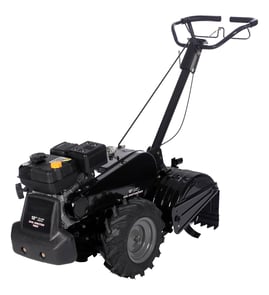



Do you push or pull a rear tine tiller?
On the Snapper RT8 rear-tine tiller, we guide the machine while the wheel drive pulls it forward; you do not muscle it by pushing or pulling hard. Use light downward pressure on the handlebar to keep the tines engaged and let the tiller do the work (see the RT8 owner's manual).
How to operate it (what your hands and feet should do)
- Stand slightly to the side of the tilling path so you are not walking on freshly tilled soil.
- Keep both hands on the handlebar and maintain solid footing.
- Engage the tine clutch, then pull the clutch control back to the handlebar to drive the wheels.
- Apply only slight downward pressure; avoid holding the tiller back.
- At the end of a row, disengage the tine clutch but keep the wheel drive engaged while you turn.
Push vs. pull: quick guide
| Situation | What you do | What the tiller does |
|---|---|---|
| Normal tilling pass | Guide and steady the handlebar | Wheels pull forward; tines dig |
| Turning at row end | Keep wheel drive engaged; tines disengaged | Rolls and pivots more easily |
| Transporting to the site | Raise tines to clear the surface; drive with wheels | Moves without gouging lawn/pavement |
| Rough, uneven ground | Start shallow; lift handlebar slightly if it hangs up | Regains traction without forcing controls |
Why it matters
Letting the RT8’s wheel drive and tines do the work reduces operator fatigue and helps prevent bouncing, trenching, and loss of control. It also protects the transmission and clutch controls from being forced when traction is poor.
Helpful related DIY guidance
For more technique and wheel and tine troubleshooting tips, use our DIY resources like rear tine tiller troubleshooting tips wheels and tines. For parts and diagrams for this model, start with the RT8 parts list, or search by model on Sears PartsDirect.
Last updated: February 2026
What size belt is a Snapper rt8?
On the Snapper RT8 rear-tine tiller, the drive belt size depends on the specific belt used in your forward and reverse drive routing. We match the correct belt by the RT8 model and serial number and the belt’s measured length and width; use the RT8 owner's manual belt-routing section to confirm the exact belt path before ordering from Sears PartsDirect.
How to identify the correct belt on an RT8
Because the RT8 uses a belt-and-pulley system that can be routed differently for forward and reverse, the most reliable way to size the belt is to verify what is installed and how it’s routed.
- Shut the engine off and let all moving parts stop
- Disconnect the spark plug wire before inspecting the belt
- Remove the belt cover and note the belt path around the big pulley, little pulley, and guide pin
- Measure belt width across the top (common tiller V-belts are often around 1/2 inch)
- Measure belt outside circumference with a flexible tape (or mark-and-measure method)
Quick belt sizing reference (typical rear-tine tiller V-belts)
These are common ranges for rear-tine tiller drive belts; use them to sanity-check your measurements.
| What you measure | Typical range | What it tells you |
|---|---|---|
| Top width | 3/8 to 1/2 inch | Belt cross-section family |
| Outside length | 55 to 70 inches | Overall belt length class |
| Sidewall condition | No cracks or glazing | Whether replacement is needed |
Why it matters
A belt that is too long can slip (poor tine engagement, weak drive). A belt that is too short can overload bearings and make shifting between forward and reverse difficult. Confirming the RT8 belt routing and measuring the belt you have prevents repeat failures.
Helpful DIY guidance
Last updated: February 2026
What is the bar on the back of a tiller for?
On the Snapper RT8 rear-tine tiller, the bar at the back is used as a support and handling point; it helps you lift and position the tiller to adjust tine depth (via the skid arm) and it also lets you stand the tiller upright for storage and underside access. See the RT8 owner's manual.
What that rear bar does (most common uses)
- Helps control tilling depth: you lift the rear of the tiller to take weight off the skid arm, then set the skid arm notch so the tines clear the ground for transport or dig in for tilling.
- Makes transporting easier: raising the tines before moving prevents gouging lawn or pavement.
- Stand-up support for service and storage: the RT8 can be stood on end for easier access to underside components and can be stored off-season on the front stand-up bar.
- Adds stability when repositioning: gives you a solid leverage point when turning at row ends or moving across uneven terrain.
Quick guide: transport vs. tilling setup
| Task | What you do | Why it matters |
|---|---|---|
| Transport to the work area | Raise tines by lifting the rear and setting the skid arm so tines clear the surface; keep tine clutch disengaged | Prevents surface damage and reduces drag |
| Start tilling | Set handlebar position, set skid arm for desired depth, start in low speed, then engage tine clutch and wheel drive | Improves control and helps the tines bite consistently |
| Turn at row end | Disengage tine clutch while keeping wheel drive engaged | Lets you turn without the tines pulling the machine |
Safety and handling notes we recommend
- Stop the engine and disconnect the spark plug wire before standing the tiller on end.
- Prevent fuel leakage before storing on end; check for oil leakage if stored that way.
- On rough terrain, start with a shallow pass to smooth the surface before going deeper.
- Let the tiller do the work; use only light down pressure on the handlebar.
Why it matters
Using the rear bar correctly improves traction and depth control, protects your lawn and driveway during transport, and makes routine maintenance (like checking tines and fasteners) safer and easier.
For model-specific parts and diagrams, start with the RT8 parts list on this page or search by model at Sears PartsDirect.
Last updated: February 2026
Are rear tine tillers better?
Rear tine tillers are better when you need maximum traction and control for tougher soil; the Snapper RT8 is built for cultivating and seed-bed prep in forward rotation, and it can be switched to reverse tine rotation for breaking sod or new ground (a common advantage of rear-tine designs). For RT8 operating and safety details, use the RT8 owner's manual.
When a rear tine tiller is the better choice
Rear tine tillers typically outperform front tine models when the job is demanding because the wheels help drive the machine forward while the tines work the soil.
- Breaking new ground, sod, or compacted soil
- Working around roots, rocks, and uneven terrain
- Tilling larger garden plots with less operator effort
- Needing adjustable depth control (skid arm/depth lever)
- Wanting the option to change tine rotation direction
RT8-SPECIFIC features that support “better” performance
Your Snapper RT8 manual highlights several design and use points that matter in real-world tilling:
- Forward tine rotation is the default setup; it is best for cultivating and seed-bed preparation.
- Reverse tine rotation is used when you want more bite for breaking sod or new ground.
- Handlebar adjustment lets you shift side-to-side and adjust height for comfort and control.
- Transport setup: you can raise the tines to avoid gouging pavement or lawn while moving to the work area.
Quick comparison: rear tine vs front tine
| Feature | Rear tine tiller (like RT8) | Front tine tiller |
|---|---|---|
| Best use | New ground, larger areas, tougher soil | Lighter cultivation, smaller areas |
| Traction/control | Higher (wheel-driven) | Lower (tines pull the unit) |
| Operator effort | Typically less | Typically more |
| Maneuverability | Typically less | Typically more |
Why it matters
Choosing the right tine layout affects safety, soil results, and wear on parts like the drive belt, tine fasteners, and shear bolts. A rear tine tiller like the RT8 is designed to stay planted and keep moving when conditions get difficult.
Parts and repair help
We list model-specific replacement parts by diagram on the RT8 parts page; for broader parts search by model number, use Sears PartsDirect. For DIY help on tine and drive issues, use rear tine tiller troubleshooting tips wheels and tines.
Last updated: February 2026