Installation guide
 Owner’s manual
 Error Codes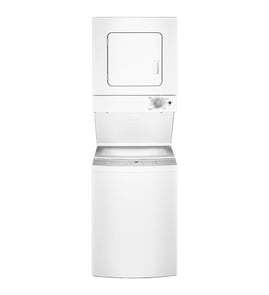



How does the GE washer dryer combo work?
The GE GUD24ESSM1WW is a stacked laundry center (not a single-drum all-in-one combo): the washer is on the bottom and the dryer is on top, and you move clothes from the washer to the dryer. Operating steps and cycle details are in the GUD24ESSM1WW owner’s manual.
How the washer side works on GUD24ESSM1WW
The washer is a top-load washer; you choose a cycle, temperature, and options, then press Start.
- Load items loosely; overloading can reduce cleaning and rinsing.
- Use detergent as directed; HE detergent is recommended.
- The washer pauses if you open the lid during a cycle.
- The lid locks during spin and releases shortly after the basket stops.
- Brief water valve bursts and a short pause at startup can be normal.
How the dryer side works on GUD24ESSM1WW
The dryer is a vented dryer that dries by tumbling clothes while heated air moves through the drum and out an exhaust duct to the outdoors.
- Clean the lint filter before each load.
- Select a dry cycle (automatic or timed, depending on your control panel).
- The dryer will not start with the door open.
- Poor venting or lint buildup can cause long dry times.
“Combo” vs stacked laundry center (what you have)
| Feature | All-in-one washer/dryer combo | GE GUD24ESSM1WW stacked laundry center |
|---|---|---|
| Wash and dry in the same drum | Yes | No |
| Move clothes to dry | No | Yes |
| Dryer vent required | Often no (varies by design) | Yes, vents outdoors |
| Washer and dryer can run at the same time | Sometimes | Yes |
Why it matters
Knowing you have a stacked laundry center helps you troubleshoot correctly. For example, slow drying on GUD24ESSM1WW is usually related to airflow (lint screen, ducting, exhaust hood), not a condenser or heat pump system.
Helpful related DIY content
Last updated: January 2026
How many years should a GE washing machine last?
GE does not publish a specific “expected lifespan” in the documentation for the GE GUD24ESSM1WW laundry center, so we can’t confirm an exact number of years for this model from model-specific sources. In typical home use, many washers run for roughly a decade or more; maintenance and usage make the biggest difference.
What we can confirm for GUD24ESSM1WW (model-specific)
Use the care and troubleshooting guidance in the GUD24ESSM1WW owner’s manual to reduce wear and prevent common failures.
Key model-relevant habits called out in the manual include:
- Use the correct amount of detergent; too much can cause oversudsing and residue.
- Load items loosely; avoid overfilling the basket.
- Leave the washer lid open after washing to let moisture evaporate.
- Turn off water faucets when not in use.
- Inspect fill hoses and replace them about every 5 years.
What usually shortens washer life (any laundry center)
These are common factors across GE laundry centers like the GUD24ESSM1WW:
- Frequent overloading or repeated out-of-balance spinning
- Excess detergent or non-HE detergent in an HE-style wash system
- Hard water mineral buildup
- Poor airflow and lint buildup on the dryer side (extra heat stresses components)
- Skipping basic cleaning and inspections
Repair vs. replace: a practical way to decide
Instead of focusing on age alone, we recommend looking at the type of failure and repair cost.
| What you’re seeing | Often points to | Typical next step |
|---|---|---|
| Won’t drain, standing water | Drain system issue | Inspect pump, hoses, clogs |
| Won’t spin or leaves clothes wet | Drive or shift issue | Check belt, shifter, lid lock |
| Loud banging | Suspension or load balance | Redistribute load, inspect rods |
If the washer won’t drain, a common repair item is the laundry center washer drain pump WH23X26206.
Why it matters
Because GE doesn’t specify a set lifespan for the GUD24ESSM1WW, consistent maintenance is the best way to extend service life and avoid preventable breakdowns.
Last updated: January 2026
How do I get my GE washer to drain and spin?
On the GE GUD24ESSM1WW laundry center, you can drain and spin by turning the washer cycle knob to Drain & Spin, closing the lid, and pressing Start. This cycle pumps water out and then spins to remove extra moisture from the load.
Steps to run Drain & Spin (GUD24ESSM1WW)
- Turn the washer cycle knob to Drain & Spin.
- Close the lid completely (the washer will not spin with the lid open).
- Press Start.
- If you changed cycles after starting, press Start again to begin the new selection.
- If the load ends up wetter than normal, redistribute items and run Drain & Spin again.
For cycle selection and what happens when you turn the knob after a cycle starts, follow the washer operating instructions in the GUD24ESSM1WW owner’s manual.
If you need a rinse first
This model does not list a separate “Rinse & Spin” cycle. Instead, the manual notes that Drain & Spin can be used for wet loads, and on some models you can add a rinse using a 2nd Rinse option.
- If your control panel has a 2nd Rinse option: enable it, then run Drain & Spin.
- If your panel does not have that option: run a regular wash cycle with no detergent (or a light cycle) to rinse, then run Drain & Spin.
- Always use cold water for rinsing unless the fabric care label requires otherwise.
If it won’t drain or won’t spin
Common causes on a stacked laundry center include load balance issues, lid lock problems, or a drain path restriction.
- Out-of-balance load: redistribute items evenly around the basket.
- Lid lock not engaging: the washer may not spin if it cannot lock the lid.
- Drain hose issue: check for kinks and confirm the drain setup matches the installation requirements.
- Pump problem: if you hear humming but water does not move, inspect the pump area.
If you suspect the pump is failing, the draining component to check is the laundry center washer drain pump WH23X26206.
Quick reference
| What you want | Best choice on GUD24ESSM1WW | Adds water? |
|---|---|---|
| Remove water and extract moisture | Drain & Spin | No |
| Rinse then extract moisture | Drain & Spin plus 2nd Rinse (if present) | Yes (during rinse) |
Why it matters
Using Drain & Spin avoids re-washing when you only need water removed; it also helps reduce strain on the drive system by letting you correct an out-of-balance load before a full-speed spin.
Last updated: January 2026