Owner’s manual
 Error Codes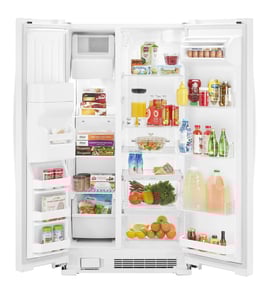


How to tell cubic feet of Kenmore refrigerator by model number?
For Kenmore model 10659599990, the most reliable way to get the exact cubic-foot capacity is to look it up in the specifications section of the 10659599990 owner's manual. If you need a quick estimate, we recommend calculating interior volume from measurements.
Best ways to find cubic feet (most accurate first)
- Check the specifications section in the 10659599990 owner's manual.
- Look up the model’s published specs using the full model number (all digits matter).
- Estimate capacity by measuring the usable interior (fast, but approximate).
- Use the model/serial label to confirm you have the exact model number (the manual notes the label is on the inside wall of the refrigerator compartment).
How to estimate cubic feet by measuring
- Empty the compartment you’re measuring (fresh food and freezer are often listed separately).
- Measure width x depth x height of the usable interior in inches.
- Multiply to get cubic inches.
- Divide by 1,728 to convert to cubic feet.
- Cubic feet = (W x D x H) / 1728
- Measure to the nearest 1/8 inch for a tighter estimate.
- Exclude fixed “dead space” you cannot use (duct covers, light housings, large protrusions).
Quick reference table
| What you have | What you get | Accuracy |
|---|---|---|
| 10659599990 owner's manual | Published capacity/specs | Highest |
| Interior measurements | Estimated usable capacity | Medium |
| Model-number pattern guesses | Rough size range | Lowest |
Why it matters
Cubic-foot capacity helps you compare refrigerators, plan food storage, and choose correctly sized accessories (bins, shelves, and ice storage). It also prevents ordering parts based on “close” model numbers that can have different configurations.
Last updated: January 2026
How wide is a Kenmore side by side refrigerator?
Most Kenmore side-by-side refrigerators are about 36 inches wide. For your Kenmore model 10659599990, the exact cabinet width and required clearance are listed in the 10659599990 owner's manual; plan for extra space on the hinge side so the doors can swing fully.
What width to expect (typical)
Side-by-side refrigerators are commonly built to fit a 36-inch opening, but the overall space you need is usually a bit more than the cabinet width.
- Typical cabinet width: about 35 7/8 to 36 inches
- Typical overall space needed: cabinet width plus clearance
- Door swing clearance matters as much as cabinet width
- Counter-depth models are often similar in width but shallower front-to-back
Clearances that affect the “real” width you need
Your 10659599990 manual calls out installation clearances that can change how wide the opening must be.
- Allow 1/2 inch of space on each side and at the top for ventilation
- If installed next to a fixed wall, allow 2 inches minimum on each side (depending on model) for door swing
- Leave extra space behind the refrigerator if an ice maker water line is connected
Quick planning guide
| What you are measuring | What to plan for | Why |
|---|---|---|
| Cabinet width | ~36 inches | Fits most side-by-side cutouts |
| Opening width | ~37 inches (or more) | Adds side ventilation clearance |
| Wall on hinge side | Add at least 2 inches | Prevents door from hitting the wall |
Why it matters
If the opening is too tight, the refrigerator can run warmer (restricted airflow), doors may not open fully, and the ice maker water line can get pinched during installation.
Last updated: January 2026
Why is my Kenmore side by side ice maker not working?
If your Kenmore 10659599990 side-by-side refrigerator ice maker isn’t making ice, the most common causes are the ice maker being turned off (shut-off arm up or switch OFF), the water supply valve being closed, or an ice jam in the ejector area. Use the 10659599990 owner's manual steps below to restore ice production.
Quick checks that fix most “no ice” problems
- Confirm the ice maker is ON:
- Style 1: lower the wire shut-off arm (arm down).
- Style 2: slide the ice maker switch to ON (left).
- Make sure the household water shut-off valve to the refrigerator is fully open.
- Check for a kinked water supply line behind the refrigerator.
- Look for an ice cube jammed in the ejector arm area; clear it with a plastic utensil.
- Verify the freezer door closes tightly; poor door closure can reduce ice production.
What the ice maker should do (so you know what’s “normal”)
In normal mode, this model’s ice maker typically produces about 7 to 9 batches in 24 hours. Some versions also have a maximum ice production setting that can raise output to about 10 to 14 batches in 24 hours.
| Mode | Typical output | What to do if it’s slow |
|---|---|---|
| Normal ice production | 7 to 9 batches per 24 hours | Adjust the freezer control colder in small steps; wait 24 hours between changes |
| Maximum ice production (if equipped) | 10 to 14 batches per 24 hours | Turn on the MAX feature, then recheck after 24 hours |
If the mold is dry vs. full of water
Use this quick split to narrow the problem:
- Mold is dry (no water): focus on water supply, shut-off valve position, frozen fill tube, or a failed inlet valve.
- Mold has water but no cubes: focus on the ice maker mechanism, ejector jam, or the ice maker assembly.
If you suspect the valve is not opening to fill the mold, replacing the refrigerator inlet valve W10408179 is a common repair on this style of Kenmore.
Why it matters
An ice maker depends on steady freezer temperature and consistent water flow. A shut-off arm in the OFF position, a closed water valve, or a small ice jam can stop production completely, even when the refrigerator seems to cool normally.
Last updated: January 2026
Where is the defrost timer on Kenmore side by side?
On Kenmore side-by-side refrigerator model 10659599990, the defrost timer (often an adaptive defrost control) is mounted in a serviceable control area, but the exact access point varies by configuration. Use the 10659599990 owner's manual to match the correct panel and component location for your unit.
Most common places to look
Unplug the refrigerator first, then check these typical locations used on Kenmore 106-style side-by-sides:
- Inside the fresh food section control console (near the temperature controls and light)
- Behind the base grille or lower toe panel at the front
- In a control box at the back of the cabinet (near the compressor area)
- Behind an interior cover where multiple wire harness connections meet
How to confirm you found the right part
A defrost timer/control is tied to the automatic defrost cycle. During normal operation, you may hear a distinct click when the defrost cycle begins or ends.
- Look for a small module/board with multiple wire connectors
- Check for labeling that references defrost or control
- Compare the shape and connector layout to the replacement part listing
Parts commonly checked with the defrost control
If you are troubleshooting heavy frost buildup or warm temperatures, we check the full defrost system together:
| What you see | What it usually points to | Model-compatible example |
|---|---|---|
| Frost blanket on freezer back wall | Defrost system not clearing ice | Refrigerator defrost timer 4388932 |
| Frost returns quickly after a manual defrost | Defrost thermostat not opening/closing correctly | Refrigerator defrost bi-metal WPW10225581 |
| No heat during defrost | Failed heater or wiring issue | Refrigerator heater WP2323198 |
Why it matters
When the defrost timer/control does not run the defrost cycle correctly, frost can build up on the evaporator and block airflow; that makes the refrigerator section warm even though the compressor may still run.
Last updated: January 2026