Installation guide
 Owner’s manual


How to hard reset a Kenmore dishwasher?
For a Kenmore dishwasher model 66513283K118, the most reliable “hard reset” is to reset the control by canceling the current cycle: press CANCEL/DRAIN twice, then select a new cycle and press START. This clears the control and restarts the wash program logic (see the 66513283K118 owner's manual).
- Open the door slightly to stop the cycle; wait for spraying to stop.
- Press CANCEL/DRAIN once.
- Close the door within 3 seconds so it can drain.
- When you need a full control reset, press CANCEL/DRAIN twice.
- Select your new cycle and options, then press START.
- Make sure the door is fully closed and latched.
- If the Start light is blinking, close the door and press START.
- Confirm a cycle is selected (some options are not available on every cycle).
- Check household power (breaker or fuse) if the dishwasher is completely dead.
- If water remains in the tub, let the drain cycle finish (it can run about 2 minutes).
| Reset method | What it does | When to use it |
|---|---|---|
| CANCEL/DRAIN twice | Resets the control and restarts from the beginning | Stuck cycle, wrong selection, odd behavior |
| CANCEL/DRAIN once + close door | Starts a drain cycle if water is in the tub | Standing water, need to stop mid-cycle |
| Power cycle (breaker off 1 minute, then on) | Reboots the dishwasher electronics | No response to keys, control seems frozen |
A proper control reset clears a paused or confused cycle without guessing button sequences. It also forces a drain when needed, which helps prevent odors and improves the next wash results.
For code-related issues, use Kenmore 665 model dishwasher error codes to match the blinking lights or displayed code to the right fix.
Last updated: January 2026
Where is the filter on a Kenmore quiet guard dishwasher?
On Kenmore dishwasher model 66513283K118, the filter is located inside the tub at the bottom center, under the lower rack. This model uses an Ultra Wash HE filtration system with an upper filter assembly and a lower filter that lift out for cleaning (see the 66513283K118 owner's manual).
- Pull out the lower rack to expose the sump area.
- Look for the round filter assembly at the bottom center of the tub.
- Remove the filters in this order:
- Turn the upper filter assembly about 1/4 turn counterclockwise, then lift it out.
- Grasp the lower filter in the circular opening, lift slightly, and pull forward to remove.
- Rinse both filters under running water; use a soft brush if needed.
Cleaning the filters monthly helps maintain cleaning performance and can reduce noise.
- Do not use a wire brush or scouring pad; they can damage the filter screens.
- If you have hard water, calcium deposits may require a soft brush.
- Reinstall the lower filter under the locating tabs so the round openings line up.
- Insert the upper filter, then rotate it clockwise until it drops and locks.
- Do not run the dishwasher unless both filters are installed and the upper filter is locked.
| Filter part | What it does | Common symptom when dirty or loose |
|---|---|---|
| Upper filter assembly | Keeps oversized items and fine particles out of the pump | Poor wash, unusual sounds |
| Lower filter | Helps keep food from being recirculated onto dishes | Grit on dishes, redepositing soil |
A clogged or incorrectly seated filter can leave food soils on dishes and may affect normal operating sound. Keeping the filter clean also helps the wash system circulate water efficiently.
Last updated: January 2026
What is the service code f4e1 on a Kenmore Elite dishwasher?
On a Kenmore dishwasher like model 66513283K118, an F4E1 service code points to a wash motor or circulation problem (the dishwasher is not moving water through the spray arms correctly). The most common fix is restoring proper wash-motor operation and then clearing the code using the reset steps in the 66513283K118 owner's manual.
- Cancel/drain and restart a cycle to see if the code returns.
- Confirm the door is fully closed and latched; a loose latch can interrupt operation.
- Verify water supply is on and the tub is getting water early in the cycle.
- Check for a clogged filter area that can restrict water flow.
- Listen for wash action: you should hear a steady spray or “whoosh” during the wash portion.
F4E1 is usually triggered when the dishwasher cannot circulate water as expected.
| Symptom you notice | Most likely issue | Common repair direction |
|---|---|---|
| F4E1 appears and dishes stay dirty | Weak or no circulation | Inspect/replace wash motor assembly |
| Hums but little spray | Jammed pump, debris in sump | Clean sump area; inspect pump components |
| Intermittent wash, odd noises | Motor struggling or failing | Replace motor assembly if confirmed |
For this model, a common circulation-related replacement is the dishwasher pump motor assembly W11032770. If the dishwasher is also not draining, the issue can be separate; the dishwasher drain pump WPW10348269 is the common drain-side part.
Many Kenmore dishwashers require a keypad sequence to clear stored faults after the underlying problem is fixed. Use the reset procedure shown in the 66513283K118 owner's manual so the control can re-check operation on the next cycle.
The dishwasher relies on strong circulation to spin the spray arms, heat water effectively, and rinse detergent away. When circulation drops, you can get poor cleaning, residue, and repeated fault codes.
Last updated: January 2026
What are the common problems with Kenmore dishwashers?
Common problems on the Kenmore 66513283K118 dishwasher are no-start conditions, draining problems, poor cleaning, spotting from hard water, leaks, and weak drying. Most issues trace back to loading or water supply problems, a blocked filter or spray arm, or a failed component such as a latch, pump, or heater; use the 66513283K118 owner's manual troubleshooting chart to narrow it down.
- Dishwasher does not run: door not fully closed and latched, cycle not selected, power issue, or a control that needs a reset (the manual notes blinking Start lights often clear by closing the door and pressing Start).
- Won’t drain or water remains in tub: kinked drain hose, disposer knockout plug not removed, or a clog in the drain path.
- Poor cleaning: blocked spray arm holes, dirty filters, or incorrect detergent.
- Hard water residue or spotting: mineral deposits; the manual recommends rinse aid and monthly dishwasher cleaner, and a water softener if hardness is 15 grains or more.
- Leaking: loose hose connections, damaged drain hose, or a door sealing issue.
- Confirm the door closes firmly and the latch engages.
- If Start or status lights blink, close the door and press Start.
- Inspect the drain hose routing for kinks and check the disposer inlet knockout plug.
- Clean the filter and check the spray arm for debris.
- Verify hot water supply temperature is about 120°F (49°C) for best cleaning and drying.
| Symptom | Common part to inspect | Example part for this model |
|---|---|---|
| Won’t start or stops mid-cycle | Door latch | Dishwasher door latch WPW10653840 |
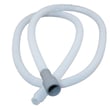
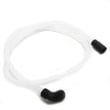
| Won’t drain | Drain pump, drain hose | Dishwasher drain pump WPW10348269, dishwasher drain hose 8269144A |
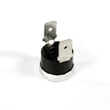
| Not drying, poor wash temp | Heating element | Element assembly W10518394 |
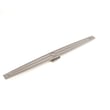
| Poor cleaning | Spray arm, filter | Dishwasher spray arm WPW10491331, dishwasher filter W10872845 |
A dishwasher that is not draining, not heating, or not filling correctly can leave soil on dishes, cause odors, and extend cycle times. Catching a kinked hose, hard-water buildup, or a failing pump early helps prevent repeat clogs and reduces strain on the circulation system.
Last updated: January 2026