Owner’s manual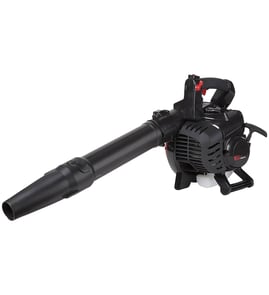

What is the life expectancy of a gas leaf blower?
A gas leaf blower typically lasts about 8 to 10 years with normal homeowner use and routine maintenance. For the Craftsman 358794740 (25cc 2-cycle), consistent fuel-system care, clean airflow, and proper storage do the most to extend service life; see the 358794740 operator's manual for model-specific maintenance intervals.
Most gas blower/vacuum units fall into these ranges:
| Usage pattern | Typical life expectancy | What usually ends life first |
|---|---|---|
| Occasional homeowner use | 10+ years | Fuel system issues, cracked lines, primer bulb |
| Regular seasonal use | 8 to 10 years | Carburetor wear, air leaks, ignition problems |
| Heavy use | 5 to 8 years | Engine wear, vibration damage, intake debris |
We see the longest-lasting Craftsman 2-cycle blowers when owners stay ahead of these basics:
- Use fresh, properly mixed 2-cycle fuel; do not store mixed fuel for long periods.
- Empty the fuel tank before long storage and run the engine until it stops to reduce varnish in the carburetor.
- Keep the air intake and blower tubes clear so the engine is not starved for airflow.
- Replace aging rubber parts early (fuel lines and primer bulbs harden and crack over time).
- Inspect for loose fasteners and vibration wear, especially around the engine cover and tube connections.
If your blower starts getting hard to start, won’t stay running, or needs constant priming, these are frequent culprits:
- Ayp leaf blower primer bulb 530035497 (cracks, won’t draw fuel)
- Ayp lawn & garden equipment fuel line, large 530069216 (air leaks, fuel starvation)
- Spark plug and air cleaner (normal wear items)
A “worn out” gas leaf blower is often a fuel-delivery problem, not a dead engine. Keeping the fuel system sealed and clean helps the Craftsman 358794740 start easier, run steadier, and avoid premature carburetor replacement.
Last updated: January 2026
What is better, cfm or mph for a leaf blower?
For a leaf blower, CFM and MPH work together, and which is “better” depends on the job. On the Craftsman 358794740, the operator’s manual lists 430 CFM and 200 MPH; use higher CFM for moving lots of leaves and higher MPH for breaking loose wet or stuck debris. See the 358794740 operator’s manual for the rated performance.
- CFM (cubic feet per minute): how much air volume the blower moves; best for pushing big piles and covering wide areas.
- MPH (miles per hour): how fast the air stream is; best for dislodging heavy, wet, or embedded debris.
- Nozzle and tube setup affects both; a narrower nozzle usually increases air speed at the tip.
- Technique matters: keeping the air stream close to the ground improves effectiveness.
| Your task | Prioritize | Why |
|---|---|---|
| Dry leaves on driveway or lawn | Higher CFM | Moves more material per pass |
| Wet leaves, pine needles in cracks | Higher MPH | Breaks debris loose |
| Mulch mode or vacuum pickup | Higher CFM (plus steady high speed) | Keeps material moving through the tube |
| General yard cleanup | Balanced CFM + MPH | Best all-around performance |
- Run at the lowest throttle that still does the job to reduce noise and fuel use.
- Use the full nozzle extension so the air stream works close to the ground.
- For vacuuming, operate at high speed and keep the tube about 1 inch above the ground.
- Clear the area of rocks, wire, and hard debris to prevent dangerous blowback.
Choosing CFM vs. MPH correctly saves time and reduces clogging and rework. In most yards, CFM is the bigger day-to-day advantage, while MPH is the problem-solver for stubborn debris.
Last updated: January 2026
What brand of gas leaf blower is best?
For most homeowners, the “best” gas leaf blower brand is the one that fits your yard size, starts reliably, and has easy-to-get replacement parts. If you already own a Craftsman blower like model 358794740, staying with Craftsman is often the best choice because parts support and service information are straightforward using the 358794740 operator’s manual.
Focus on the features that affect real-world performance and ownership cost:
- Engine size and output: More cc and higher MPH/CFM help with wet leaves and heavy debris.
- Starting and drivability: A good choke/primer setup and stable idle matter more than peak numbers.
- Parts availability: Fuel system and ignition parts should be easy to source.
- Comfort: Weight, handle design, and vibration control affect how long you can use it.
- Serviceability: Simple access to the carburetor, fuel lines, and spark plug saves time.
| Yard size / use case | What to prioritize | Typical best fit |
|---|---|---|
| Small yard, light dry leaves | Easy starting, lighter weight | Handheld gas blower/vac |
| Medium yard, mixed debris | Higher CFM, good throttle control | Higher-output handheld |
| Large yard, long run time | Comfort, reduced fatigue | Backpack blower |
Your Craftsman 358794740 is a 2-cycle, gasoline-powered blower/vac, and the manual highlights key performance specs (MPH/CFM) and maintenance guidance. Keeping a unit like this running usually comes down to routine fuel-system upkeep and replacing common wear items.
Common parts that often solve “won’t start” or “runs poorly” complaints include:
- Ayp leaf blower primer bulb 530035497 (helps prime fuel for starting)
- Ayp lawn & garden equipment fuel line, large 530069216 (fixes air leaks and fuel starvation)
- Spark plug and air cleaner (normal tune-up items)
Brand matters, but support matters more. A blower that has readily available parts and clear maintenance steps typically lasts longer and costs less to keep running than a “better on paper” model with limited parts support.
Last updated: January 2026