Installation guide
 Owner’s manual
 Error Codes


How do I know what model Kenmore dishwasher I have?
To identify your Kenmore dishwasher model, open the door and look for the model and serial number label on the inside edge of the tub or door area. On Kenmore model 66516389300, the label location is shown in the 66516389300 owner's manual.
Where to look (fast checklist)
- Open the dishwasher door fully.
- Check the inside rim of the tub near the door opening.
- Look along the left or right inner edge where the door seals.
- Find a label that lists MODEL and SERIAL.
- Write the model number exactly as printed (letters and numbers).
What the label tells you
The rating label typically includes:
- Model number (used to match parts and diagrams)
- Serial number (used for production date and service history)
- Electrical ratings (volts/amps) and other manufacturing details
Why the exact model number matters
Kenmore dishwashers can look similar across multiple series, but parts like the door seal, pump, and racks can vary by model. Using the exact model number helps us match the correct replacement parts and installation details.
Quick examples (what to copy)
| On the label | What to record | Why it helps |
|---|---|---|
| MODEL | 66516389300 | Ensures correct parts fit |
| SERIAL | (your serial) | Helps with service identification |
If the label is hard to read
- Wipe the label gently with a damp cloth and mild soap; dry it.
- Use your phone camera and zoom in for clearer text.
- If the label is damaged, check your purchase paperwork or the use and care packet.
Last updated: February 2026
Is it worth repairing a Kenmore dishwasher?
Yes, repairing a Kenmore dishwasher like model 66516389300 is worth it when the problem is isolated (leak, drain issue, door seal, or a single failed electrical part) and the tub and racks are still in good shape; a targeted repair usually costs far less than replacement and avoids a full reinstall.
Quick way to decide
We use these practical checkpoints before investing in parts or labor:
- One clear symptom (won’t drain, leaks at the door, won’t start) points to a repairable failure.
- Repeated breakdowns in different systems (wash, drain, heat, controls) points to replacement.
- Rust-through on the tub or inner door panel is a replacement-level issue.
- Rack rust can be worth fixing if everything else runs well.
- Electrical no-power problems are often a single component (fuse, wiring, control) and can be repairable.
What the manual says about durability and coverage
Your Kenmore dishwasher is designed for years of dependable operation, and the warranty language in the 66516389300 owner’s manual highlights that major components can be serviceable (for example, electronic control and power supply board coverage for two years, and limited coverage on parts of the wash system). That supports the idea that many failures are intended to be repaired, not treated as disposable.
Common “worth repairing” scenarios (and parts that often solve them)
| Symptom | Most likely area | Example part for this model |
|---|---|---|
| Won’t start, dead panel | Power supply, wiring, fuse | Fuse 8193762 |
| Leaks at the door | Door seal or gasket fit | Gasket W11196317 |
| Poor wash, loud grinding | Chopper, pump, spray system | Dishwasher chopper assembly W10083957V |
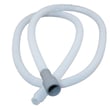
| Won’t drain, water left in tub | Drain path, hose routing | Dishwasher drain hose 8269144A |
Why it matters
A dishwasher replacement often adds hidden costs (installation, fittings, possible cabinet adjustments). A repair keeps your existing fit and finish, reduces downtime, and can restore performance quickly when the failure is limited to a single part.
Last updated: February 2026
What are the most common issues with 66516389300?
The most common issues we see with the Kenmore 66516389300 dishwasher are no-start or stopping mid-cycle, not filling, long run times, water left in the tub, detergent not dispensing, poor drying, and unusual grinding noises. Our owner's manual troubleshooting steps cover these symptoms and the fastest checks.
Quick checks first (most no-start complaints)
- Confirm the door is fully closed and latched.
- Check the household breaker or fuse.
- Make sure the cycle is selected correctly and the dishwasher is started.
- Verify the water shutoff valve is turned on.
- If it stopped mid-cycle, wait a few minutes; the motor can reset after an overload.
Common symptoms and what they usually mean
| Symptom | Most common cause | What to do next |
|---|---|---|
| Won’t start or stops | Door not latched, power issue, motor overload | Latch door, reset breaker, retry cycle |
| Won’t fill | Overfill float stuck up | Press float down so it moves freely |
| Runs too long | Heating water to temp | Start with hot water; expect pauses |
| Water remains | Cycle not complete or drain issue | Let cycle finish; check drain path |
| Detergent left in dispenser | Caked detergent or cycle interruption | Use fresh detergent; clean dispenser |
| Spots/film | Low rinse aid, hard water, low inlet temp | Fill rinse aid; target 120°F inlet |
| Grinding/buzzing | Hard object in wash module | Stop cycle if safe; remove debris |
Parts that commonly relate to these problems
If troubleshooting points to a failed component, these are frequent replacements for this model:
- Drain problems or standing water: dishwasher drain hose 8269144A
- Poor wash, clogs, or circulation issues: dishwasher pump and motor assembly W10782773
- No power symptoms tied to electrical protection: fuse 8193762
- Fill problems after verifying water is on: dishwasher water inlet valve WP8531669
Why it matters
Catching the simple causes (door latch, power, water supply, float movement, fresh detergent, rinse aid) prevents repeat cycle failures, protects the pump and motor, and improves cleaning and drying performance.
Last updated: March 2026