Owner’s manual
 Error Codes



How to tell cubic feet of Kenmore refrigerator by model number?
For Kenmore model 10672013010, the model number by itself does not reliably tell the exact cubic-foot capacity. The sure way is to look up the capacity in the specifications section of the owner's manual, or calculate an estimate from the usable interior dimensions.
Fast ways to find the capacity
- Check the specifications section in the owner's manual for your exact model.
- Look for a model and serial label inside the fresh food compartment (commonly on a side wall near the crisper area or upper liner) and match it to the manual.
- If you need a quick estimate, measure the usable interior space and calculate cubic feet.
- If you are comparing sizes, use the same method for both refrigerators (manual spec or measured estimate).
How to estimate cubic feet by measuring
- Empty the section you are measuring (refrigerator and freezer are usually counted together).
- Measure usable interior:
- Width (inches)
- Height (inches)
- Depth (inches) (do not include door bins; measure to the back wall)
- Multiply:
W x H x Dto get cubic inches. - Convert to cubic feet: divide by 1,728.
Quick conversion table
| What you have | Convert to | Formula |
|---|---|---|
| Cubic inches | Cubic feet | cubic inches ÷ 1,728 |
| Inches (W,H,D) | Cubic feet | (W × H × D) ÷ 1,728 |
What to expect for this style of refrigerator
Most Kenmore bottom-mount refrigerators fall into a typical range of 18 to 25 cubic feet, depending on cabinet width, depth, and how much space is taken by insulation, the ice maker, and air channels.
Why it matters
Capacity affects food storage planning, replacement shopping, and performance expectations. Two refrigerators with the same outside dimensions can have different cubic feet because of insulation thickness, drawer design, and the evaporator airflow layout.
Last updated: February 2026
How to tell if a Kenmore refrigerator compressor is bad?
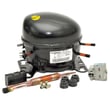
If your Kenmore 10672013010 refrigerator is warm in both the fresh food and freezer sections and you hear repeated clicking from the back without steady running, the compressor start circuit or the compressor itself is failing. Confirm basic power and control settings first, then narrow it down with a few safe checks from the owner's manual.
Quick checks we recommend first (no tools)
- Verify the outlet works (plug in a lamp) and reset any tripped breaker.
- Make sure the temperature controls are turned on and not set to “off.”
- If it was just installed or moved, allow a full 24 hours to reach temperature.
- Listen for normal operating sounds (fans and compressor may pulse as they adjust).
- Check whether both compartments are warming equally (often points to a sealed-system or compressor-side issue).
What compressor failure looks like vs common look-alikes
A “bad compressor” is less common than a start device, airflow, or control problem. Use these symptom patterns to separate them.
| What you notice | Most likely cause | What to do next |
|---|---|---|
| Repeated click every few minutes; compressor never stays running | Start device/overload or compressor locked | Unplug for 5 minutes, restart; if clicking returns, plan diagnosis/repair |
| Compressor runs but fridge still warm; little to no airflow inside | Evaporator fan or airflow issue | Check for fan noise; inspect for frost buildup and blocked vents |
| Loud buzzing/humming then click-off | Compressor struggling to start | Stop running it; schedule service to prevent overheating |
| Unit seems to run “all the time” but temps are close to normal | Normal high-efficiency run time or door seal issue | Check door closing and gaskets; clean condenser area |
Safe observations that strongly point to a compressor-side problem
- The condenser fan (near the compressor) runs but cooling does not improve.
- The compressor is very hot to the touch and cycles off with a click.
- You never hear a steady compressor run, only brief attempts.
Why it matters
A compressor that cannot start or cannot pump refrigerant leaves both compartments warm and can cause food spoilage quickly. Ruling out power, control settings, and airflow first prevents replacing expensive parts unnecessarily.
If you confirm a compressor-side symptom pattern, we recommend having a qualified technician test the start components and compressor electrically. For related cooling and airflow repairs, common model-matched parts include the refrigerator evaporator fan motor W11024089 and the refrigerator electronic control board WPW10317076.
Last updated: February 2026
How to tell what model Kenmore refrigerator?
To tell what model Kenmore refrigerator you have, we look for the model/serial tag on the cabinet (not on a removable drawer). On Kenmore model 10672013010, the model number format appears as 106.7200 or 106.7201 in the owner's manual, and your tag will show the full model number needed to match parts.
Where to find the model number tag
Check these common locations first (use a flashlight and look on the fixed cabinet walls):
- Inside the fresh food compartment on a side wall
- On the ceiling area inside the refrigerator compartment
- Behind or above the crisper drawers (on the cabinet frame)
- Along the door opening frame (hinge side)
- Near the lower front kick plate area (depending on design)
How to read the number once you find it
Kenmore model numbers are usually a long string of numbers; write it down exactly as shown.
- Include every digit (example: 10672013010)
- Ignore spaces or dots used for formatting (example: 106.7200 still points to the 106.7200x family)
- Record the serial number too; it helps when checking production variations
Quick example
| What you see | What it means for parts lookup |
|---|---|
| 106.7200 or 106.7201 | Model family shown in the manual; your tag will list the full model number |
| 10672013010 | Full model number used to match the correct parts list |
Why it matters
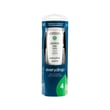
The model number controls parts compatibility for key systems like the ice maker, water filter, door gaskets, and electronic controls. For example, ordering the correct water filter for this model is tied to the exact model identification (see refrigerator water filter EDR4RXD1).
After you have the model number
Use it to confirm the exact replacement part you need:
- Match the part description and part ID to your symptom (cooling, leaking, ice maker, door seal)
- Cross-check the part in the parts list for your model
- Use the manual for location diagrams and operating details
Last updated: February 2026
Is a top or bottom mount fridge better?
A top-mount (top-freezer) refrigerator is typically more energy-efficient and simpler, while a bottom-mount (bottom-freezer) refrigerator like Kenmore 10672013010 is usually more convenient for everyday use because fresh food sits at eye level. “Better” depends on whether you prioritize efficiency, cost, or ergonomics.
Quick comparison: top-mount vs bottom-mount
| Feature | Top-mount (top freezer) | Bottom-mount (bottom freezer) |
|---|---|---|
| Everyday access | You bend more for fresh food | Fresh food is easier to reach |
| Energy use | Typically lower | Typically slightly higher |
| Purchase price | Typically lower | Typically higher |
| Freezer access | Easier to reach | Drawer style, can be deeper |
| Maintenance | Often simpler layouts | More drawers, rails, and seals |
How to decide for your kitchen and habits
- If you cook often and use the refrigerator section most, bottom-mount is the better daily experience.
- If you want the lowest operating cost and simplest design, top-mount is the better value.
- If you store lots of frozen food, compare freezer drawer capacity and how easy it is to organize.
- If you have limited clearance next to a wall, door swing space matters; the manual calls out clearance needs for ventilation and door opening.
- If you have an ice maker or water line, plan for extra space behind the refrigerator for connections.
Why it matters (performance and real-world use)
The “best” layout is the one that keeps temperatures stable and fits your routine. For example, poor clearance can restrict airflow and raise energy use, and poor door alignment can cause warm air leaks that lead to frost, longer run times, and food spoilage.
Model-specific notes for Kenmore 10672013010
From our owner's manual, plan for:
- About 1/2 inch of space on each side and at the top for ventilation
- About 1 inch of space behind the refrigerator
- At least 3 3/4 inches from a fixed wall (hinge side) so the door can swing open
Last updated: February 2026