Owner’s manual
 Error Codes


What's the lifespan of a bottom freezer fridge?
A bottom-freezer refrigerator typically lasts about 13 years with normal household use and basic maintenance. For your Kenmore 59672389411, keeping doors sealing properly, airflow clear, and temperatures stable helps the compressor and fans run efficiently and extend service life (see the 59672389411 owner's manual).
Typical lifespan and what affects it
Most bottom-mount (bottom-freezer) refrigerators land in this range:
| Use and care level | Typical lifespan | What you usually see |
|---|---|---|
| Light use, good maintenance | 14 to 17 years | Fewer cooling and ice maker issues |
| Average household use | About 13 years | Normal wear items over time |
| Heavy use, poor airflow/dirty coils | 8 to 12 years | Longer run times, warm temps, icing |
Maintenance that adds years (and prevents common failures)
We recommend these practical habits for the Kenmore 59672389411:
- Keep doors fully closed and minimize openings; warm air drives longer run times.
- Do not block air vents inside the refrigerator; blocked vents cause warm spots and icing.
- Allow 24 hours after installation or major changes for temperatures to stabilize.
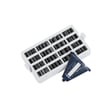
- Replace the air filter on schedule to reduce odors and keep airflow fresh (use refrigerator air filter W10311524).
- Fix door sealing issues early; a leaking gasket makes the compressor run more than it should.
Signs your fridge is nearing end of life
These symptoms often show up in the last few years of service:
- Refrigerator or freezer temperature swings even after adjustments
- Motor/compressor seems to run almost constantly
- Frost buildup on the back wall or repeated defrost problems
- Water leaks or recurring puddles
- Ice maker performance becomes inconsistent
Why it matters
A refrigerator that runs too long or struggles to hold temperature uses more energy and can shorten the life of major components like the compressor, evaporator fan motor, and electronic control board. Catching airflow and sealing problems early is usually the most cost-effective way to protect the cooling system.
Last updated: January 2026
Which is better top mount or bottom mount fridge?
A bottom-mount refrigerator like Kenmore 59672389411 is usually better for everyday convenience because fresh food sits at eye level and the freezer is in a pull-out drawer. A top-mount is often the better pick if you want a simpler layout and typically lower purchase and repair costs.
Quick comparison: top mount vs. bottom mount
- Bottom mount: easier access to refrigerator shelves and crisper drawers; freezer drawer can hold bulky items but may require bending to reach the bottom.
- Top mount: freezer is at eye level; refrigerator section is lower so you bend more for fresh food.
- Organization: bottom mounts commonly offer more drawer-style storage and dividers.
- Energy use: top mounts are often slightly more efficient because the freezer is on top (cold air naturally sinks).
- Repairs: bottom mounts can have more components (drawers, rails, door wiring) that may need service over time.
What we recommend for most households
Choose based on how you use your refrigerator day to day:
- Pick bottom mount if you cook often and want quick access to fresh food, produce, and deli items.
- Pick top mount if you prioritize value, simplicity, and easy access to frozen foods.
- If you have mobility concerns, bottom mount usually reduces bending for fresh-food access.
- If you store lots of frozen items, top mount can feel more convenient.
| Feature | Top mount | Bottom mount (like 59672389411) |
|---|---|---|
| Fresh food access | Lower | Higher (more convenient) |
| Freezer access | Higher | Lower (drawer style) |
| Typical complexity | Lower | Higher |
| Typical efficiency | Often slightly better | Often slightly lower |
Why it matters
The “better” style is the one that matches what you reach for most. Most households access the refrigerator section far more than the freezer, so bottom-mount designs often feel more comfortable and organized over the long term.
Helpful reference for your Kenmore 59672389411
For model-specific features, door alignment, and setup details, use the 59672389411 owner's manual.
Last updated: January 2026
What are the common problems with Kenmore Elite refrigerators?
Common problems we see on Kenmore refrigerators like model 59672389411 include no cooling, frost buildup, dispenser or ice maker issues, and unusual noises. Many fixes start with basic checks in the 59672389411 owner's manual and then move to cleaning, airflow, and a few key parts.
Most common symptoms and what usually causes them
- Not cooling or weak cooling: dirty condenser coils, blocked vents, failed evaporator fan, control settings turned off, or Showroom mode enabled.
- Too much frost or ice buildup: door not sealing, frequent door openings, or a defrost system problem (heater, sensor, or control).
- Water dispenser not working: doors not fully closed, shutoff valve closed, kinked water line, or low water pressure.
- Ice maker not making ice: water supply issue, freezer temperature too warm, or a failed ice maker.
- Buzzing, clicking, or rattling: fan blade hitting ice, loose panels, or compressor/start components.
Quick checks we recommend first (before replacing parts)
- Confirm the refrigerator is plugged into a grounded 3-prong outlet and the outlet has power.
- Make sure cooling is turned on and allow 24 hours after a new install or power interruption for full cooling.
- Verify doors close fully and nothing is holding them open.
- If the dispenser is weak or dead, check the home shutoff valve, straighten any kinks, and confirm 35 psi or higher water pressure.
- Clean condenser coils and make sure interior air vents are not blocked by food packages.
Parts that commonly solve these problems on this model
| Symptom | Part to consider | What it affects |
|---|---|---|
| Warm fridge/freezer, poor airflow | Refrigerator fan motor W10633627 | Circulates cold air across the evaporator |
| Heavy frost, warm temps after a few days | Refrigerator defrost heater WP12729128 | Melts frost off the evaporator coils |
| No ice or intermittent ice | Refrigerator ice maker W11577195 | Produces ice in the freezer |
| No water to dispenser/ice maker | Refrigerator water inlet valve assembly WPW10341329 | Controls water flow into the refrigerator |
Why it matters
Catching airflow, door-seal, and water-supply problems early helps prevent temperature swings that can spoil food, overwork the compressor, and create repeat icing or leaking issues.
Last updated: January 2026