Owner’s manual
 Error Codes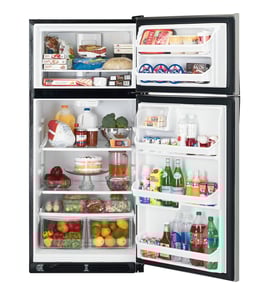



How many cubic feet is my Kenmore Elite washer?
Your Kenmore Elite model 10674202401 is a top-mount refrigerator, not a washer; cubic feet on this model refers to refrigerator capacity, not washer tub size. For the exact cubic-foot capacity for your specific unit, check the model specifications in the owner's manual.
- Look in the Specifications or Product data section of the manual.
- Check the model/serial tag inside the fresh food compartment; some versions list capacity.
- If the tag lists only the model number, use the manual specs for 10674202401.
- Do not use washer capacity ranges; washer “cu ft” numbers do not apply to refrigerators.
Cubic feet is the interior storage volume of the refrigerator (fresh food plus freezer). It helps you compare how much food the cabinet holds, but it does not tell you shelf layout or usable space with bins installed.
Most Kenmore-style top-mount refrigerators are commonly in this range:
| Refrigerator type | Typical total capacity (cu ft) | Notes |
|---|---|---|
| Top-mount refrigerator | 14 to 22 | Varies by cabinet width and features |
| Compact/apt-size | 3 to 10 | Smaller footprint |
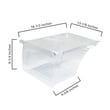
Knowing the correct cubic-foot capacity helps when you are planning kitchen fit, comparing energy use expectations, and choosing storage accessories (like a replacement refrigerator crisper pan W10854037) that match your layout.
Last updated: February 2026
How to tell if a Kenmore refrigerator compressor is bad?
On the Kenmore Elite 10674202401, a bad compressor typically shows up as poor or no cooling even though the unit has power, along with unusual clicking or repeated start attempts, or the refrigerator running much longer than normal. Confirm basics first, because normal compressor and refrigerant sounds can be mistaken for failure (see the owner's manual).
- Make sure the refrigerator control is not set to OFF.
- Verify the outlet has power (reset a tripped breaker or replace a blown fuse).
- If your model has digital controls, turn cooling off, then back on to reset.
- Wait 30 minutes after a reset; an automatic defrost cycle can temporarily stop cooling.
- Listen for normal operating sounds (pulsating or high-pitched compressor sound, gurgling, sizzling during defrost).
A compressor issue is more likely when you see cooling failure plus a start/run problem:
- Clicking every few minutes with little or no cooling (often a start device or compressor overload situation)
- Compressor runs but temperatures stay warm in both fresh food and freezer
- Compressor is very hot to the touch after repeated attempts to run (use caution)
- No compressor sound or vibration while fans may still run
| Sound/behavior | Usually normal | Usually a problem |
|---|---|---|
| Brief buzzing when ice maker fills | Yes | No |
| Gurgling at end of cycle | Yes | No |
| Compressor runs longer than an older fridge | Yes (high-efficiency design) | Only if temps stay warm |
| Repeated clicking with no cooling | No | Yes |
Before replacing a compressor, we typically rule out common related parts that affect starting and airflow:
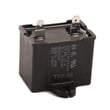
- Upright freezer run capacitor WPW10662129 (start/run circuit support)
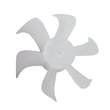
- Evaporator motor WP2315539 (moves cold air through compartments)
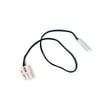
- Refrigerator temperature sensor WP2188819 (can affect cooling control decisions)
Compressors are part of the sealed refrigeration system and are one of the most expensive repairs. Verifying power, control settings, defrost timing, and airflow first prevents unnecessary parts replacement and gets you to the real cause faster.
Last updated: February 2026
What are the common problems with Kenmore Elite refrigerators?
Common problems on the Kenmore Elite 10674202401 top-mount refrigerator are warm temperatures (poor cooling), moisture buildup, doors that do not close or are hard to open, ice maker problems, and water leaks; most are caused by blocked airflow, dirty or sticking door gaskets, or a defrost or fan issue. See the owner's manual troubleshooting section for model-specific checks.
- Not cooling or warming up: blocked air vents, control settings needing adjustment or reset, evaporator fan not running
- Moisture buildup inside: doors opened often, vents blocked, warm food loads added
- Doors will not close: food packages blocking the door, unstable or unlevel cabinet, door alignment issue
- Doors hard to open: dirty or sticky gaskets (often fixed with cleaning and a thin coat of paraffin wax)
- Ice maker not making ice: water supply not fully on, water system not prepared after installation, ice maker component failure
- Water leaks: water supply connection issue, cracked or loose tubing
- Confirm airflow: make sure packages are not blocking interior vents (proper air circulation matters for even cooling).
- Check control settings: verify the temperature controls match room conditions; for digital controls, power the unit off and back on to reset.
- Inspect door sealing: clean the gasket and the surface it touches; if it sticks, apply a thin coat of paraffin wax after cleaning.
- Level and align: if the refrigerator wobbles or doors do not line up, level the cabinet and adjust doors.
- Look for obvious water issues: inspect tubing connections for kinks, cracks, or looseness.
| Symptom | Likely area | Example part on this model |
|---|---|---|
| Warm fridge or freezer | Evaporator airflow | Evaporator motor WP2315539 |
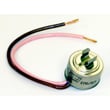
| Frost buildup, warming | Defrost protection | Defrost bi-metal WP4387503 |
| Leaks at water system | Water line/tubing | Refrigerator water tube 8201597 |
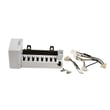
| No ice | Ice maker assembly | Ice maker assembly 4317943 |
Airflow and door sealing drive temperature stability. When vents are blocked or gaskets do not seal cleanly, the refrigerator runs longer, warms during door openings, and can create moisture and frost that lead to bigger cooling and ice maker complaints.
Last updated: February 2026
What model is my Kenmore Elite refrigerator?
Your Kenmore Elite refrigerator’s model number is printed on the model and serial number label inside the fresh food (refrigerator) compartment. For model 10674202401, the label is typically on an inside wall of the refrigerator section; use the owner's manual to confirm the exact label location for your unit.
- Open the refrigerator door and scan the inside side walls at eye level
- Check the inside wall near the crisper drawer area
- Look for a sticker or plate that lists Model and Serial
- Write down the full model number and serial number exactly as shown
- Keep the purchase date with the model and serial information for future service or parts lookup
The model/serial label is usually a white or silver sticker/plate with:
- Model number (for example: 10674202401)
- Serial number (a longer code, often letters and numbers)
- Electrical ratings (volts/amps) and other manufacturing details
Using the exact model number helps us match the correct Kenmore Elite top-mount refrigerator parts, diagrams, and troubleshooting steps. Even small model-number differences can change which door gasket, ice maker, or evaporator fan motor fits.
| What you need | Where it’s found | What to do with it |
|---|---|---|
| Model number | Inside wall of the refrigerator compartment | Use it to match parts and diagrams |
| Serial number | Same label as the model number | Helps identify production details |
| Purchase date | Receipt or records | Useful for maintenance and documentation |
Last updated: February 2026