Owner’s manual
 Error Codes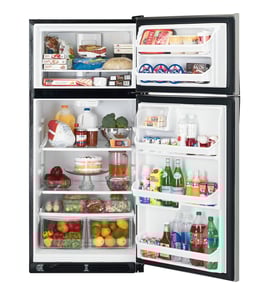


What is the upper part of a fridge called?
On the Kenmore 79568032210 top-mount refrigerator, the upper section is typically called the freezer compartment (or simply the freezer). It’s the coldest area of the appliance and is designed to keep food frozen and store ice.
- Freezer compartment
- Freezer section
- Top freezer
- Freezer cabinet (less common)
- Freezer liner (refers to the interior walls, not the whole section)
The freezer section is more than just a storage box; it supports several key cooling functions.
- Maintains temperatures cold enough for long-term frozen storage
- Helps drive overall cooling by circulating cold air to the fresh food section
- Houses the evaporator area on many top-mount designs
- Often contains the ice maker (if equipped) and ice bin
| Term | What it means | Where it is |
|---|---|---|
| Freezer compartment | The whole upper frozen-food area | Top section |
| Fresh food compartment | The refrigerator (non-freezer) area | Bottom section |
| Air damper | Door/vent that meters cold air to the fridge section | Between sections |
| Door gasket | The seal that keeps warm air out | Around the door perimeter |
Using the right term helps when you’re troubleshooting temperature issues, ordering parts, or reading diagrams. For example, if the freezer door is not sealing, warm air can cause frost buildup and poor cooling in both sections.
For model-specific diagrams and naming, use the 79568032210 owner's manual.
Last updated: January 2026
How much clearance does a refrigerator need on top?
For the Kenmore 79568032210 top-mount refrigerator, we recommend leaving about 1/2 inch to 1 inch of clearance above the cabinet so heat can escape and the refrigerator can run efficiently. For the exact installation clearances for your kitchen layout, use the 79568032210 owner's manual.
These clearances help airflow around the condenser area and reduce overheating.
- Top: 1/2 to 1 inch
- Rear: 1 to 2 inches
- Sides: 1/8 to 1/4 inch (enough to prevent rubbing and allow door swing)
- Front: keep the grille area unobstructed; do not block vents
| Location | Typical clearance | Why it helps |
|---|---|---|
| Top | 1/2 to 1 in. | Lets warm air rise away from the cabinet |
| Rear | 1 to 2 in. | Improves airflow and heat rejection |
| Sides | 1/8 to 1/4 in. | Prevents cabinet contact and door interference |
Some installations need extra room beyond the typical minimums.
- Tight overhead cabinets that trap heat
- A recessed alcove with limited rear airflow
- A warm garage or enclosed pantry location
- Doors that need more swing clearance for bins and drawers
Too little clearance can trap heat, increase run time, and lead to warmer temperatures in the fresh food section or freezer. Proper spacing helps the compressor and condenser fan move heat out efficiently.
Last updated: January 2026
How to clean the drip pan on a Kenmore refrigerator?
On Kenmore refrigerator model 79568032210, the drip pan (drain pan) collects defrost water that evaporates near the compressor. We clean it by safely accessing the pan, washing and disinfecting it, then reinstalling it so it sits flat and does not spill. See the 79568032210 owner's manual for your model’s access method.
- Unplug the refrigerator or switch off power at the breaker.
- Remove the lower rear access cover or front toe grille only if your model uses one.
- Protect the floor with towels; the pan can slosh when moved.
- Wear gloves; drip pans often have mold or bacteria.
- Avoid tipping the refrigerator more than necessary.
- Pull the refrigerator straight out to create working space.
- Locate the drip pan near the compressor area (commonly at the back, low to the floor).
- Slide the pan out carefully; keep it level.
- Wash with hot water and dish soap.
- Disinfect with a mild bleach solution (about 1 tablespoon bleach per 1 gallon of water), then rinse.
- Dry completely and slide the pan back in until fully seated.
- Restore power and confirm the refrigerator is level.
- Check the defrost drain for clogs (food debris or ice).
- Make sure the refrigerator is level so water flows to the pan.
- Inspect door gaskets for gaps that can cause excess frost and defrost water.
- If you see heavy frost buildup, the defrost system may need service.
| Situation | Recommended cleaning |
|---|---|
| Normal use, no odors | Every 6 to 12 months |
| Musty smell or visible mold | Clean now, then every 3 months |
| Water on floor near fridge | Clean and inspect drain immediately |
A clean drip pan helps prevent odors, mold growth, and overflow that can cause puddles under the refrigerator.
Last updated: January 2026
What size is Kenmore refrigerator model 79568032210?
Kenmore refrigerator model 79568032210 is a top-mount (top freezer) refrigerator; the exact exterior dimensions and total capacity vary by configuration and are listed in the product specifications section of the 79568032210 owner's manual. Use the manual specs to confirm fit through doorways and into the cabinet opening.
“Size” can mean capacity (cu. ft.) or physical dimensions (W x D x H). For 79568032210, we recommend checking these items:
- Overall capacity (cu. ft.): helps compare storage space
- Width: critical for cabinet cutout and doorway clearance
- Depth: confirm whether depth includes handles and doors
- Height: confirm whether height includes hinges
- Clearances: space needed for airflow and door swing
If you are estimating before measuring, most Kenmore top-mount units fall into these common ranges:
| Spec | Typical range (top-mount) | What to measure at home |
|---|---|---|
| Width | 29 to 33 inches | Cabinet opening and doorway |
| Depth | 30 to 34 inches | From wall to front of handles |
| Height | 66 to 70 inches | Floor to top hinge area |
| Capacity | 18 to 22+ cu. ft. | Compare to your current fridge |
- Measure width at the widest point, including door edges.
- Measure depth two ways: cabinet only, then cabinet plus handles.
- Measure height to the top hinge cover (not just the cabinet).
- Allow extra space to tilt and maneuver the refrigerator during install.
Getting the correct dimensions prevents delivery day surprises, protects flooring and cabinetry, and ensures proper airflow so the compressor and condenser can cool efficiently.
Last updated: January 2026