Installation guide
 Owner’s manual
 Error Codes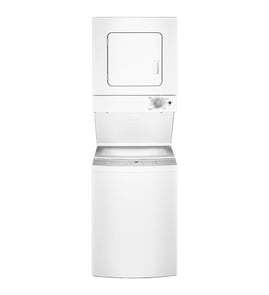




How long is the Frigidaire normal wash cycle?
On the Frigidaire GLET1031FS1 stacked laundry center, the Normal wash cycle typically runs about 60 to 80 minutes. Actual time can change with load size, water temperature, and how the cycle is set on your control panel; confirm your exact cycle chart in the GLET1031FS1 owner's manual.
What can make the Normal cycle longer or shorter?
- Load size and fabric type: heavier loads and bulky items take longer to wash and spin out
- Water temperature selection: colder water can extend wash action needed for cleaning
- Soil level: heavily soiled loads often need more agitation time
- Out-of-balance loads: the washer may pause and redistribute before spinning
- User changes mid-cycle: pushing in the cycle knob and reselecting settings can change total time
Quick timing guide (what to expect)
| Cycle type | Typical time range | Best for |
|---|---|---|
| Normal | 60 to 80 minutes | everyday mixed loads |
| Short/light cycles | 30 to 45 minutes | small, lightly soiled loads |
| Heavy/permanent press style cycles | 70 to 95 minutes | heavier soil, more wrinkle control |
How to estimate your cycle time at home
- Start a Normal load and note the start time.
- If you stop the washer, push in the cycle selector knob; restarting or changing settings can affect total time.
- Remember the lid can stay locked 2 to 3 minutes after the tub stops spinning, so “end of cycle” and “lid opens” are not always the same moment.
Why it matters
Knowing the Normal cycle length helps you plan laundry loads, spot performance issues (like repeated rebalancing), and avoid leaving clothes sitting after the cycle ends, which can lead to odors or wrinkles.
Last updated: January 2026
Where to put fabric softener in a Frigidaire washer?
On the Frigidaire GLET1031FS1 stacked laundry center, liquid fabric softener goes in the built-in fabric softener dispenser on the agitator (if your unit has one). If your model does not have a dispenser, add diluted softener during the final rinse, not directly on clothes.
How to add fabric softener (built-in dispenser models)
Follow the steps shown in the GLET1031FS1 owner's manual:
- Pour liquid fabric softener into the dispenser cup on the agitator
- Add water to bring the liquid level up to the fill line on the dispenser cap
- Start the wash cycle as normal
- Remove the dispenser after each use
- Rinse the cap and cup with warm water, then reinstall it on the agitator
If your washer does not have a fabric softener dispenser
Use the final rinse method to prevent staining and residue:
- Dilute the fabric softener with water (per the softener label)
- Add the diluted mixture to the washer during the final rinse
- Do not pour undiluted softener directly onto the wash load
Quick comparison
| Washer setup | Where softener goes | Key tip |
|---|---|---|
| Built-in dispenser on agitator | Dispenser cup | Add water to the fill line |
| No dispenser | Final rinse (diluted) | Never pour directly on clothes |
Why it matters
Adding softener in the right place helps prevent blue stains, oily-looking spots, and buildup in the tub or on fabrics. Using the dispenser (or diluting for the final rinse) also helps the softener disperse evenly through the load.
Last updated: January 2026
What is the purpose of GLET1031FS1?
The Frigidaire GLET1031FS1 is a stacked laundry center designed to wash and dry clothes in one space-saving unit. It combines a washer and an electric dryer in a single cabinet, making it a practical choice for closets, apartments, and other tight laundry areas.
What this model is built to do
A stacked laundry center like the GLET1031FS1 is meant to handle everyday laundry from start to finish without needing separate machines.
- Wash and spin clothes in the lower washer section
- Dry clothes in the upper electric dryer section
- Fit into smaller spaces where side-by-side units will not
- Vent dryer exhaust safely through an approved exhaust system
- Connect to household drain and electrical supply per requirements
Key installation needs to plan for
The installation guide for this model focuses on the essentials you must have ready before setup.
| What to plan | What it affects | What to check |
|---|---|---|
| Drain requirements | Washer can empty properly | Standpipe, sink, or drain hookup height and flow |
| Exhaust system requirements | Dryer dries efficiently and safely | Vent material, length, and outside termination |
| Electrical connections | Unit powers correctly | 3-wire vs 4-wire cord connection at terminal block |
| Location and rough-in dimensions | Unit fits and can be serviced | Clearance, access, and utility placement |
For the exact rough-in dimensions, venting rules, and 3-wire/4-wire connection steps, use the GLET1031FS1 installation guide.
Why it matters
When the drain, venting, and electrical setup match the requirements, the washer drains reliably, the dryer dries faster, and you reduce overheating and nuisance shutdown issues that often come from restricted airflow.
Last updated: January 2026
How to reset a Frigidaire washer/dryer combo?
To reset your Frigidaire GLET1031FS1 stacked laundry center, we recommend doing a simple power reset: turn the controls to OFF, unplug (or switch the breaker off) for 5 minutes, then restore power and start a new cycle. This clears many control glitches and stuck-cycle issues.
Quick reset steps (safe for most situations)
- Turn the washer and dryer controls to OFF.
- Unplug the laundry center, or switch OFF the circuit breaker/fuse.
- Wait 5 minutes.
- Restore power.
- Select a cycle and start the washer or dryer.
For model-specific control behavior and cycle-start steps, use the GLET1031FS1 owner's manual.
If the washer seems “stuck” in spin or the lid will not open
This model uses a lid lock during spinning; it can stay locked for 2 to 3 minutes after the tub stops.
- Push in the cycle selector knob to stop the washer.
- Wait 2 to 3 minutes for the lid lock to release.
- Do not force the lid open.
- After the lid unlocks, reselect the cycle and pull out the knob to restart.
If the dryer will not start after a reset
A reset will not bypass normal start conditions. Check these common items:
- Door fully closed (dryer stops when the door is opened).
- Cycle selector set to a cycle (not between settings).
- Start control turned to ON and held 1 to 2 seconds.
- Power restored at the breaker/fuse box.
What “reset” fixes vs. what it does not
| Situation | Reset helps? | What to do next |
|---|---|---|
| Control glitch, cycle won’t advance | Yes | Power reset, then restart cycle |
| Lid locked right after spin | Sometimes | Wait 2 to 3 minutes |
| Dryer won’t start at all | Sometimes | Check door, timer setting, start control |
| No heat or long dry times | No | Follow airflow and heating troubleshooting |
Why it matters
Resetting safely protects the timer/control and helps you avoid forcing a locked lid or repeatedly cycling power too quickly, which can make intermittent electrical problems harder to diagnose.
If you’re seeing an error code, use Frigidaire laundry center -washer error codes and Frigidaire laundry center -dryer error codes to match the code to the right next step.
Last updated: January 2026