Owner’s manual



How to factory reset LG sensor dryer?
For the LG DLE7300VE dryer, a true “factory reset” is typically done by power-cycling the control; it clears many temporary glitches but does not change the dryer’s built-in cycle programming. Turn the dryer off, cut power briefly, then restore power and restart the cycle using the control panel steps in the DLE7300VE owner's manual.
- Press POWER to turn the dryer off.
- Unplug the dryer (or switch the breaker off).
- Wait 1 to 5 minutes.
- Restore power.
- Press POWER, select a cycle, then press START/PAUSE.
- If the dryer was paused, remember it can shut off automatically after about 60 minutes if not resumed.
A stored Custom PGM can make the dryer feel like it “won’t reset” because it recalls your saved settings.
- Turn the dryer on.
- Press Custom PGM to recall the saved program.
- To overwrite it: choose your new cycle and options, then press and hold Custom PGM for 3 seconds.
| What you’re trying to fix | Reset usually helps? | What to do next |
|---|---|---|
| Control panel acting frozen | Yes | Power-cycle, then reselect cycle and press START/PAUSE |
| Dryer won’t start | Sometimes | Check door fully closed; verify power supply; then reset |
| Long dry times or airflow warnings | No | Check venting and lint filter; run airflow check per manual |
| Error codes (tE1/tE2, HS, PF/nP/PS) | Sometimes | Address the cause shown; power issues and sensor faults need correction |
Resetting the dryer is a quick first step for sensor-dry and control glitches, but problems like restricted venting, power supply issues, or failed sensors will keep coming back until the underlying cause is fixed.
If you’re seeing an error code, use our LG dryer error codes guide alongside the manual’s code chart to match the code to the most likely cause.
Last updated: February 2026
Where to find the model number on a LG dryer?
On an LG dryer like model DLE7300VE, the model number is printed on the appliance’s rating label. You’ll typically find that label on the door opening (cabinet frame) or on the back of the dryer near the top; match it to your paperwork for parts and service.
Check these spots in this order:
- Inside the door opening on the cabinet frame (open the door and look around the opening)
- Back of the dryer near the top edge
- Behind the control panel area (less common; only check if you already have access during a repair)
- Owner paperwork that came with the dryer (often lists model and serial)
The rating label usually includes both the model and serial number. Copy the model number exactly (letters, numbers, and any dashes).
| Item on label | Why it matters |
|---|---|
| Model number (example: DLE7300VE) | Ensures you get the correct LG dryer parts and diagrams |
| Serial number | Helps confirm production details for service and support |
| Electrical info | Useful when diagnosing power or heating issues |
Using the exact model number prevents ordering the wrong part when you’re replacing common wear items such as a drum belt, idler pulley, or thermostats. It also helps you follow the correct procedures and specs in the DLE7300VE owner’s manual.
If your dryer is noisy, not tumbling, or taking too long to dry, confirm the model number first, then compare the part description to your symptom:
- No tumble or squealing: inspect the LG dryer drum belt 4400EL2001F
- Thumping or rumbling: check drum rollers and the idler pulley
- Overheating or shutting off: test thermostats and the thermistor
Last updated: February 2026
What is the most common problem with LG dryers?
The most common problem we see with LG dryers like model DLE7300VE is poor drying or no heat, and the root cause is usually restricted venting or airflow (often flagged by Flow Sense). The next most common issue is a no-tumble condition from a worn belt or drum support parts.
- Long dry times or clothes still damp: lint filter clogged, vent restriction, overloaded drum, or incorrect cycle settings.
- Runs but no heat: a power supply issue can let an electric dryer run without heating; heating circuit parts can also be involved.
- Flow Sense stays on: the vent restriction may be cleared, but the indicator can take multiple consecutive cycles to reset.
- No tumbling or squealing/thumping: belt, idler pulley, or support rollers are worn.
- Stops too soon on sensor cycles: very small loads can confuse the moisture sensing; time dry works better.
- Clean the lint filter before every load; hold it up to a light to confirm it is not film-clogged.
- Check airflow at the outside vent hood; weak flow points to a crushed hose, lint buildup, or a blocked hood.
- Confirm the cycle and options match the load; some energy-saving settings add air-dry time and can feel like “not heating.”
- Avoid very small loads on sensor dry; add a few items or use time dry.
- If the dryer runs but does not heat, check the home breaker; electric dryers can run with only one leg of power.
| Symptom | Most likely cause | Example part for DLE7300VE |
|---|---|---|
| Drum will not turn | Broken/worn belt | LG dryer drum belt 4400EL2001F |
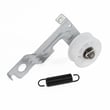
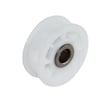
| Squeal, rumble, thump | Worn roller or idler | Dryer drum support roller 4581EL2002H or LG dryer idler pulley 4561EL3002A |
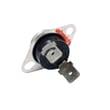
| Overheats or shuts off | Airflow restriction or thermostat issue | Dryer high-limit thermostat 6931EL3003D |
Airflow problems do more than slow drying; they can trigger Flow Sense warnings, cause overheating shutdowns, and shorten the life of heating and drum-drive components. Fixing venting and load habits often restores normal drying without major repairs.
- Use the troubleshooting charts and Flow Sense guidance in the DLE7300VE manual.
- If you see a code, match it to the symptom using LG dryer error codes.
Last updated: February 2026
How to remove front of LG dryer to clean?
To remove the front on your LG DLE7300VE dryer for cleaning, we unplug the dryer first, then remove the top panel, control panel (as needed), and the front panel so we can vacuum lint from the blower area and cabinet. Use the DLE7300VE owner's manual for the exact screw locations and safety notes.
- Unplug the dryer to prevent electric shock.
- Let the dryer cool completely.
- Wear gloves; sheet metal edges can be sharp.
- Support the door and front panel as you remove fasteners (the door is large and heavy).
- Avoid pulling on wires; disconnect harnesses by the connector, not the wires.
- Unplug the dryer.
- Remove the lint screen, then remove the screws in the lint screen housing opening (common access point for top release screws).
- Release the top panel: slide it back and lift it off (or lift the front edge after releasing clips, depending on build).
- Remove the control panel (if it blocks the front panel screws): take out mounting screws and set the panel on top of the cabinet without straining the wiring.
- Remove the front panel screws (usually along the top inside corners once the top is off).
- Lift the front panel up and off the lower mounting tabs.
- Disconnect the door switch harness if it is attached to the front panel.
- Lint buildup around the blower housing and base
- The door opening and seal area (wipe with a soft, damp cloth)
- The lint filter and lint chute
- The exhaust outlet area and transition duct
| Symptom you notice | Common cause | Part to inspect |
|---|---|---|
| Squealing or thumping | Worn roller or idler | Dryer drum support roller 4581EL2002H or LG dryer idler pulley 4561EL3002A |
| Drum not turning | Broken belt | LG dryer drum belt 4400EL2001F |
| Poor airflow, long dry times | Lint restriction | Venting and blower area |
Lint inside the cabinet can restrict airflow, increase dry times, and overheat components. Cleaning the cabinet and checking airflow helps your LG dryer run more efficiently and protects heating and thermostat parts.
Last updated: February 2026