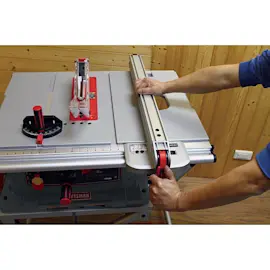
Owner’s manual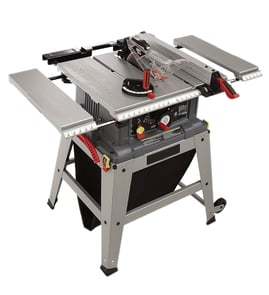

Where is the reset button on a Craftsman table saw?
On the Craftsman table saw model 137248100, the reset is the overload reset button on the switch housing (near the ON/OFF switch), not a separate “reset” on the outside of the saw. If the motor shuts off from overload or low voltage, you press this reset after the motor cools.
Where to find it on model 137248100
Look for the ON/OFF switch with the removable safety key; the overload reset button is located on that same switch assembly.
- Find the ON/OFF switch on the saw
- Identify the removable switch key (used to lock out the saw)
- Locate the overload reset button on the switch housing
- If the saw stopped mid-cut, treat it as an overload trip and reset it only after cooling
For the exact control locations and diagrams, use the 137248100 owner's manual.
How to reset it safely (recommended steps)
If the motor stopped during a cut, reset the overload like this:
- Turn the switch OFF
- Unplug the power cord
- Wait about 5 minutes for the motor to cool
- Press the overload reset button
- Plug the saw back in and turn it ON
Quick checklist before you restart
- Blade spins freely by hand (with the saw unplugged)
- Blade is sharp and appropriate for the material
- Fence and blade are aligned (binding can overload the motor)
- Workpiece is supported; you are not forcing the feed rate
What usually causes the overload to trip
Overload trips are most often caused by cutting conditions that make the motor work too hard.
| Common cause | What you notice | What to do next |
|---|---|---|
| Dull/dirty blade | Burning, slow feed, rough cut | Clean or replace blade |
| Fence/blade misalignment | Pinching, kickback tendency | Re-align blade and fence |
| Feeding too fast | Motor bogs down | Slow the feed rate |
| Thick/hard stock | Frequent trips | Use correct blade, take lighter passes |
A helpful next step for cut-quality and alignment issues is our table saw bad cuts guide.
Why it matters
The overload reset protects the drive motor and wiring from overheating. Resetting without fixing the underlying bind, dull blade, or alignment problem can cause repeated shutdowns and poor cuts.
If you need replacement parts for your Craftsman 137248100 table saw, we list model-matched parts on the parts diagram, and you can also search by model number on Sears PartsDirect.
Last updated: February 2026
What are the common table saw mistakes?
Common mistakes on the Craftsman 137248100 table saw include skipping basic safety checks, using the wrong guide for the cut (rip fence vs. miter gauge), setting the blade height incorrectly, and cutting warped stock. Our owner's manual lays out the required pre-use checks and safe ripping and crosscutting steps.
Most common mistakes to avoid
- Cutting without eye protection and basic PPE
- Leaving the blade guard, splitter, and anti-kickback parts off or not functioning
- Ripping with the miter gauge installed (remove it for ripping)
- Crosscutting with the rip fence still in place (remove the fence for crosscuts)
- Setting the blade too high; we set it about 1/8 inch above the workpiece for many cuts
- Ripping twisted, warped, bowed, or edge-not-straight lumber (higher kickback risk)
- Standing directly in line with the cut path (kickback zone)
Quick “do this, not that” guide
| Task | Do this | Avoid this |
|---|---|---|
| Ripping (with the grain) | Use the rip fence; keep it parallel to the blade | Using the miter gauge while ripping |
| Crosscutting (across the grain) | Use the miter gauge in the groove | Leaving the rip fence on for the cut |
| Blade height | Set blade about 1/8 inch above the workpiece | Raising the blade excessively |
| Stock selection | Use straight, flat stock with a straight edge | Cutting warped or twisted boards |
Pre-cut safety checks we recommend every time
These checks prevent the most common “one-second” mistakes that cause binding, kickback, and poor cuts:
- Confirm the blade is tight on the arbor
- Tighten the bevel angle lock knob
- If ripping, lock the fence and verify it is parallel to the miter gauge grooves
- Verify the blade guard is installed and working properly
- Wear safety glasses; keep hands out of the blade path
Why it matters
Most table saw injuries and bad cuts come from the same root causes: the workpiece binds, the fence or gauge is used incorrectly, or the operator’s hands drift into the blade path. Following the correct setup for ripping vs. crosscutting and keeping the guarding system working reduces kickback risk and improves cut accuracy.
Related DIY help
You can also look up diagrams and replacement parts by model number on Sears PartsDirect.
Last updated: February 2026
What size blade is a Craftsman 137248100 table saw?
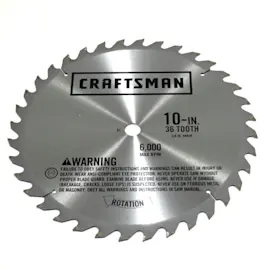
The Craftsman 137248100 table saw uses a 10-inch blade. This is the correct blade diameter for this model’s arbor and guard setup; using the proper size helps the blade reach full speed safely and keeps the throat insert and blade guard aligned.
How to confirm the blade size on your saw
We recommend verifying the blade diameter and any blade requirements in the 137248100 owner's manual.
- Check the manual cover and specifications section for “10-inch blade”
- Confirm the blade is labeled 10 in. on the blade itself
- Verify the blade spins freely without contacting the insert or guard
- Make sure the blade is installed with the teeth facing the correct direction
- Tighten the arbor nut securely (do not overtighten)
Blade size vs. other common table saw blades
Most jobsite and contractor-style table saws use a 10-inch blade, but smaller benchtop saws sometimes use 8-1/4 inch blades. For the Craftsman 137248100, stick with 10-inch.
| Blade diameter | Typical use | Fit for Craftsman 137248100 |
|---|---|---|
| 8-1/4 in. | Compact benchtop saws | No |
| 10 in. | Most table saws | Yes |
| 12 in. | Larger cabinet saws | No |
Why it matters
Using the correct blade diameter helps maintain proper cutting depth, keeps the blade guard and insert working as designed, and reduces the chance of binding or unsafe contact with the table insert.
Related DIY help
If you are swapping blades, follow a step-by-step procedure to avoid damaging the arbor threads and to reinstall the guard correctly: how to replace a table saw blade. If your cuts are not square after a blade change, calibration steps can help: how to adjust a table saw blade.
If you need replacement parts for the Craftsman 137248100, start with the model’s parts list, or search by model number on Sears PartsDirect.
Last updated: February 2026
Does Craftsman make a good table saw?
Yes. Craftsman table saws like model 137248100 are a solid choice for DIYers and hobbyists who want good cutting power and straightforward operation; they are less ideal for production-level precision work unless you spend time tuning the fence, blade alignment, and bevel stops using the 137248100 owner's manual.
What you can expect from the Craftsman 137248100
This model is designed as a practical, high-speed 10-inch table saw for common shop tasks.
- Power and speed: 3.0 HP (max developed) and 5000 RPM for the blade
- Electrical: factory wired for 110-120V on a 15A time-delay fuse or breaker
- Best fit: ripping and crosscutting for home projects, learning, and general woodworking
- Where it needs attention: accuracy depends heavily on setup and periodic adjustments
How to judge “good” for your needs
A table saw is “good” when it matches your accuracy expectations, workload, and how much tuning you are willing to do.
| If you mostly do… | Craftsman 137248100 is typically… | What to focus on |
|---|---|---|
| DIY projects, basic cuts | A good value | Blade condition, fence alignment, clean mechanisms |
| Furniture-grade joinery | Usable with tuning | Miter/fence calibration, sled/jig setup |
| Heavy daily use | Not the best match | Motor load, vibration control, repeatable fence settings |
Setup and maintenance that make the biggest difference
These steps are what most often separate “frustrating” from “good” results.
- Calibrate bevel stops so 45° cuts land accurately
- Keep the blade-raise and tilt mechanisms clean; sawdust buildup causes stiffness and slop
- Use dry lubricants (graphite or silicone) on pivots and threaded rods; avoid oil/grease that holds sawdust
- Inspect the power cord and replace it immediately if worn, cut, or damaged
- Use a push stick and follow the safety rules every time
Why it matters
Most “mixed reviews” on table saws come down to alignment, fence repeatability, and maintenance. When the saw is tuned and kept clean, you get straighter rips, safer feeding, and less burning or binding.
For cut-quality troubleshooting and tuning ideas, we recommend our DIY guide on table saw bad angle cuts. For parts lookups by model number, use the parts list for 137248100 or search on Sears PartsDirect.
Last updated: February 2026