Owner’s manual
 Error Codes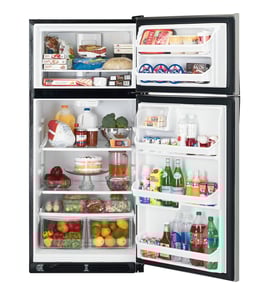


How to tell cubic feet of Kenmore refrigerator by model number?
You generally can’t determine the exact cubic-foot capacity from the Kenmore model number alone. For Kenmore model 10670932901, the most reliable way is to check the capacity listed on the product data label or in the 10670932901 owner's manual.
Best ways to find the cubic feet (in order)
- Check the product data label (often inside the fresh food compartment on a side wall or ceiling area).
- Look in the specifications section of the 10670932901 owner's manual.
- Measure the interior and calculate an estimate (useful when the label is missing).
- If you are comparing similar Kenmore 106 top-mount units, use the label or manual for each model because sizes vary.
How to estimate cubic feet by measuring (quick method)
If you need an estimate, measure the usable interior (not the outside cabinet):
- Fresh food compartment: width x depth x height
- Freezer compartment: width x depth x height
Then convert cubic inches to cubic feet:
| What to do | Formula |
|---|---|
| Convert to cubic inches | width x depth x height |
| Convert to cubic feet | cubic inches ÷ 1,728 |
Tip: Shelves, drawers, the evaporator cover, and air channels reduce usable space, so a measured estimate often differs from the advertised capacity.
Why the “outside dimensions” method is misleading
Using exterior cabinet dimensions (for example, overall depth and height) overstates capacity because it includes insulation, the sealed system area, and non-storage spaces. Capacity ratings are based on internal volume, not the outside footprint.
Related help for Kenmore refrigerators
If you are troubleshooting cooling or ice production while you’re checking specs, we recommend reviewing Kenmore 106 model refrigerator error codes.
Last updated: January 2026
What does code er if mean on Kenmore Elite fridge?
On Kenmore model 10670932901, the user manual does not use “ER IF” as a standard display error code; when you see ER IF, treat it as a fan or airflow-related cooling fault affecting the freezer and ice maker area, then troubleshoot airflow and the evaporator fan circuit.
What “ER IF” usually points to
On Kenmore refrigerators that display this message, it commonly relates to the refrigerator not sensing the expected airflow or fan operation needed to keep the ice maker and freezer properly cold.
Check these common causes first:
- Frost or ice buildup restricting airflow behind the rear freezer panel
- Evaporator fan not running, running intermittently, or hitting ice
- Blocked vents from overpacked food
- Door not sealing, causing excess frost and airflow restriction
- Loose wiring connection at the fan or control
What to do first (safe checks)
- Power reset: Unplug the refrigerator for 5 minutes, then restore power.
- Confirm airflow: Make sure freezer vents are not blocked.
- Listen for the fan: With the freezer door closed (or door switch held), listen for a steady fan sound.
- Inspect for frost: Heavy frost on the freezer back wall points to an airflow restriction or defrost issue.
Quick symptom guide
| What you notice | Most likely issue | Best next step |
|---|---|---|
| Freezer warming, little or no fan sound | Fan not running | Inspect and test the evaporator fan motor |
| Grinding/buzzing from freezer | Fan blade hitting ice or failing motor | Defrost ice buildup; replace fan motor if noise returns |
| Heavy frost on back wall | Airflow restricted (often defrost-related) | Clear frost; then diagnose defrost components |
Parts that commonly solve fan-related cooling faults
If the evaporator fan is not running or is noisy, the repair is often replacing the refrigerator evaporator fan motor WP2315539.
Why it matters
When airflow drops, the freezer temperature rises, ice production slows, and the compressor can run longer than normal. Fixing airflow quickly helps protect food and restores normal cooling.
For model-specific operating and troubleshooting steps (controls, ice maker use, normal sounds), use the 10670932901 owner's manual.
Last updated: January 2026
What is the top part of a fridge called?
On the Kenmore top-mount refrigerator model 10670932901, the top compartment is the freezer. It’s designed to keep foods frozen and, on many setups, it also houses the ice maker and the vents that circulate cold air down into the fresh-food section (refrigerator compartment). See the 10670932901 owner's manual.
What the freezer does (and why it matters)
The freezer is more than “the cold box” on top; it helps the whole refrigerator cool correctly.
- Keeps food at freezing temperatures for long-term storage
- Supplies cold air that circulates between freezer and refrigerator sections
- Contains airflow vents that should not be blocked by food packages
- Often includes the ice maker area (if your refrigerator is equipped with one)
Why it matters
If the freezer vents are blocked, airflow is restricted and you can end up with temperature swings, moisture issues, and uneven cooling in both compartments.
Quick terminology guide
Here are the common names customers use for the “top part,” and what they usually mean.
| What people say | What it usually refers to | Where it is |
|---|---|---|
| “Top part of the fridge” | Freezer compartment | Upper section |
| “Fridge part” | Fresh-food (refrigerator) compartment | Lower section |
| “Top vent” | Air vent feeding the refrigerator section | Upper area of fresh-food section |
Helpful tips for better cooling
We recommend these basics for Kenmore top-mount refrigerators like model 10670932901:
- Leave space around vents in both compartments so air can circulate
- Wrap or cover foods tightly to reduce odor transfer between sections
- After installation or a power outage, allow about 24 hours for temperatures to stabilize
- Keep the temperature control near the mid-setting first, then adjust gradually
Last updated: January 2026