 Error Codes



How to lower wheels on Kenmore refrigerator?
To lower the front wheels (leveling legs) on your Kenmore refrigerator model 59673504203, turn the front leveling screw counterclockwise. The screw is an adjuster, so it keeps turning to change height and typically does not “back out” like a normal screw.
Steps to lower the front wheels safely
- Unplug the refrigerator or switch off power at the breaker.
- Pull the refrigerator straight out a few inches so you can reach the front corners.
- Locate the leveling screw/bolt at the front (often behind the toe grille).
- Use the correct tool (commonly a 1/4-in or 3/8-in nut driver, or an adjustable wrench).
- Turn counterclockwise to lower the front; turn clockwise to raise it.
- Recheck door swing and cabinet level; adjust in small increments.
Quick direction guide
| What you want to do | Turn the leveling screw | Typical result |
|---|---|---|
| Lower the front wheels/legs | Counterclockwise | Front drops, doors close more easily |
| Raise the front wheels/legs | Clockwise | Front lifts, doors may swing open less |
If the adjuster is hard to turn
- Remove food from door bins to reduce weight on the front.
- Slightly tilt the refrigerator back (have a helper steady it) to take pressure off the adjuster.
- Clean debris from the front base area and toe grille.
- If the adjuster turns but the height never changes, inspect for a stripped adjuster mechanism or damaged front support.
Why it matters
Proper front height helps the doors self-close, improves gasket sealing, and reduces vibration and noise. If the cabinet is too low in front, doors can drift open and cause temperature swings.
Related help: how to align the doors on a french door refrigerator with adjustable rollers video
Last updated: January 2026
How to find model number on Kenmore?
On a Kenmore refrigerator, the model number is printed on a rating label inside the fresh food compartment or freezer area. For Kenmore model 59673504203, check the inside walls, the door frame, or behind the lower crisper drawers for the label.
Common places to look
- Inside the refrigerator compartment on a side wall (often near the top)
- Inside the freezer compartment on a side wall or back wall
- On the door frame (visible when the door is open)
- Behind or just above the lower crisper drawers
- Behind the toe grille or kick plate at the bottom front
What the label looks like (and what to copy)
The rating label usually includes several identifiers. Copy these exactly:
- Model number (example format: 596.7350XXXX)
- Serial number
- Electrical ratings (volts/amps)
- Manufacturing date code (sometimes shown)
| What you need | Why we ask for it | Example |
|---|---|---|
| Model number | Ensures parts fit your exact refrigerator | 59673504203 |
| Serial number | Helps match production changes | Varies |
Why it matters
Kenmore refrigerators can have multiple versions that look similar but use different parts (like a light switch, water valve, or door bin). Using the exact model number helps us match the correct replacement part the first time.
If the label is hard to read
- Wipe the label gently with a damp cloth and dry it
- Use your phone camera with flash, then zoom in
- If the door is blocking your view, remove drawers for better access
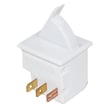
If you are troubleshooting a light that will not turn on while you search for the label, a common related part is the refrigerator switch W11396033.
Last updated: January 2026
What are the common problems with Kenmore Elite refrigerators?
Common Kenmore Elite refrigerator problems include warm temperatures (cooling failure), frost buildup, water leaks, ice maker or dispenser issues, and unusual noises. On Kenmore model 59673504203, these symptoms usually trace back to airflow restrictions, defrost drainage problems, or water-supply component wear.
Most common symptoms and what they usually mean
- Not cooling or weak cooling: dirty condenser coils, evaporator fan not moving air, blocked vents, or a sealed-system issue
- Frost or ice buildup: door not sealing, frequent door openings, or a defrost system problem
- Water under the fridge or in the fresh food section: clogged defrost drain, ice buildup in the drain trough, or a loose water line connection
- No ice or slow ice production: low water pressure, frozen fill tube, or a failing inlet valve
- Buzzing, clicking, or humming: normal cycling, fan blade hitting ice, or a compressor start component problem
Quick checks we recommend before replacing parts
- Set temps to typical targets: 37°F fresh food and 0°F freezer.
- Confirm both doors close fully and bins are not preventing closure.
- Clean condenser coils and verify the condenser fan (if equipped) runs.
- Check for ice blocking the freezer vents or the evaporator fan cover.
- If you have a dispenser, verify household water supply is on and line is not kinked.
Parts that commonly relate to these issues
| Symptom | Likely area | Example part for this model |
|---|---|---|
| No ice or no water dispense | Water inlet system | Refrigerator valve WP12544002 |
| Leaking at a water line connection | Water line fittings | Refrigerator water supply tube union, 5/16 x 5/16-in WP2300868 |
| Interior light or door sensing issues | Door switch circuit | Refrigerator switch W11396033 |
Why it matters
Catching airflow, drainage, and water-supply problems early helps protect food temperatures, reduces ice buildup, and prevents leaks that can damage flooring and nearby cabinets.
Helpful DIY reference
For display codes and troubleshooting steps that often apply across Kenmore refrigerator platforms, use Kenmore 111 model bottom freezer refrigerator error codes.
Last updated: January 2026





