Installation guide
 Owner’s manual


How to figure out dryer model number?
Your Kenmore dryer’s model number is printed on the model and serial number plate; on model 11062702101, it’s the same plate you use to record the model and serial for service and parts matching. Check the door opening area first, then the cabinet frame.
Most Kenmore dryers (including model 11062702101) place the model and serial number plate in one of these common spots:
- Inside the dryer door opening on the cabinet frame (most common)
- On the door frame itself (near the latch side)
- Behind the lower front panel (some designs)
- On the back panel of the dryer cabinet
Use the location diagrams and labeling notes in the 11062702101 owner’s manual to confirm the exact plate location and how it’s labeled.
The plate typically includes both identifiers you need for parts and troubleshooting.
- Model number (example format: 110.XXXXXXXX)
- Serial number (unique to your unit)
- Electrical rating information (varies by version)
- Sometimes a manufacturing code or date code
- Copy the model number exactly as printed (include all digits)
- Copy the serial number exactly (letters and numbers)
- Take a clear photo of the plate for future reference
We use the model number to match the correct Kenmore 11062702101 dryer parts list and ensure compatibility for items like a belt, heating element, thermostat, or door switch. Even small model-number differences can change the correct part.
| Item | What it tells us | Used for |
|---|---|---|
| Model number | The exact dryer design/version | Correct parts and diagrams |
| Serial number | Your specific unit’s production ID | Service history, warranty, production run |
Last updated: January 2026
How to hard reset a Kenmore dryer?
To hard reset your Kenmore dryer model 11062702101, disconnect power by unplugging the dryer (or switching off the breaker) for about 1 to 5 minutes, then restore power and try starting a cycle again. This clears many temporary control or cycle issues.
- Turn the cycle selector to OFF.
- Unplug the dryer (or turn OFF the dedicated breaker).
- Wait 1 to 5 minutes.
- Restore power.
- Close the door fully, select a timed or heat cycle, then press PUSH TO START.
For model-specific operating and start instructions, follow the 11062702101 owner's manual.
A reset will not fix a mechanical failure or a safety device that has opened. Use these quick checks first:
- Confirm the controls are set to a running position (not OFF).
- Press PUSH TO START firmly with the door fully closed.
- Verify the outlet has power and the house fuse or breaker is good.
- Check airflow: a crushed or kinked vent can cause overheating and shutdowns.
- If the dryer runs but stops or has no heat, inspect for overheating causes and consider the thermal safety parts.
If you suspect an overheating shutdown, the dryer thermal cut-off fuse kit 279816 is a common repair item on this platform when airflow problems have occurred.
| What you’re trying to fix | Hard reset helps? | What usually fixes it |
|---|---|---|
| Temporary control glitch or stuck cycle | Yes | Power reset, then restart cycle |
| Dryer will not start due to door not closed | Sometimes | Door alignment, door switch check |
| No heat or shuts down from overheating | No | Vent cleaning, thermostat or thermal cut-off repair |
| Drum will not turn but motor runs/hums | No | Belt or drum support repair |
Hard resets are a fast first step, but dryers also stop or fail to start when safety conditions are not met (door not closed, no power) or when airflow is restricted. Keeping the vent clear and uncrushed helps prevent overheating and repeat failures.
Last updated: January 2026
What is the cubic foot of my Kenmore dryer model 11062702101?
The exact drum capacity (cubic feet) for Kenmore dryer model 11062702101 isn’t listed in the manual excerpts we have for this model. Most 29-inch Kenmore electric dryers of this design are typically around 6.0 to 7.0 cu. ft., so about 6.5 cu. ft. is a practical expectation for planning loads. See the 11062702101 owner's manual for model-specific details and operating guidance.
If you’re comparing dryers or sizing loads, use these practical checks:
- 29-inch wide electric dryers commonly fall in the 6.0 to 7.0 cu. ft. range.
- If your dryer handles a full basket from a typical top-load washer in one cycle, it’s usually in the larger-capacity range.
- If bulky items (comforters, blankets) feel cramped, treat it as closer to 6.0 cu. ft.
- If you’re seeing long dry times, confirm airflow first (venting issues can mimic “small capacity”).
Capacity affects how well clothes tumble and how evenly they dry. Overloading reduces tumbling, increases wrinkles, and can extend cycle time, even when the heater and thermostat are working correctly.
Use this as a simple loading rule-of-thumb:
- Fill the drum no more than about 3/4 full for mixed loads
- Leave space at the top so items can lift and drop
- Dry heavy items (towels, jeans) separately from lightweight items
- Clean the lint screen every load; restricted airflow increases dry time
| Load type | Best fill level | What you’ll notice if overloaded |
|---|---|---|
| Mixed everyday clothes | ~2/3 to 3/4 | Damp spots, longer cycles |
| Towels/denim | ~1/2 to 2/3 | Thumping, poor tumbling |
| Bulky bedding | ~1/2 | Balling up, uneven drying |
If you’re trying to match capacity to performance symptoms (long dry times, odd cycle behavior), use Kenmore 110 series electronic control model dryer error codes to narrow down control and sensor-related issues.
Last updated: January 2026
How do I tell if my dryer heating element is bad?
If your Kenmore dryer model 11062702101 runs but clothes stay damp or you feel little to no heat, the heating element circuit is a top suspect. We confirm by doing a quick “feel for heat” check, then testing the element for continuity with power disconnected.
- Run a timed, high-heat cycle for about 5 minutes, then open the door and feel for heat (a basic check described in the 11062702101 owner's manual).
- Make sure the dryer is on a heat cycle (not Air/Fluff).
- Check airflow: a crushed or kinked vent hose can cause poor heating and overheating.
- Verify power supply: many electric dryers use two fuses or breakers; if one trips, the dryer can run but not heat.
- Unplug the dryer (or shut off the breaker) before opening panels.
- Access the heater terminals (location varies by design; follow the 11062702101 installation guide for safe access and setup basics).
- Use a multimeter on ohms/continuity across the element terminals.
- Interpret results:
- No continuity (open circuit): element is failed.
- Continuity present: element may be OK; keep checking thermostats, thermal cut-off, and airflow.
| Symptom | Most common cause | What to check next |
|---|---|---|
| Runs, no heat | Power issue or open heater circuit | 2 breakers/fuses, element continuity |
| Heats briefly then stops | Overheating protection opening | Vent restriction, thermal cut-off |
| Long dry times | Poor airflow | Lint screen, vent hose, outside hood |
If testing points to a failed heater circuit, these are common replacements for this model:
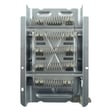
- Dryer element 279838 (the heater itself)
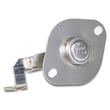
- Dryer thermal cut-off fuse kit 279816 (opens if overheating occurs)
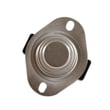
- Dryer operating thermostat WP3387134 (controls cycling temperature)
- Dryer high-limit thermostat WP3977767 (backup overheat protection)
A bad heating element (or an overheating safety device opening due to restricted venting) can turn a normal cycle into “no heat” or very long dry times. Fixing airflow issues first helps prevent repeat failures.
Last updated: January 2026