Installation guide
 Owner’s manual
 Error Codes


How do I reset my Maytag dishwasher f9 e1?
On a Maytag MDBH969AWB1 dishwasher, the most effective “reset” for an F9 E1 (drain problem) is to cancel the cycle and restart it, then correct the drain path so the unit can pump water out normally. Use the steps in the MDBH969AWB1 user manual to confirm the proper Start/Resume and door-close timing.
- Press Cancel/Drain (or the cancel function for your console) to stop the cycle and initiate draining.
- Wait about 1 minute.
- Select a cycle.
- Press START/RESUME.
- Close the door firmly within 3 seconds (top-control models will flash if the door is not closed in time).
- If Control Lock is on, press and hold Heated Dry for 3 seconds to turn it off.
F9 E1 usually returns if the dishwasher still cannot drain. Check these items in order:
- Air gap (if installed): remove the cap and clean out debris.
- Garbage disposal inlet: make sure the knockout plug was removed when the dishwasher drain hose was connected.
- Drain hose routing: verify a high loop under the counter and no kinks or crushing.
- Sink/disposal clog: confirm the sink drains normally.
- Pump area blockage: check for glass, labels, or food pieces that can jam the impeller.
| What you see | What it usually means | What to do |
|---|---|---|
| Water left in tub after cancel | Drain path restricted | Clean air gap, disposal inlet, and hose routing |
| Humming but little/no drain | Pump jam or weak pump | Inspect pump area; test drain pump if needed |
| Drains sometimes, not always | Partial clog or intermittent pump | Recheck hose loop and debris; test pump motor |
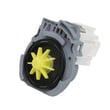
If the drain path is clear and the code returns, we focus on the drain pump circuit.
- Test the drain pump motor for continuity; a typical reading is about 40 to 80 ohms.
- If the pump is noisy, seized, or fails the test, replace the drain pump.
Relevant model part:
F9 E1 is a protection response: if the dishwasher cannot evacuate water, it may stop mid-cycle, leave standing water, and reduce cleaning performance. Restoring proper draining prevents repeat errors and helps protect the pump and wiring.
Last updated: January 2026
What is the average lifespan of a Maytag dishwasher?
Most Maytag dishwashers, including model MDBH969AWB1, typically last 10 to 12 years with normal household use; with consistent cleaning and correct installation, it’s common to reach the upper end of that range. For care and operating guidance that helps maximize service life, follow the MDBH969AWB1 user instructions manual.
A dishwasher’s life is usually determined by heat, water quality, loading habits, and how well it drains.
- Keep the interior and wash system clean (food soil buildup strains the pump and wash system)
- Use the right detergent amount for your water hardness (too much can cause residue, too little reduces cleaning)
- Make sure the door closes and latches firmly every time
- Address slow draining quickly (standing water accelerates odor and component wear)
- Avoid running cycles with heavily blocked spray arms or overloaded racks
The manual calls out practical steps that prevent common problems, including checking a drain air gap if the dishwasher isn’t draining well and preparing the unit for seasonal storage. Use these as a simple routine.
| Maintenance task | Good interval | Why it helps |
|---|---|---|
| Clean the filter area and remove debris | Weekly to monthly | Helps prevent poor wash performance and drain issues |
| Check spray arm holes for clogs | Monthly | Keeps water pressure strong for cleaning |
| Check the drain path (air gap or high loop) | If draining slows | Prevents backups that overwork the drain pump |
| Run a dishwasher cleaner cycle | Monthly to quarterly | Reduces mineral and grease buildup |
A dishwasher that drains and heats correctly cleans better, dries better, and puts less stress on key components like the circulation system, heating circuit, and door latch. Small maintenance steps often prevent the “cycle runs too long” and “not drying” complaints that shorten overall lifespan.
Last updated: January 2026
What is the most common problem with a Maytag dishwasher?
For the Maytag MDBH969AWB1 dishwasher, the most common customer-reported problems are poor cleaning, not draining, and leaking. In many cases, the fix is basic maintenance (filters and spray arms), correct loading, and confirming the door is fully latched and the cycle is started correctly per the MDBH969AWB1 user manual.
- Poor cleaning: clogged filter area, blocked spray arm holes, overcrowded racks, or low water temperature
- Not draining: clogged drain path, dirty air gap (if installed), kinked drain hose, or a weak drain pump
- Leaking: worn door seal, misaligned door, or a cracked/loose hose connection
- Detergent not dispensing: dispenser door blocked by dishes or a failing dispenser assembly
- Cycle seems “stuck” or long: normal pauses can happen during the cycle; restarting correctly matters
- Cancel the cycle and restart; if the START/RESUME light is blinking, press it and close the door firmly within 3 seconds.
- Check the bottom for standing water and clear any visible debris.
- If you have a drain air gap, clean it if the dishwasher is not draining well.
- Confirm the racks are not blocking the detergent dispenser door.
- Run hot water at the sink until it is hot, then start the dishwasher.
| Symptom | Likely part area | Example model-matched part |
|---|---|---|
| Not draining | Drain system | Dishwasher drain pump WPW10348269 |
| Leaking at door | Door sealing | Dishwasher door seal and strike kit W10542314 |
| Poor drying or water not heating | Heating circuit | Dishwasher heating element W10518394 |
These three symptoms (cleaning, draining, leaking) often share the same root causes: restricted water flow, restricted drain flow, or a compromised seal. Catching them early helps prevent repeat wash cycles, odors, and water damage.
Last updated: January 2026