 Installation guide
 Owner’s manual


What brand of dryer has the least problems?
No brand can be named as the single “least-problem” dryer brand for your GE GTDP490ED7WS based on model-specific information alone; reliability varies by model design, installation, and maintenance. For this GE electric dryer, following the venting and care guidance in the GTDP490ED7WS owner’s manual is one of the most effective ways to reduce common failures.
What we can say confidently (and what we cannot)
We cannot verify a universal brand ranking from the GTDP490ED7WS documentation; however, industry experience shows problem rates are often driven more by airflow, heat stress, and usage than by the logo.
- Simple, well-vented dryers tend to have fewer service calls than feature-heavy units
- Electric dryers are especially sensitive to restricted exhaust airflow
- Maintenance habits can outweigh brand differences over time
- Model-to-model variation within the same brand is normal
How to reduce problems on a GE GTDP490ED7WS
The GTDP490ED7WS manual emphasizes lint control and proper venting. Focus on these high-impact steps:
- Clean the lint screen before every load
- Use rigid metal 4-inch ducting when possible
- Keep the vent run short and avoid kinks or crushed ducting
- Inspect and clean the exhaust ducting at least once a year
- Do not overload; it increases dry time and heat buildup
If your dryer is taking longer to dry, use our dryer takes a long time to dry guidance to pinpoint airflow and loading issues.
Quick comparison: what affects “least problems” most
| Factor | Lower-problem setup | Higher-problem setup |
|---|---|---|
| Venting | Short, rigid metal, clear outside hood | Long, crushed, plastic, partially blocked |
| Controls/features | Basic timer and switches | More electronics and sensors |
| Maintenance | Lint screen every load, yearly duct cleaning | Infrequent cleaning, lint buildup |
| Load habits | Medium loads, good tumbling | Overloads, heavy mixed items |
Why it matters
Most dryer complaints (no heat, long dry times, shutting off early) trace back to restricted venting and lint buildup. Keeping airflow correct helps your GTDP490ED7WS run cooler, dry faster, and reduce stress on heating and safety components.
Last updated: January 2026
What is the life expectancy of a GE dryer?
GE electric dryers like model GTDP490ED7WS typically last 10 years with normal household use. With consistent lint and vent maintenance (as outlined in the GTDP490ED7WS owner’s manual), it’s common for a dryer to reach 12 to 15 years before major repairs become frequent.
What affects dryer lifespan the most
- Venting condition (restricted airflow makes the dryer run hotter and longer)
- Lint control (cleaning the lint screen every load)
- Load size (overloading strains the motor, belt, and drum support)
- Heat settings (excessive high-heat use accelerates wear)
- Installation quality (proper metal ducting, minimal bends)
Maintenance that helps GTDP490ED7WS last longer
The GTDP490ED7WS manual calls out simple care steps that directly reduce wear and overheating risk.
- Clean the lint screen before each load; replace it if torn or warped (see dryer lint screen WE18X25100)
- Inspect and clean the exhaust ducting at least once a year
- Use rigid metal 4-inch duct and keep the run as short as practical
- Avoid crushing or kinking the vent behind the dryer
- Level the dryer to reduce vibration and drum support wear
When repair vs. replace usually makes sense
| If your dryer is… | Typical best move | Why |
|---|---|---|
| Under ~10 years old | Repair is often worth it | Core components usually have life left |
| 10 to 15 years old | Depends on the failure | Balance repair cost vs. remaining life |
| Over ~15 years old | Replace is often smarter | Multiple wear parts may be near end-of-life |
Why it matters
A dryer that’s struggling to move air often takes longer to dry, uses more electricity, and runs hotter than it should. Keeping airflow strong and lint under control is the simplest way to protect key wear parts like the drum belt and motor.
Last updated: January 2026
What is the most common problem with a GE dryer?
For the GE GTDP490ED7WS electric dryer, the most common issues we see are no heat or long dry times, usually tied to restricted airflow (lint buildup or venting problems) or a failed heating circuit component. Start with basic airflow checks and the troubleshooting steps in the GTDP490ED7WS owner’s manual.
Most common symptoms (and what they usually point to)
- Dryer runs but no heat: house power issue (one breaker tripped), heating element or thermostat problem
- Takes too long to dry: clogged lint screen, crushed/kinked vent duct, blocked exterior vent hood
- Won’t start: door switch not closing, push-to-start switch issue, timer/control issue
- Noisy or thumping: belt, idler pulley, or drum support wear
Quick checks we recommend first (fast, high-impact)
- Clean the lint screen before every load; wash it with mild soap if it looks “waxy” from softener residue.
- Inspect the vent path; use rigid metal ducting and keep the run short and unkinked.
- Check the outside vent hood; confirm the flapper opens strongly while the dryer runs.
- Verify both breakers/fuses are on; many electric dryers tumble with only one leg of power.
- Avoid overloading; heavy loads trap moisture and extend cycle time.
Parts that commonly solve these problems on this model
If airflow is good and power is correct, these model-compatible parts are common suspects:
| Symptom | Part to consider | What it does |
|---|---|---|
| Runs but no heat | Dryer heating element WE11M10001 | Generates heat for drying |
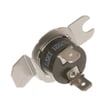
| Runs but cycles oddly or overheats | Dryer high-limit thermostat WE4M137 | Helps prevent overheating by limiting temperature |
| Won’t start when you press Start | Dryer push-to-start switch WE4M416 | Sends the start signal to the motor circuit |
| Door must be slammed to run | Dryer door switch WE4M415 | Confirms the door is closed for safe operation |
Why it matters
Airflow restrictions are the root cause behind many “no heat” and “takes too long” complaints because poor venting makes the dryer run hotter, longer, and less efficiently. Keeping the lint screen and exhaust duct clean helps protect heating components and improves drying performance.
Last updated: January 2026





