Owner’s manual


How do you reset a Samsung washing machine?
For the Samsung WA50F9A8DSW washer, the most reliable reset is a power reset: turn the washer off, unplug it (or switch the breaker off) for 5 minutes, then restore power and start a cycle. This clears many temporary control glitches and stuck error states.
Quick reset steps (power reset)
- Press Power to turn the washer off.
- Unplug the washer (or turn the circuit breaker off).
- Wait 5 minutes.
- Restore power.
- Press Power, then run a Rinse/Spin or a short cycle to confirm normal operation.
If the washer still will not run
These checks fix the most common “looks dead” or “won’t start” situations after a reset:
- Make sure the lid is fully closed and the latch engages.
- Confirm the outlet has power (test with a lamp) and the breaker is not tripped.
- Cancel the cycle, then reselect the cycle and press Start/Pause.
- Reduce the load size and redistribute items evenly (heavy, off-balance loads can stop a cycle).
- If an error code returns, use the troubleshooting steps in the WA50F9A8DSW owner's manual.
What “reset” can and cannot do
| Reset type | What it does | What it does not do |
|---|---|---|
| Power reset (unplug 5 minutes) | Clears temporary control logic issues | Fix a failed part or wiring problem |
| Cancel and restart cycle | Clears a stuck selection | Remove the cause of an error code |
Why it matters
A reset is a safe first step because many washer problems are caused by a momentary control-board lockup, a paused cycle state, or a power interruption. If the same symptom returns right away, focus on the underlying cause (lid closure, drain, fill, or an error code).
Last updated: February 2026
What does SC on my Samsung washer mean?
On the Samsung WA50F9A8DSW washer, the SC code commonly points to a drain problem (the washer is not pumping water out fast enough). We focus first on simple drain-hose and load checks, then move to the drain pump if the code returns. See the WA50F9A8DSW manual for the model-specific reset and drain steps.
What to check first (fast fixes)
- Cancel and drain: Press Power to stop the cycle, then start a Drain/Spin (or Spin) cycle.
- Drain hose position: Make sure the hose is not kinked, crushed, or shoved too far down the standpipe.
- Standpipe or sink drain: Confirm the household drain is not backing up.
- Load size and balance: Reduce oversized loads; redistribute heavy items (blankets, towels).
- Suds issue: Too much HE detergent can create excess suds that slow draining; run a rinse and spin with no detergent.
When it points to a part
If the washer hums but does not drain, drains very slowly, or the SC code returns after the checks above, the most common suspect is the drain pump or a restriction in the tub-to-pump path.
Common part-related causes
- Debris in the pump (coins, hair pins, lint)
- Pump impeller damage
- Pinched or restricted drain hose
- Loose wiring connection at the pump
| Symptom | Most likely cause | What we do next |
|---|---|---|
| Water stays in tub, pump is silent | Power/control or wiring issue | Check connections; then test components |
| Pump hums, little or no water flow | Blockage or failed pump | Inspect hoses; replace pump if needed |
| Drains sometimes, SC comes back | Intermittent restriction or weak pump | Check hose routing; consider pump replacement |
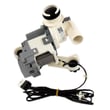
If replacement is needed, match the pump to your exact model configuration; a common option for this model is the washer drain pump DC31-00054D.
Why it matters
A drain fault can leave water in the tub, prevent high-speed spin, and cause repeated cycle interruptions. Fixing the drain path quickly helps protect the motor, reduces odor risk, and gets the washer back to normal cycle times.
Last updated: February 2026
What is the capacity of the Samsung WA50F9A8DSW?
The Samsung WA50F9A8DSW is a top-load washer model, and its capacity is 5.0 cu. ft. Use the WA50F9A8DSW manual to confirm the rated tub capacity for your exact version and to follow Samsung’s load and cycle guidance.
What 5.0 cu. ft. capacity means in real use
A 5.0 cu. ft. top-load washer is built for larger mixed loads and many bulky items, as long as you load loosely so water and detergent can circulate.
- Wash larger family loads with fewer cycles
- Fit bulky items like comforters and blankets more easily
- Reduce out-of-balance issues by mixing item sizes
- Improve cleaning by avoiding packed-down loads
- Help protect components by using the right cycle and spin speed
Load sizing tips that prevent vibration and poor cleaning
How you load matters as much as the tub size.
- Place items in loose layers; do not compress the load
- Keep the load below the top rim of the basket
- Mix towels, shirts, and smaller items to balance the spin
- Use Bedding/Bulky (or similar) for comforters and thick blankets
- If the washer bangs or stops to rebalance, reduce the load size
Quick reference: washer capacity classes
| Capacity class | Typical range (cu. ft.) | Best for |
|---|---|---|
| Standard | 3.5 to 4.4 | Smaller households, lighter weekly laundry |
| Large | 4.5 to 5.3 | Families, bulky items, fewer loads |
| Extra-large | 5.4+ | Very large loads, frequent bulky bedding |
Why it matters
Using the correct load size helps the WA50F9A8DSW clean better and spin smoothly; it also reduces strain on key systems like the drain path and suspension. If you’re chasing a draining issue, the washer drain pump DC31-00054D is one common part involved.
Last updated: February 2026