Owner’s manual
 Error Codes



How to find model number on Kenmore?
On Kenmore refrigerator model 79578309804, the model and serial number are printed on an identification label inside the fresh food (refrigerator) compartment, typically on the right-hand side wall. Use that exact model number when ordering parts or checking troubleshooting steps in the 79578309804 owner's manual.
- Open the refrigerator door and look along the right interior wall of the refrigerator compartment.
- Check near the crisper drawer area and side walls where labels are commonly placed.
- Look for a label that lists both Model No. and Serial No.
- Write the numbers down exactly as shown (including any dashes or extra digits).
If you do not see the label right away, these are other typical spots on bottom-mount refrigerators:
- Inside the refrigerator compartment near the top side wall
- On the door liner (side edge of the door when it is open)
- Behind the toe grille (kick plate) at the bottom front
- On the rear exterior panel (less convenient, but sometimes used)
| Label item | What it’s used for | Example |
|---|---|---|
| Model number | Matching parts and diagrams | 79578309804 |
| Serial number | Identifying production run | Varies |
| Electrical ratings | Service reference | Varies |
Using the exact model number helps us match the correct Kenmore parts for your refrigerator, such as a door switch, water inlet valve, or door gasket. Even small model-number differences can change which parts fit.
Last updated: January 2026
What does DH mean on Kenmore Elite refrigerator?
On Kenmore model 79578309804, dH (often shown as Er dH) points to a defrost heating problem: the refrigerator is not warming the evaporator enough during the defrost cycle, so frost can build up and airflow can drop. Use the troubleshooting steps in the 79578309804 owner's manual to confirm the symptom and checks.
- Freezer temperature slowly rises, then food starts to soften
- Frost or ice buildup on the freezer back wall
- Reduced airflow from vents (fresh food section warms)
- Fan noise changes as ice interferes with airflow
- Door alarm may sound more often if doors are not closing fully
- Power reset: unplug for 5 minutes, then restore power.
- Confirm doors seal and close: the manual notes doors may need slight pressure to close completely; make sure nothing blocks the doors.
- Check airflow: keep vents clear; the manual stresses proper air circulation between freezer and refrigerator.
- Clean condenser coils: dirty coils make the system work harder and can worsen cooling issues.
| What can cause dH | What to look for | Typical fix |
|---|---|---|
| Defrost heater circuit issue | Heavy frost on evaporator cover | Diagnose heater circuit, replace failed component |
| Defrost sensor/thermistor issue | Defrost never completes or reads wrong temp | Replace sensor assembly |
| Control board issue | No power sent to defrost circuit | Diagnose board outputs |
If you find heavy frost buildup, the defrost sensor is a common starting point on this platform; for this model, see the refrigerator defrost sensor assembly 6615JB2005C.
When defrost heat is not working, frost blocks airflow. That makes the refrigerator section warm even if the compressor is running, and it can lead to repeated temperature swings.
Last updated: January 2026
Why is my Kenmore refrigerator leaking underneath?
On Kenmore refrigerator model 79578309804, leaking underneath is usually caused by water missing the drain path during defrost (clogged or frozen defrost drain) or by a water-supply leak to the ice maker/dispenser. Start by checking for ice or debris at the defrost drain and inspecting the water line and valve area.
- Unplug the refrigerator before accessing internal panels or wiring.
- Look for a sheet of ice on the freezer floor or water under the crisper drawers (common with a blocked defrost drain).
- Pull the unit out and check for water trails near the household water connection and the inlet valve.
- Inspect the drain pan for cracks or overflow.
- Confirm doors close fully; warm air intrusion increases defrost water and can overwhelm a partially blocked drain.
| What you see | Most likely cause | What to do next |
|---|---|---|
| Water under freezer drawer, ice on freezer floor | Defrost drain clogged or frozen | Thaw the drain area with warm water; clear the drain hole and tube with a soft brush or pipe cleaner; verify water flows to the drain pan |
| Puddle near back of fridge, especially after ice maker runs | Water line or inlet valve leak | Inspect fittings and tubing; check the inlet valve body for seepage; replace the valve if it drips or won’t seal |
| Water only occasionally, pan is full | Drain pan shifted or evaporating slowly | Re-seat the pan and clean dust from condenser area so heat can evaporate water normally |
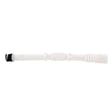
If you find the drain tube is split, loose, or blocked beyond cleaning, replacement is often the fix. For this model, we commonly see:
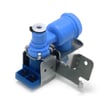
If the leak traces back to the water supply system (ice maker/dispenser), the inlet valve is a frequent source:
A small leak can turn into floor damage and can also create ice buildup that restricts airflow, leading to warm temperatures in the refrigerator or freezer. Fixing the drain path or water supply leak restores normal defrost drainage and cooling performance.
For safety steps and guidance on water line connections (including preventing water damage), follow the 79578309804 owner's manual.
Last updated: January 2026