 Error Codes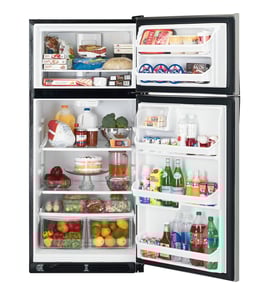



What are the dimensions of the Kenmore Coldspot model 3639656616?
The Kenmore Coldspot refrigerator model 3639656616 measures 66 3/4 in. high (with hinge), 32 1/8 in. deep (without handle), and 33 7/9 in. deep (with handle). With the doors open, the maximum depth is 49 7/8 in.
- Height with hinge: 66 3/4 in.
- Depth without handle: 32 1/8 in.
- Depth with handle: 33 7/9 in.
- Maximum depth with doors open: 49 7/8 in.
Even with published dimensions, we recommend measuring your exact unit (especially if you are planning a tight fit).
- Measure height from the floor to the top of the hinge cover area
- Measure depth from the wall to the front edge of the handle (if installed)
- Allow extra clearance behind the cabinet for the power cord and airflow
- Confirm door swing clearance using the “doors open” depth
| What you’re planning | What to allow | Why |
|---|---|---|
| Slide-in space height | Add about 1 in. | Prevents hinge and cabinet rubbing |
| Back clearance | 1 to 2 in. | Helps airflow and cord routing |
| Door opening space | Use 49 7/8 in. depth | Ensures drawers and shelves can clear |
Correct refrigerator dimensions help prevent installation problems like doors hitting walls, poor ventilation that can reduce cooling performance, and difficulty removing crispers or shelves for cleaning.
If the refrigerator seems “too deep” or the door does not close cleanly, a worn door seal can be a common cause. For this model, we list door gasket options such as the refrigerator gasket WR24X10228.
Last updated: January 2026
What is the average lifespan of a Kenmore refrigerator?
Most Kenmore refrigerators, including model 3639656616, typically last 12 to 15 years. Keeping the condenser area clean, maintaining good airflow, and fixing small issues early (like a weak door seal or noisy fan) helps the refrigerator run longer and more efficiently.
- Condenser cleanliness and airflow: Dust buildup and tight clearances make the compressor work harder.
- Door seal condition: Warm air leaks increase run time and frost.
- Defrost performance: Poor defrosting can lead to ice buildup and restricted airflow.
- Fan operation: A failing fan can cause warm temperatures and overheating.
- Power quality: Frequent outages or surges can stress electrical components.
- Vacuum dust from the lower rear area and around the condenser cover.
- Confirm doors close easily and do not pop open.
- Keep food from blocking interior air vents.
- Set typical temperatures: 37 to 40°F fresh food, 0 to 5°F freezer.
- Listen for new noises (rattling, grinding, or a fan that stops and starts).
| Symptom | What it often means | Example part for this model |
|---|---|---|
| Door won’t seal, moisture on gasket | Worn or warped door gasket | Refrigerator gasket WR24X10228 |
| Clicking then no cooling | Compressor start device issue | Refrigerator overload WR8X122 |
| Warm temps, fan noise, poor airflow | Fan motor wearing out | Fan motor WR60X187 |
| Heavy frost, warm fridge section | Defrost system problem | Defrost control WR9X502 |
A refrigerator near the end of its typical lifespan often uses more electricity and has more temperature swings. Addressing airflow, sealing, and defrost issues early can prevent food spoilage and reduce strain on major components like the compressor.
Last updated: January 2026
How to tell if a Kenmore refrigerator compressor is bad?
On a Kenmore refrigerator model 3639656616, a “bad compressor” usually shows up as poor cooling even though the unit has power, runs often, and the compressor area gets unusually hot or noisy. Before replacing the compressor, we rule out airflow, defrost, and start-device problems because they can mimic compressor failure.
- Refrigerator and freezer temperatures stay warm (food soft, ice melts) even after 24 hours of running
- Compressor runs almost constantly with little or no cooling improvement
- Loud clicking, buzzing, or hard-start sounds from the compressor area
- Compressor shell is very hot to the touch (use caution)
- Breaker trips or the overload repeatedly shuts the compressor off
These steps help confirm whether the compressor is actually the problem.
- Condenser airflow: Clean dust from the condenser area and confirm the condenser fan runs (if equipped). A failed fan can cause overheating and weak cooling.
- Door seal leaks: Inspect for gaps, tears, or a loose seal. Warm air leaks can cause nonstop running and poor temps; see how to fix a fridge door seal.
- Defrost system issues: Heavy frost on the back freezer wall points to a defrost failure that blocks airflow. On this model, a failed defrost control WR9X502 is a common suspect.
- Evaporator airflow: If the freezer is cold but the fresh food section is warm, airflow problems are more likely than a compressor.
| Symptom | Most likely cause | What we check next |
|---|---|---|
| Warm fridge and freezer, compressor hot, clicking | Start/overload or compressor | Start components, wiring, amp draw |
| Freezer frosted over, weak airflow | Defrost problem | Defrost timer/control, heater, thermostat |
| Runs constantly, doors hard to close | Door gasket leak | Gasket condition, door alignment |
| Warm temps, no fan movement | Fan motor issue | Fan operation, obstructions |
A compressor replacement is one of the highest-cost refrigerator repairs. Confirming airflow, defrost, and sealing first prevents replacing a good compressor and gets cooling restored faster.
Last updated: January 2026
What is a top mount refrigerator?
A top-mount refrigerator is a classic fridge layout where the freezer compartment is on top and the fresh-food (refrigerator) compartment is below. Your Kenmore model 3639656616 uses this style, which is popular for straightforward storage, easy freezer access, and simple temperature control.
- Freezer on top: shelves and bins for frozen foods
- Refrigerator below: main shelves, crispers, and door storage
- Single cooling system: cold air is produced and distributed to both sections
- Airflow controls: a damper or vent typically regulates how much cold air moves into the refrigerator section
| Style | Freezer location | Best for | Common tradeoff |
|---|---|---|---|
| Top-mount (top freezer) | Top | Value, reliability, easy freezer access | Fresh-food shelves sit lower |
| Bottom freezer | Bottom | Eye-level fresh-food access | Freezer access requires bending |
| Side-by-side | Left/right | Narrow door swing, balanced access | Narrower shelf width |
Knowing you have a top-mount design helps narrow down likely causes when cooling is uneven. For example, if the freezer is cold but the refrigerator is warm, we typically focus on airflow and fan operation, not just temperature settings.
- Freezer cold, fridge warm: airflow restriction, iced-over evaporator area, fan issue
- Frost buildup in freezer: defrost system problem (timer, heater, thermostat)
- Warm temps everywhere: condenser airflow problem, sealed system issue, power problem
- Door not sealing: gasket wear or door alignment
These are examples of parts often involved in top-mount refrigerator performance on model 3639656616:
- Defrost control WR9X502 (helps manage defrost cycles)
- Fan motor WR60X187 (moves air across coils and through compartments)
- Refrigerator gasket WR24X10228 (helps keep cold air in and moisture out)
Last updated: January 2026





